
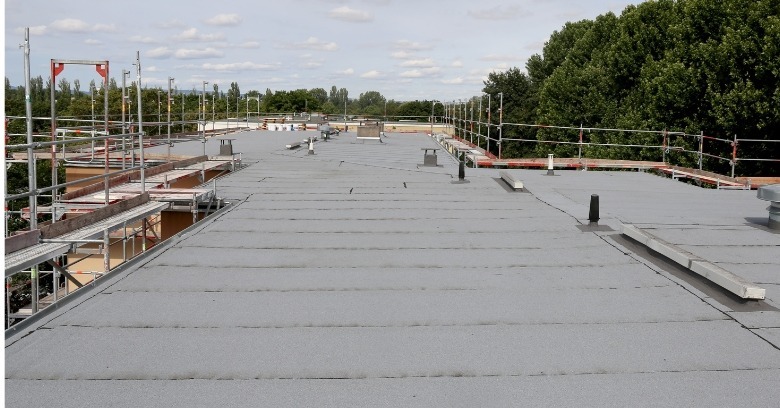
Hoping to find Commercial Roofing in Aurora Colorado?
APC Roofing builds and mends the wide, low coverings above places of work, down to the drains, edge trim and equipment curbs.
Dial 720-902-6940 and a roofer will come out and look everything over.
Business Property – Some Background
Customers, goods and running machines fill the space beneath the covering, and a leak can halt sales rather than just mark a ceiling. The area on top of a big building stretches wide at a very shallow pitch, so drainage and wind resistance are worked out by calculation.
Condensing units, exhaust stacks and antennas are spread across the top, and every duct or conduit crossing the covering demands a watertight seal. The work done below decides which assembly suits, so a refrigerated plant is specified unlike a clinic.
Membrane Families: Options on the Market
Single-ply means one factory-made layer of TPO, PVC or EPDM, modified bitumen is asphalt blended with polymer and rolled out, and built-up roofing stacks felt and hot tar in plies. The laps on a thermoplastic sheet are fused by a welding machine, but rubber sheets are joined with primer and splice tape.
Cooking vents on a restaurant leave fat beside the fans, and EPDM and asphalt swell and weaken beneath oily residue, so PVC usually covers the affected stretch. Built-up work finished with gravel carries real weight and holds up for decades, because the loose aggregate keeps ultraviolet light off the bitumen.
Commercial Steel – Wear Over Time
Screws through the flats hold an exposed-fastener sheet in place, and the threads grip purlins or joists underneath. The neoprene washer at each head dries out under years of sunlight, and the fasteners wiggle loose as the sheets expand and contract.
A standing-seam roof is held by clips folded into the ribs, and the pans slide freely along the length. Rust is often found at overlaps and cut edges, and an elastomeric coating over sound metal can keep the damage in check.
The Deck – Why the Base Counts
Attachment methods are limited by what the original builders put in, and a new covering goes over the same framing. Corrugated steel gives screws a firm bite, concrete calls for adhesive or drilled anchors, and wood or gypsum plank uses fasteners rated for the material.
Rust from old leaks can leave soft spots in metal decking, and a weak area gets a new panel before anything goes on top. From inside, the underside is inspected wherever the ceiling allows, and small cores from above show the rest.
Keeping a Membrane in Place – Pros and Cons
A fastened install uses plates and screws in the overlaps, fully adhered systems are glued across the whole underside, and ballasted sheets are held down by rock or pavers. Building height, site exposure and deck material shape the choice, and the framing's spare load capacity limits how much weight can go on top.
Between the plates, a fastened sheet balloons in stiff gusts, but adhered work stays motionless and needs a dry surface to grip. A ballasted layout turns inspection into a slow job, as every seam remains hidden until the stone or pavers are shifted.
Wind Forces Overhead: What Codes Expect
Corners take the strongest suction, since air accelerates on rolling over the perimeter. A band along each side takes somewhat less, and the middle of the field takes a small fraction.
Attachment rows tighten on the approach to corners and edges, and design tables for the height and exposure set the spacing. An under-fastened outer angle lets the sheet curl up, and the opening grows as each gust gets beneath.
Insulating Foam – an Overlooked Component
Polyiso sheets are laid across the deck with joints staggered, and a gypsum or fiber cover board commonly caps the stack. Good insulation trims the demand on the HVAC system, and a tapered layout pitches the finished face toward the drains.
Moisture in polyiso drives the R-value down sharply, and trapped water weighs on the structure and corrodes steel. An infrared scan at dusk, backed by cores, outlines the affected zone, and each sodden piece is removed instead of buried.
Drainage Hardware – Parts of the System
Each interior sump wears a cast strainer dome, and the slots hold back gravel and plastic bags. When the grate mats over, rain has nowhere to go, and a pond spreads across the field.
A raised overflow waits above each primary drain, so a gush at the upper spout means the normal path is shut. Standing water loads the frame with weight beyond the design, and a puddle that survives two days hints at settling or a choked strainer.
Finding the Source of a Drip: Why Care Pays
The mark on a suspended ceiling shows where moisture landed, yet the defect up top may be dozens of feet distant. Runoff travels along the flutes of a steel deck, and joints between boards lead a trickle further still.
A roofer probes the laps, curbs and outlets upslope of the stained area, and an electronic scan can pinpoint a hidden leak. A patch placed right over the wet ceiling often misses, so a fresh ring appears in the next shower.
Package Units Overhead – Practical Notes
Each machine is bolted to a curb that rises from the deck, and a flashing sleeve climbs the walls to a formed metal hood. Corner work calls for patient hands, and a poorly sealed crease admits rain.
Swapping a machine for a newer model tends to add an adapter curb without flashing, and the ceiling underneath begins to spot. A trickle from a condensate pipe wears a streak of slime into the membrane, and the fix is carrying the flow to a drain.
Penetrations Through the Field – the Small Stuff
Each round stack wears a prefabricated boot with a clamp, while odd shapes go into a pitch pocket filled with sealant. Aging compound contracts and opens hairline gaps, so a fresh layer goes on every maintenance list.
Runs of conduit and gas line rest on unattached blocks, as a stand screwed into the deck punctures the waterproofing. Pads cut from spare roofing stock go under each base, and the buffer takes the wear as everything expands and shifts.
Openings With Lids – How Leaks Begin
Acrylic panes yellow and turn fragile after years of sun, and the screwed-down rim is where cracks start. Rain slips past a dried gasket or an open frame corner, and the covering gets accused of a fault in the glazing.
Technicians lift the access hatch many times a year, so the latch, springs and weatherstrip eventually give out. Smoke vents release automatically when a fusible link melts, and no roofing work may block the mechanism.
Parapet Walls and Coping – Getting the Details Right
The covering bends upward and becomes base flashing, a termination bar grips the upper end, and a strip of counterflashing overlaps from higher up. Coping over the crest steers rain to either side, but an open joint between sections lets storms into the wall below.
Unsealed brick draws water in and carries moisture indoors, and the ceiling stain that follows mimics a membrane problem. The coping, the wall and every flashing are reviewed together with the field, and failing mortar is raked out and repointed.
Edge Metal Without a Parapet – Parts and Purpose
A continuous cleat is fixed along the eave and locks the hem of the flange, and a stripping ply seals the sheet to the horizontal face. Codes want perimeter pieces that pass uplift testing for the site, since loose metal becomes a lever that gusts use against the field.
An eave gutter on a big building collects runoff from a vast surface, which calls for sturdy hangers and oversized downspouts. Dented or lifting trim counts as a repair item, since securing the metal now keeps the sheet from tearing.
Visitors Who Are Not Roofers: Protecting the Sheet
Refrigeration mechanics may call on a large store every few weeks, and a path gets a little more scuffed each season. A forgotten screw is stepped straight into the covering, and a toolbox dragged across the top tears the surface.
Thick rubberized pads trace a safe path to each unit, and grinding hits dense material instead of the field. Contracts with service firms can spell out where crews may walk, and screws and scraps can be bagged and taken down.
Maintenance Visits: Small Jobs Kept Small
Twice annually is a sensible rhythm for a walk-through of a commercial system, and heavy wind is reason for an extra check. Routine care lifts and empties each strainer, any open lap is found with a probe, and brittle sealant gets marked for replacement.
A walk before the stormy months concentrates on outlets and the perimeter, and a second pass seeks out what heat or heavy rain disturbed. Small problems are noted against a drawing of the building, and repairs can be grouped and timed sensibly.
A Building's Roof History – a Long Memory
A sketch of the whole area places each unit, drain and hatch, and a written cross-section lists every layer from the deck up. A dated photo log follows each repair, and moisture readings are added as taken.
Older properties frequently hold no notes on the covering, so the same facts get rediscovered with each visit. Roof records stay with the site office, and a copy passes to the next manager or buyer.
Repair, Restore or Replace – Matching Work to Condition
A sound membrane with a handful of local faults simply gets patched, and a weathered surface that is still dry can take a fresh liquid layer. Extensive saturated boards make the job a replacement, and so do seams that have turned brittle everywhere, though years alone never decide the matter.
A liquid coating needs a scrubbed surface and sound mending beneath, since damp layers below stay hidden and soggy. Swapping only the ruined sections is sometimes a sensible middle course, provided the rest of the field has good years left.
Reroofing Options – Picking a Direction
A recover puts a fresh membrane over the current roof, and a cover board sits in between. An overlay is allowed by code over no more than a single existing covering, as long as the insulation below is dry.
A complete strip-off clears away every layer, and any soft or rusted area can be rebuilt. Fresh tapered boards can give a dead-flat surface some fall, and a saddle between drains turns the flow toward each outlet.
Warning Signs – Reasons to Call
- A steady stream from the backup scupper in a storm, which announces a stalled main outlet.
- Discolored ceiling panels that darken after wet weather, which means leakage has crossed every layer.
- Blotches or efflorescence on brick under the coping, which can suggest flashing trouble near the top.
- Loose screws or gaps along the perimeter trim, which can give wind a place to pry.
- A ceiling that sags or bows between the joists, which hints at a low area in the structure or a slow drain.
- A hazy plastic dome over the warehouse floor, which may give way under a misstep.
- Drips from light fixtures or sprinkler heads after a storm, which suggests an opening some distance uphill.
- A gutter that overflows along the front edge in rain, which can reflect loose brackets or a jam.
How APC Roofing Works on Commercial Roofing in Aurora Colorado: the Order of Work
Our first stop is every drain, scupper and overflow, and the laps, curbs and perimeter come next. When a leak is present, the boards beneath are scanned, because saturation below changes the answer.
Everything we find is written up with photographs and a sketch, and every defect is keyed to a location. The conclusion is repair, restore or replace, and the why is explained in terms you can verify.
Commercial Roofing in Aurora Colorado: What Needs Doing Up Top
Call 720-902-6940 and we will fix a time to see the building.
Working Above Occupants: Practical Arrangements
Screwing into a steel deck rings through the rooms beneath, and adhesive fumes can drift into rooftop air intakes. Noisy tasks are scheduled with the manager's input, and outside-air vents next to the work can be sealed for the day.
Old membrane and foam are lowered by hoist or dropped through a covered chute, and desks and machines under an open section can be shielded. Water-based adhesives give off far less odor than solvent-based glue, so the softer-smelling kind is common above occupied rooms.
Phasing a Large Replacement – Protecting the Interior
Old layers come off only in amounts that can be closed up by evening, and each bare part gets fresh boards before more is taken up. A holding seal ties the completed edge to the untouched field each night, and the extra piece is sliced off the next morning.
How much is stripped depends on the weather outlook, so an approaching storm means a smaller opening. Unprotected boards caught in a cloudburst soak through, and drips can fall on whatever sits underneath.
Our Service Area's Range: Planning Locally
The colder end of our territory adds hail and snow load to the list, and denser cover boards with verified beam capacity follow. Strong sun across every town we serve slowly bakes a membrane, so a bright, reflective finish reduces solar gain.
The coastal end of our territory demands fastening designed around hurricane gusts, and torrential rain makes backup outlets essential. Low temperatures slow or stop many adhesives from curing, whereas welded seams can go down in cool weather but never onto a wet deck.
Safety for Everyone Who Goes Up: Rules on the Job
A knee-high parapet or a bare perimeter leaves a sheer drop, and anyone near the edge works inside warning lines or clipped to anchors. Skylight lenses cannot take a body falling onto the plastic, and fixed screens rule out a plunge into the space below.
Anchor points installed for good serve every trade that follows, and a self-closing gate at the hatch adds a barrier. Where a screen or warning line is missing, our findings say so, since even a low building is high enough for a serious fall.
When you need Commercial Roofing in Aurora Colorado, call APC Roofing at 720-902-6940. A roofer will walk the membrane, the drains and the perimeter, and written findings follow, with the choice left to you.
Verified

Verified
Verified
Verified


















