
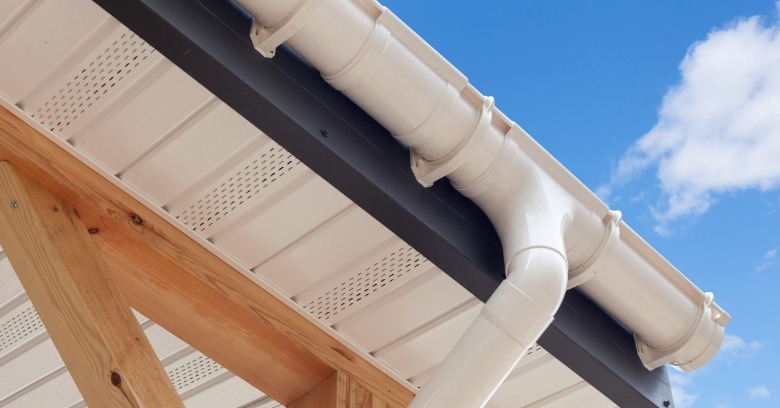
In need of Gutters in Aurora Colorado?
APC Roofing plans, installs, and maintains rainwater systems on Aurora Colorado buildings.
Dial 720-902-6940 to walk your roofline with someone who does this daily.
A Good Gutters Bid Starts With a Number – Not a Sales Pitch
Practically every undersized roof-drainage setup that has to be replaced throughout Aurora Colorado stopped coping at the same point: nobody sized it against the roof feeding it. A gutter run is a pipe with a job to do, and the volume it carries is fixed by a pair of numbers: the area of roof it serves, and the heaviest burst that roof will ever take.
That second figure catches most homeowners off guard. Gutters are not sized against the annual rainfall total. The standards contractors work from – the ones every sheet-metal shop keeps on the wall – are built on peak short-duration intensity. A trough does not overflow during a wet year. It spills in the ten minutes a thunderstorm sits directly overhead.
The distinction carries real weight across the areas we cover. One of the markets we work in gets better than fifty inches a year; somewhere else on the list measures less than twenty inches. Common sense says the drier markets need half the drainage. The tables say otherwise. The peak rate moves much less than a rainfall map implies.
The Two Figures That Decide What You Pay for Gutters in Aurora Colorado
First comes the size of the gutter. The two sizes you will actually be quoted on a house are five-inch and six-inch. Going from one to the other is not a trim decision: a six-inch profile carries close to fifty percent more water than a five-inch gutter. On a small, low-slope roof the extra is a cushion. On a big roof with a steep pitch draining into a single run, it decides between working and overflowing.
Number two is how the water gets out. Here is the figure that most quotes leave out, and it is the one that fails. A small rectangular outlet – the common small section – will take about 600 square feet of roof. Change up to the larger rectangular downspout and you get close to double, to around twelve hundred. The four-inch round profile is in the same territory. That is real capacity, and it costs very little more.
Take the two numbers together and the calculation is plain. Calculate the area of roof that ends up in each run, then check how many downspouts there are. If the numbers say three outlets are needed and only one is there, no amount of clearing will stop the overflow. That is an engineering shortfall, not poor upkeep.
Where the Fall Goes and Why It Matters
The trough is not hung flat, though it should read as level from the ground. The usual rule of thumb is close to a quarter of an inch for each ten feet of gutter. Practice varies anywhere from an eighth to a half inch in ten feet, but the reasoning does not shift: enough to move the water, little enough that the eye reads it as straight.
Not enough fall and the run holds standing water. A trough that never fully empties is what kills a gutter: it collects grit, it works on the seams, and it loads the hangers exactly where you least want it. Excessive pitch and the roofline looks off while the flow overruns the outlet during a heavy burst.
The length of a run counts for as much as the slope. Once a length gets past forty feet or so, a second outlet is the answer, not a larger trough. Water traveling a long way arrives at the bottom at a rate one opening cannot absorb, and the spill starts at the low end of the run – typically over the front step, which is why homeowners notice.
Hangers, Brackets, and Thermal Movement
How far apart the hangers sit is one of the few details a homeowner can check from the ground. Hangers and brackets should sit no more than about two to three feet apart. Up north in the territory we cover, closer is correct – to eighteen inches or so – because snow and ice pile above the rim and stay for weeks, when rainwater is gone in minutes.
The other thing no estimate mentions is expansion. Aluminum expands and contracts with the temperature. On a long run between a winter morning and a summer afternoon, you are looking at over an inch of movement. It has to be allowed for. A length with nowhere to move buckles, opens its seams, or tears its own brackets out over a few seasons. It is not a flaw in the aluminum. This is an install detail that was missed.
The Detail That Decides Whether Water Gets Behind
There is a failure mode that everybody blames on a leaking gutter but has another cause entirely. Water appears on the board behind the run, or runs down the wall at the back of the gutter line, while the gutter is perfectly sound. The problem is the edge detail.
The common edge flashing is an L-shaped strip that sends water off the deck. When that strip is the only flashing, runoff can still curl back onto the fascia on surface tension alone. An apron is a deeper piece that bridges the deck edge and lands inside the run. It closes the gap that was letting water behind. On a steep roof sending water off hard, the difference is plain.
The roof covering itself alters how the joint is made. A standard shingle roof is the least trouble. Concrete or clay tile is heavier and stands taller, and the flashing at the edge has to be worked in before the tile is set. A metal roof drops its whole snow load at once instead of letting it melt away, which is the reason putting snow guards above the eave is a gutter question and not only a roofing one. Flat and low-slope sections change the answer again. APC Roofing works with all of those roof types, which is why we raise it.
Freezing Weather and the Cold End of the Roof
In the parts of our territory that freeze, this is the conversation. And it is the one most regularly turned on its head.
A ridge of ice at the eave does not come from the gutter. It is caused by heat finding its way into the roof from the rooms below. That heat softens and melts the snow on the upper roof; the runoff works its way down to the cold edge, where nothing underneath is heated, and turns back to ice. Run that cycle over a few days and a ridge of ice builds, holding water back further up the slope.
The gutter is not to blame, but a frozen run is not innocent either. A run packed solid with ice takes away the last route out, and deepens the backup. The honest answer, when someone asks whether new gutters solve the problem, is that they cannot. The actual fix lives in the attic. What a properly built system does is give the meltwater somewhere to go before it does a further round of damage when the thaw comes. A company pitching a gutter job as an ice dam solution has the diagnosis wrong.
What Happens at Ground Level
A perfectly sized system emptying right at the foundation has just moved the damage instead of solving it. It has gathered water from a wide roof area, focused it into one discharge, and placed it at the one place it can do most harm.
This is one of the few points where the building code sets an actual figure. In areas with expansive or collapsible soils, water off the roof has to be carried not less than five feet away from the foundation walls, or to a drainage system the code accepts. Notice what sets that rule off: the ground, not the rain.
That single point is the reason the driest market we serve is exactly the market where what happens at ground level carries the most weight. Clay that swells once it is wet and contracts as it dries out will lift and drop a foundation through the wet and dry cycles. The water that drives it need not amount to much. It just has to be repeatedly concentrated beside one wall. A downspout with no extension does it every single storm.
A second code figure applies everywhere, whatever the soil: the finished grade has to fall six inches across the first ten feet away from the foundation. That is the slope the discharge lands on. The best drainage in the world delivering water to a reverse slope is fighting a losing battle. We take a look at the grade while the roof is being measured – the two belong together.
What Actually Fills a Gutter
What lands up there does not all behave alike, which is why the standard twice-a-year advice is a starting point rather than an answer. Roughly speaking, three sorts of material fill a gutter.
- Coarse debris – full leaves, small twigs, pods and cases. It lands over a few weeks, tends to float, and lifts away cleanly. It is also what most people picture when cleaning comes up.
- The soft load – pine needles, oak catkins, maple seeds, and blossoms. This is the awkward one. It drops through most screens and guards, settles in the low spots, and turns to a dense mat that water will not shift.
- Granules off the roof – the mineral granules coming off a shingle roof throughout the roof's life. A small amount is expected. A noticeable jump in what gathers at the downspout is worth a phone call, because it is a signal from the roof rather than a drainage one.
Guards and screens give with one hand and take with the other. They reduce how often you are up a ladder, which matters. Against that they cut down the gap that water must get through, and in a hard downpour some water will run straight over the top. Fine material still works its way in. Whether guards are right for your roof depends on what overhangs the roof, which is something to look at together instead of assuming.
What Goes Under the Downspout
There are three workable ways to carry water out beyond the wall, and each has a catch. The concrete or plastic splash block is the low-cost option and does the least. It blunts the impact of the water hitting it and scatters it, but it carries it barely a foot or two. Where the grade is poor the runoff ends up right where it started to the wall.
A hinged or roll-out extension sits in the middle. The outlay is small, it moves aside when the lawn is cut, and it does move water some distance clear of the wall. The drawback is that it lies across the ground, and anything underfoot gets knocked off and is never reconnected. We see more of these lying detached than we ever do failed troughs.
An underground drain is the answer that holds up when the ground demands it: a rigid pipe carried out to a discharge point well clear of the structure. You never see it, nothing can knock it loose, and it will still be there when the gutters are not. What you take on is that it can fill with silt without anyone noticing, and that is the reason an access point belongs in the design instead of being regretted later.
The Board Behind the Gutter
A gutter hangs from something, and what it hangs from is normally the fascia or the ends of the rafters. If a run has been overflowing or tracking down the back over time, the board has usually gone soft when we pull the old system away.
We would rather tell you that before the work starts than turn it up after the tear-off has started. A hanger screw fixed into a rotten board holds for a while and then works free, typically under load – which is precisely when it has to hold. Where rot has taken hold, we tell you, walk you to it, and price the repair separately so you know what you are paying for.
Low-Slope Work and Larger Drainage
Not every roofline drains at a gutter. Low-slope and flat sections work another way: the water is taken off by parapet openings, internal drains, or a built-in fall rather than over the roof edge. The design questions are no different, but the failures are quieter and a good deal less forgiving.
On an ordinary sloped roof a blocked gutter spills over and it is obvious. Where the roof is flat a plugged outlet leaves the roof ponding, and that pond puts real weight on the structure while nobody is looking. APC Roofing takes on both kinds of work, meaning a mixed roof gets one drainage plan rather than two separate crews pointing at each other over the junction.
What Wind and Hail Do to a Gutter
Weather damage to the covering itself is plain to see. The gutters lower down get looked at last, if they are checked at all. That is backwards on two grounds.
A point worth making – the gutter is usually the plainest evidence of what came through. Dents in a metal trough record size and direction. They are a record that stands up in a claim when the covering above is harder to assess.
Also worth knowing – a run shifted out of line keeps quiet about it. Nothing appears out of place from below, and it works in normal rain. The problem shows up in the next heavy rain, which might be a few months later – sometimes past the deadline for a claim. An inspection soon after is a fraction of the bill that follows a late discovery.
Signs the Roofline Needs Attention
No climbing is required to notice the usual signs. Take a slow lap of the building during or just after heavy rain, because that is when a gutter shows what it can do.
- Runoff pouring over the front in a storm – undersized, blocked, or badly hung.
- A gap opening between the gutter and the fascia – spacing or fastener failure, usually after a heavy load.
- Staining on the fascia board though the gutter itself is not leaking – the flashing at the edge, nothing to do with capacity.
- A trench, a splash line, or bare soil beneath an outlet – the discharge stops short.
- Water lying at the foot of the foundation hours after the rain has gone – grade and discharge together.
- A dip in the middle of a length – water standing where it should not be, and it does not improve on its own.
The Places That Overload a Correctly Sized Gutter
Roof area alone is not the whole story, because roofs do not hand the water over evenly. A single valley collects two slopes and drops the whole flow onto a short length of gutter. That short stretch might be carrying several times the water of the lengths beside it, while looking no different.
And that is why a run can overflow in exactly one place every single storm while every other run stays perfectly dry. The answer is hardly ever a bigger gutter. It is an outlet set exactly at where the valley discharges, so it drops out as soon as it arrives instead of traveling down a length that was never sized to take it.
Second-story roofs produce the same effect in another shape. A drop from a higher roof discharging onto a lower roof is common practice, and it is more often than not a bad arrangement. It focuses the entire area above onto one point of the lower covering, which strips the surface and then swamps the gutter that lower roof drains into. Taking the upper downspout down past the lower roof removes both faults together.
What a Real Quote Should Tell You
When you have two competing estimates and one comes in lower, the price gap is hardly ever the contractor's margin. Time and again it is a different specification that neither estimate makes plain.
An estimate worth reading tells you the profile and the material used, the downspout count and size, the hanger type and spacing, whether an apron or drip edge is specified and whether it is priced in, and where the runoff is carried after it leaves the pipe. That is the short list. If an estimate says nothing about one of them, that is where the money went.
All five appear on the estimate because that is the work. A figure per foot and nothing spelled out is only a number, not a real estimate.
Timing, Access, and How Long the Work Takes
The average job wraps up inside a day, sometimes two. The run is formed on site out of coil stock, cut to the exact length, and that is the reason the length carries no joints between the corners. The corners, the drops, and the end caps are joints even so, and they are where the sealing work matters.
Weather drives the schedule more than we would like. The job calls for dry weather – sealant needs time to cure and nobody belongs on a wet roof edge. We would sooner move a booking than rush it in poor weather and have it leaking by spring.
Access around the house counts too. Tight clearance at the side, shrubs and beds under the eave line, single-story additions, and shared boundaries all shape how we stage it. We check that when we measure, rather than on the morning of the job.
What Happens When APC Roofing Takes On Gutters in Aurora Colorado
The first thing we do is measure the roof. Area per run, pitch, the length of each run, and where drops can sensibly discharge – those four things set what the house needs. What follows – the visible choices – is a choice you get to make with the figures in front of you.
Because roofs are part of what we do, the joint between roof and gutter is worked out rather than inherited. Asphalt, tile, standing seam, low-slope – each one changes the way the edge detail is made. That is not something added later. It happens to be where the work starts.
Fix or replace is a judgment, and we will say which one applies. A run that is sound with one failed length or a sag is a repair. A run that was never big enough for the area draining into it cannot be repaired into a working system. Cleaning it twice as often will not change the math.
Book Gutters in Aurora Colorado Without the Guesswork
Call APC Roofing today at 720-902-6940 for an honest look at your roofline.
Slab, Basement, or Crawl Space
The same shortfall in drainage has very different consequences on every house, and the deciding factor is what is under the slab or floor.
A home on a slab has nothing underneath to flood. What goes wrong is quieter: moisture working beneath the edge of the slab, soil being carried out from below, and wet spots on the floor through the floor a long way from where the water got in.
A crawl space offers the water a room, and it goes there. Seepage through the wall, a chalky bloom on the masonry, a sump pump that keeps running almost without stopping, and humid air pulled up through the whole house – every one of those begins at a single downspout discharging too close.
In either case the answer is outside, and it is cheaper than any work attempted from indoors.
What a Gutter Is Made Of
Aluminum goes on the large majority of houses, and for good reason: it cannot rust, it is light enough to be kind to the hangers, and it is rolled at the house as a single continuous run. Having fewer joints means fewer failure points. The trade-off is that it is soft and it expands and contracts a good deal, which the install has to allow for.
Galvanized or coated steel is stiffer and stands up to impact, which is worth something where hail is common, though its coating is the whole defense, so it repays attention. A copper run is the longest-lived choice and it shows. Vinyl gutter costs the least to install and hardens and cracks under UV and cold. We will go through what fits your roof and your weather with no sales pressure.
Cleaning: How Often, and What Else Gets Checked
Twice a year is the usual advice, and it is a fair place to start rather than a hard rule. The right interval comes down to what grows above the roof. A house with conifers over it takes a steady needle drop the year round and needs clearing more often. A roof with nothing above it can go a long time between visits.
The two-visit habit fits colder places best, and it fits some of our markets badly. The oaks that stay green in the southern part of our territory keep their old leaves all winter and drop them just as spring starts. Anyone with one of those over the house who stops at a fall visit is clearing the gutter at the wrong point in the year and leaving it full for the leaf fall that counts.
What we actually check is more than the leaves. Outlet flow, sealant at the joints and end caps, hanger tightness, the fall along the length, the condition of the edge flashing, and what happens at ground level. Ground level is the item most often skipped and the one most likely to be doing damage.
If you would rather it was handled, that is the service. A run that is inspected at reasonable intervals usually reaches the end of the material's life. A run that is only looked at when something has already gone wrong almost never does.
To get started on Gutters throughout Aurora Colorado, reach APC Roofing today at 720-902-6940. We measure the roof before anything else and the quote comes from the numbers.
Verified

Verified
Verified
Verified


















