
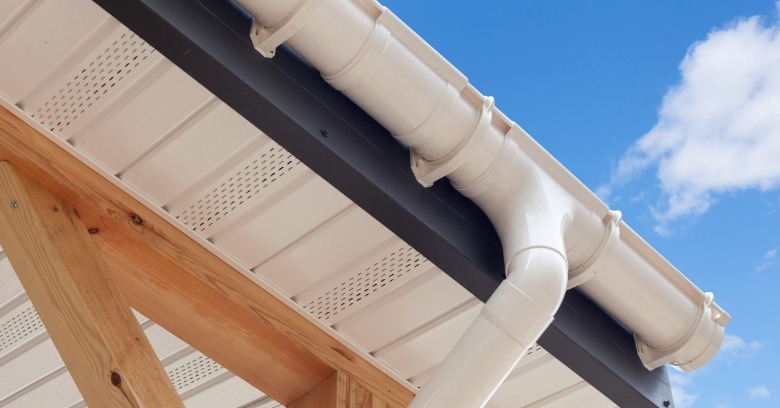
Comparing quotes on Seamless Gutters in Minneola Florida?
APC Roofing lays out, puts up, and looks after roof drainage around Minneola Florida buildings.
Phone 407-270-1129 to talk it through.
A Good Seamless Gutters Bid Starts With a Number – Not a Catalog
Nearly every overflowing length of gutter that has to come down in Minneola Florida ran out of capacity the same way: no one ever sized it against the roof feeding it. A gutter run is a pipe with a job to do, and that load is fixed by two figures: the roof area feeding it, and the heaviest burst that roof will ever take.
The rainfall number surprises people. Drainage is never worked out from the annual rainfall total. The engineering tables – the same figures commercial buildings are drained by – are based on how hard it rains in a five-minute burst. A gutter run does not overflow because the year was wet. It overflows during the ten minutes a thunderstorm sits over the block.
The difference shows up plainly across the map we cover. Part of the territory we cover takes north of fifty inches in a typical year; the drier end of our map records under twenty inches over the same year. You might assume the drier parts of the map can be drained with smaller sections. That is not how it works. The intensity of a single hard cell is a great deal closer than the annual figures imply.
The Two Figures That Decide What You Pay for Seamless Gutters in Minneola Florida
The first figure is the width of the gutter itself. The two profiles that actually get quoted on the average roofline are the five-inch and the six-inch K-style. The jump between them is not about looks: the six-inch section carries about fifty percent more water than a five-inch section. On a small simple roof that margin is comfort. On a big, fast-shedding roof dumping into one length, it decides between coping and failing.
The second is how the water gets out. This is the number almost nobody asks about, and it is where the failures start. The small rectangular downspout – the size on most houses built a while back – drains roughly 600 square feet of roof. Use a three-by-four instead and it takes about twice as much, to something near twelve hundred. The four-inch round profile carries a comparable load. That is a real doubling, and it costs very little more.
Put the two figures side by side and it is not hard to work out. Add up the roof area draining into each run, and next divide by what each downspout can take. If the arithmetic says three downspouts are called for and the wall carries a single one, no amount of maintenance will stop the overflow. That is an engineering shortfall, not poor upkeep.
Pitch, Outlets, and the Length of a Run
The trough is never hung level, though nobody should be able to see the fall. The number the trade works to sits near a quarter of an inch per ten feet of length. Crews differ between an eighth and a half inch over ten feet, but the principle holds: enough slope to keep the water moving, little enough that the eye reads it as straight.
Too little fall and water lies in the bottom. A trough that never fully empties is the start of the failure: it holds debris, it stays against the seals, and it puts pounds on the brackets at the weakest point. Too much slope and the eye picks it up from the street while water shoots past the drop when it really rains.
Run length matters as much as pitch. Somewhere beyond forty feet, a second outlet is the answer, not a deeper trough. Water in a long run with one drop arrives at the bottom quicker than a single opening can swallow it, and it tips over the side wherever the lip sits lowest – typically over the front step, which is how most people find out.
What Holds It Up, and Why It Moves
Hanger spacing is one of the few things a homeowner can check without climbing anything. Hangers and brackets need to land every two to three feet. In the markets that get real snow, we bring that in – eighteen inches – because drifts of ice and snow stack above the lip and sit there for weeks, where rainwater is gone in minutes.
The other detail that rarely comes up is expansion and contraction. A run of aluminum swells and shrinks as the temperature swings. Along a hundred feet of gutter through a full year of weather, that movement is over an inch. That much has to be accounted for. A length with nowhere to move will ripple, split a seam, or work a screw free after a handful of seasons. That is not a defect in the metal. This is a detail somebody skipped.
The Detail That Decides Whether Water Gets Behind
There is a failure mode that gets misdiagnosed as a leaking gutter and is nothing of the kind. Moisture shows on the trim board, or streaks the siding in the gap behind the gutter, and the gutter is not the source. The cause is the edge detail.
A drip edge is an L-profile strip that sends water off the deck. Where nothing else is done, water can still creep back behind the gutter by surface tension. A gutter apron is the longer version that reaches out and drops into the trough. It takes away the route the water was using. On a steep pitch sending water off hard, it is a decisive difference.
The roof covering itself alters how the joint is made. A shingle roof is the straightforward case. Clay or concrete tile stands proud of the deck, and the edge flashing has to be worked in before the tile is set. Metal panel roofing releases snow in a single slab rather than losing it a little at a time, which is why adding snow retention is part of the gutter conversation and not a roofing one alone. Low-slope and flat sections behave differently once more. APC Roofing hangs gutters under every one of those, which is why the joint gets designed rather than assumed.
Ice at the Eave
In the markets that see hard winters, this comes up every winter. And it happens to be the one most regularly misread.
A dam of ice at the eave starts nowhere near the gutter. It is caused by heat finding its way into the roof from the living space below. The escaping heat melts snow up the slope; the runoff makes its way down as far as the cold overhang, which sits over open air, and turns back to ice. Let that repeat for several days and there is a ridge of ice at the edge, damming meltwater on the roof.
The gutter is not to blame, but a frozen run is not innocent either. A run packed solid with ice leaves the melt no way out, and the backup gets worse. The straight answer, when someone asks whether new gutters will end the ice problem, is that they will not fix it. The remedy is sealing the air leaks and insulating. What drainage can do is stop the meltwater before it does damage a second time as the thaw sets in. Anybody quoting a new run as the fix for ice dams is selling you the wrong repair.
Where the Water Goes After It Leaves the Downspout
A perfectly sized system discharging hard against the foundation has just moved the damage instead of solving it. It has taken water from a large stretch of roof, drawn it together into one stream, and put that stream at the worst spot on the property.
This is one of the few areas where the residential code says something specific. Where soils are known to be expansive or collapsible, roof drainage is required to go five feet or more from the foundation walls, or to an approved drain. Read what triggers it: the ground, not the rain.
That difference accounts for why one of the driest markets on our map happens to be the place where how far the water is taken carries the most weight. Ground that swells once it is wet and shrinks back as it dries will lift and drop a foundation season after season. The rain behind it does not have to be plentiful. It just has to be repeatedly concentrated against one wall. A downspout with no extension does precisely that.
A second figure in the code applies to every property, not only the awkward ones: the finished ground level must drop at least six inches within the first ten feet measured away from the foundation. That is the slope the downspout hands its water to. A properly sized run emptying onto ground that slopes back toward the house cannot win. We look at the ground while we are measuring the roof – the two belong together.
Why Cleaning Schedules Are Not One Size Fits All
What lands in a gutter is not all alike, which explains why one blanket schedule fits almost nobody. In practice, three kinds of material fill a trough.
- The coarse load – broad leaves, twigs, seed pods. It drops over a short season, tends to float, and clears easily. It is also the material people picture when a clogged gutter is mentioned.
- The small stuff – pine needles, oak catkins, maple seeds, and blossoms. That is the problem material. It slips through most screens and guards, works into the standing water, and packs into a sludge that will not flush out.
- Roof grit – the colored granules washing off an asphalt roof over the whole of the roof's life. A little of it is expected. A sharp rise in the grit collecting at the outlet is worth a phone call, because that is a signal from the roof itself rather than a gutter one.
Gutter guards buy you something and cost you something. They reduce the number of cleanings, which matters. In exchange they shrink the opening water has to get through, and in a hard downpour a portion sheets past. Needle and seed litter still works its way in. Whether that trade is worth taking comes down to the trees around the house, which is something to look at together rather than sell from a brochure.
Getting the Water Clear of the House
In practice there are three usual ways to carry water away from the foundation, and they are not the same. A splash block is the least expensive and moves water the shortest distance. It softens the fall of the water hitting it and spreads it, but it carries it no more than a foot or two. Where grading is poor that water works its way back to the foundation wall.
A roll-out extension sits in the middle. It does not cost much, it moves aside when the lawn is cut, and it will genuinely take water well away from the wall. The weakness is that you can see it, and anything in the way gets knocked aside and is then forgotten. We find more loose extensions than we do gutters that leak.
A buried discharge line is the durable answer when the site calls for it: a rigid pipe run out to a place the water can go safely a long way from the house. Nothing shows, nothing can knock it loose, and it outlives the run feeding it. The catch is that it can clog and nothing on the surface says so, which is why a cleanout is part of the design instead of being regretted later.
Fascia, Rafter Tails, and Soft Wood
A trough hangs from something, and that something is the fascia in most cases or the ends of the rafters. Where water has been getting behind the run or running down the back for years, the wood behind is often soft once the old run is off.
We would rather flag it up front than find it with the old run already down. A hanger screw set into a soft board lasts a year at best and then works free, typically under load – and that is precisely when you are counting on it. Where the wood has rotted, we tell you, show you, and quote it as its own item so the cost is clear.
Flat Roofs and the Drainage They Need
Not every roof we are asked about sheds at an eave. Low-slope and flat sections behave differently: the water is taken off by parapet openings, internal drains, or a built-in fall instead of spilling off the edge. The design problems are the same, but the failures are less obvious and much harder to spot early.
On an ordinary sloped roof a full trough runs over where you can see it. On a flat or low-slope roof a blocked drain holds water, and standing water adds serious weight well before it is spotted. APC Roofing handles both kinds of work, meaning a property with a bit of each gets a single drainage plan instead of two trades blaming each other at the joint.
What Severe Weather Does to a Gutter Run
Weather damage to a roof gets attention. The gutters underneath come last, if at all. The order should be reversed for two reasons.
Something worth knowing – drainage is regularly the most legible record of what actually hit the property. Impact marks in the metal record size and direction. That is evidence that stands up in a claim when the surface above cannot be judged from below.
Also worth knowing – a run knocked out of true keeps quiet about it. It looks right from the ground, and it works in the weather it usually sees. The problem shows up during the next big storm, and that may be a few months later – often past any claim deadline. An inspection soon after runs to a fraction of the repair that follows.
Reading a Roofline From Below
You do not need a ladder to notice the usual signs. Walk the perimeter just after heavy rain, as that is when the system shows its hand.
- Water pouring over the front lip when it rains hard – a capacity, blockage, or pitch problem.
- The trough pulling away from the house – the fasteners or their spacing, commonly after ice or a debris load.
- Staining or peeling on the fascia with nothing wrong inside the gutter – the edge detail, nothing to do with size.
- A washed-out line in the bed under a single downspout – the discharge stops short.
- Standing water at the foot of the foundation long after the rain has passed – a grading problem as much as a drainage one.
- A run that visibly sags – standing water plus weight, and it accelerates.
The Places That Overload a Correctly Sized Gutter
The area figure by itself is not the whole story, since roofs do not spread the load evenly. A valley collects the water off two planes and delivers the combined water onto a short length of gutter. That short stretch might be carrying several times the flow of the rest of that run, even though it is the same profile.
This is why a run can overflow at a single point in storm after storm while every other run handles it without trouble. The remedy is hardly ever a bigger gutter. It is a drop placed at or very near where the water arrives, so the water leaves where it arrives rather than running down a length that was never sized to take it.
Upper roofs create the same problem by another route. A drop from a higher roof dumping onto the roof below is very common, and it is regularly the wrong way to do it. It concentrates an entire upper roof onto a single spot of the roof below, which scours the shingles and overloads the trough that serves the roof below. Taking the upper downspout straight past the lower roof removes both faults together.
What a Real Quote Should Tell You
If you are holding two quotes and one comes in lower, the difference is not usually the contractor's margin. Time and again it is a specification difference that no quote makes plain.
A quote worth comparing tells you the gutter size and the material used, the number and size of downspouts, the type of hanger and the spacing, how the roof edge is handled and who is paying for it, and where the discharge from each drop is carried after it leaves the downspout. Those five items. Where a quote omits one of them, that is where the money went.
We write those down because that is the job. A per-foot figure and nothing spelled out is nothing but a number, not a specification.
Scheduling, Access, and the Day Itself
A typical house job runs to a single day, two now and then. The run is formed on site off a coil of stock, cut to the length needed, and that is the reason no joints appear between the corners. Corners, outlets, and caps are joints, and those are the points where care is needed.
The weather sets the timing more than we would like. The install needs a reasonably dry spell – the sealants must cure and nobody should be out on a wet edge. We would rather push a date than work in the rain and watch it fail early.
Access around the house changes the day. Tight clearance at the side, mature landscaping under the eaves, lower additions, and a neighbor's fence all shape how we stage it. We look at that during the measure, not when the truck pulls up.
The Way APC Roofing Tackles Seamless Gutters in Minneola Florida
The first thing we do is measure the roof. Roof area per run, pitch, the length of each run, and where a drop can reasonably land – those four figures tell us what the house needs. What follows – the visible choices – is yours to decide with the numbers in front of you.
Because roofs are part of what we do, the edge where roof and gutter meet gets designed rather than inherited. Asphalt, tile, standing seam, low-slope – all of them change how the apron and flashing are worked. That detail is not left until later. This is the first thing we settle.
Repairing or replacing is a decision we make on the evidence, and we will say which one applies. A well-sized run with one failed length or a bad hang is a repair. A run that was never big enough for the area it drains is not a repair at all. More maintenance will not change the math.
Schedule Seamless Gutters in Minneola Florida From People Who Measure First
Phone APC Roofing right away at 407-270-1129 and start with a measurement.
Slabs, Basements, and Crawl Spaces
One and the same fault plays out differently from house to house, and what decides it is what sits below the ground floor.
A slab-on-grade house gives water nowhere obvious to collect. The trouble is quieter: moisture tracking under the slab edge, the ground beneath being carried off, and water wicking up at the wall-floor junction somewhere nobody connects to the gutters.
A house over a crawl space offers the water somewhere to sit, and it finds its way there. Seepage at the wall, a chalky bloom on the masonry, a sump pump running more often than it ought to, and humid air pushed up through the whole house – those all start at a single downspout that stops at the foundation.
In both situations the remedy is outside, and it costs far less than any of the repairs attempted from indoors.
Material Choices and What They Actually Buy You
Aluminum gutter is what most homes get, and with good reason: rust is not a concern, it is light enough to be kind to the hangers, and it can be formed on the driveway as one continuous piece. Cutting out the seams means the usual leak points are gone. The cost is that it dents and it moves with temperature, which is the installer's problem to solve.
Coated steel is stiffer and takes a hit better, which is worth something where hail is common, but the coating is the only thing keeping rust off, so it is worth checking now and then. Copper is the long-life choice and it carries a premium. Plastic is cheap to put up and hardens and cracks under UV and cold. We will walk you through what fits your roof and your weather without pushing the priciest option.
Keeping a Run Working
Two visits a year is what you will hear, and it is a sensible default rather than a rule. How often it really needs doing depends on what is growing over the roof. A roof beneath conifers gathers needles through much of the year and asks for more frequent attention. A house with no trees close by can go much longer.
The spring-and-fall habit fits colder places best, and it does not fit everywhere. Semi-evergreen oaks in the warmer markets we serve keep their old leaves all winter and drop them just as spring starts. Somebody living under one who treats the fall visit as the last one is clearing the run at exactly the wrong point in the cycle and letting it fill again for the leaf fall that counts.
What we actually check is more than the leaves. How the outlets are flowing, seals at the joints and the ends, the fasteners, whether the slope has held, how the drip edge is holding, and where that water finally lands. Ground level is the item that is skipped most often and also the one most likely to be doing damage.
If you would rather not think about it at all, that is what we do. A run that gets looked over on a sensible interval usually lasts as long as the metal will. A run that is only looked at after the damage shows almost never does.
To move forward with Seamless Gutters throughout Minneola Florida, dial APC Roofing at 407-270-1129. We will measure the roof first and the quote follows the numbers.
Verified

Verified
Verified
Verified
Verified


















