
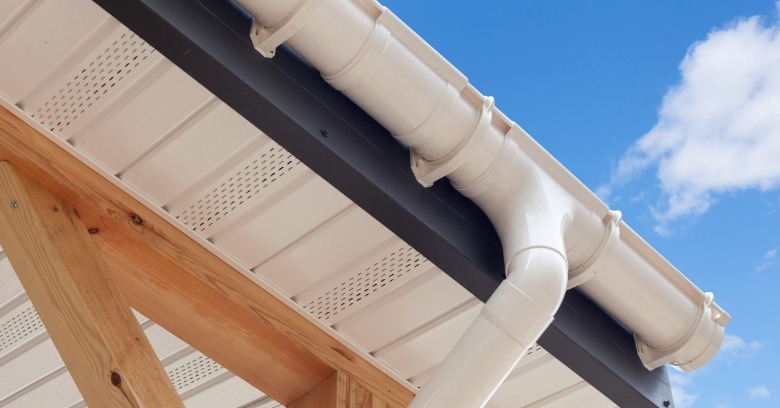
In need of Gutter Repair in Minneola Florida?
APC Roofing lays out, puts up, and looks after gutter systems for Minneola Florida properties.
Call us at 407-270-1129 to get your roofline looked at.
A Real Gutter Repair Estimate Starts With a Tape Measure – Not a Product List
Nearly every underperforming roof-drainage setup that needs replacing around Minneola Florida failed for one reason: no one ever sized it for the roof it serves. The trough is a channel with a duty, and how much water it has to move is decided by two figures: how much roof sheds into it, and the worst few minutes of rain that roof will ever see.
The rainfall figure catches most homeowners off guard. Drainage is not sized on the total that falls in a year. The engineering tables – the ones the sheet-metal trade has used for generations – start from the intensity of the worst few minutes. A gutter run does not give up because of a wet year. It fails in the few minutes a summer storm stalls above the street.
The distinction shows up plainly across the map we cover. One of the markets we work in collects north of fifty inches in a typical year; a different market measures less than twenty inches. You would think the markets that see less rain can get away with less gutter. They do not. The heaviest burst is a great deal closer than a rainfall map implies.
The Two Numbers That Set What You Pay for Gutter Repair in Minneola Florida
First comes gutter size. The two choices worth arguing about on a residence are five inch and six inch K-style. Going from one to the other is not cosmetic: the larger profile moves about fifty percent more water than the narrower profile. On a small roof with little pitch that headroom is spare capacity. On a wide, steeply pitched roof feeding one long run, it is the line between a dry wall and a soaked one.
The second figure is the size of the downspout. This is the number people skip, and it is the one that decides the outcome. The 2x3 downspout – the common small section – will take about 600 square feet of roof area. Change up to the larger rectangular downspout and you roughly double that, to around twelve hundred. A four-inch round lands in the same range. That is not marketing, and it is one of the cheapest upgrades on the job.
Combine them and the arithmetic is simple. Calculate the square footage of roof draining into each run, and check how many downspouts there are. If the answer says three downspouts are required and the wall carries a single one, no cleaning schedule in the world will put it right. That is a capacity problem, not poor upkeep.
How the Water Actually Leaves the Roofline
The trough is never hung level, and a good one never looks sloped. The common working figure sits near a quarter of an inch for each ten feet of gutter. Installers differ between an eighth and a half inch over ten feet, but the intent does not change: enough to move the water, not so much that the roofline looks crooked.
Too little fall and water stands in the trough. Standing water is the start of the failure: it traps grit and leaf litter, it sits against the joints, and it loads the hangers exactly where you least want it. Pitch it too hard and the roofline looks off while the flow skips the drop during a heavy burst.
The distance a run covers bears on the result as much as slope. Past about thirty-five or forty feet, the fix is a second outlet, not a wider section. Water in a long single-outlet run arrives at the bottom faster than it can be taken away, and the water goes over wherever the edge has dropped – frequently over the walkway, which is what brings us the call.
The Parts Nobody Looks At
Bracket spacing is among the few items anyone can inspect without getting on a ladder. Hangers and brackets need to land every two to three feet. In the northern half of our service area, tighter is better – to around eighteen inches – because ice and frozen snow mound above the rim and linger for weeks, where rain is gone within minutes.
A second detail nobody mentions is expansion and contraction. A long aluminum run moves as the temperature swings. Over a long length through a full year of weather, the travel is more than an inch. That has to be allowed for. A length with nowhere to move warps, opens a joint, or drags a hanger loose in a couple of years. That is in no way a fault in the material. It is an install detail that was missed.
Drip Edge, Gutter Apron, and the Gap Behind the Trough
There is a failure mode that presents as a leaking gutter but is not one. Water appears on the fascia, or marks the wall below behind the trough line, and the gutter is not the source. The problem is the detail where the roof stops.
Standard drip edge is a simple L-section that kicks runoff away from the roof edge. When that strip is the only flashing, water can still track back behind the gutter through surface tension alone. The gutter apron is the deeper profile that carries over the edge and into the trough. It removes the gap that was letting water behind. On a steep pitch throwing water hard, the difference is not subtle.
What the gutter hangs beneath changes what the edge detail has to be. A standard shingle roof is the least trouble. Tile sits well above the deck, and the edge flashing belongs in the build-up before the tiles go down. Metal panel roofing turns loose a full slope of snow in one movement rather than losing it a little at a time, which is why snow retention above the gutter line belongs in the gutter discussion and not a roofing one alone. Low-pitch runs of roof behave differently once more. APC Roofing hangs gutters under every one of those, which is the point.
Why Ice Builds at the Cold Edge
Across the northern half of our service area, this is the cold-weather conversation. And it is the subject most commonly turned on its head.
The ice at the roof edge starts nowhere near the gutter. The cause is heat getting into the roof structure from the house beneath. That warmth melts snow on the upper roof; the melt works its way down to the eave, with nothing warm below it, and sets as ice. Run that cycle through a string of cold nights and a ridge of ice builds, trapping the next thaw above it.
None of that is the gutter's doing, though the run plays a part. A trough already packed with ice gives that meltwater nowhere to go, and the dam grows faster. So the honest answer, when the question is put to us whether new gutters will cure the ice, is that they do not. The fix lives in the attic. What a properly built system does is give the meltwater somewhere to go before it does a further round of damage as things warm up. Anyone who sells you gutters as the answer to ice damming has the diagnosis wrong.
What the Last Few Feet Decide
A correctly sized system that empties right at the foundation has just moved the damage rather than solved it. It has taken water off a big span of roof, narrowed it into a single stream, and placed it exactly where you least want it.
Here is one of the few places where the residential building code is specific. In areas with expansive or collapsible soils, roof drainage is required to go five feet or more away from the foundation walls, or to a proper drainage arrangement. Note what triggers that: soil type, not annual rain.
That difference is the reason the market that sees the least rain is exactly the market where discharge distance carries the most weight. Ground that expands when it takes on water and pulls back as it dries will lift and drop a foundation season after season. The water doing that does not have to be heavy. All it has to be is delivered time after time at one point. A short downspout does that reliably.
A second figure in the code applies to all of it, whatever the ground is like: the finished grade must fall at least six inches inside the first ten feet out from the wall. That is the surface the discharge lands on. A perfect gutter emptying onto ground that slopes back toward the house has already lost. We take a look at the grade at the same visit – the two belong together.
What Actually Fills a Gutter
The material that lands up there is not all one thing, which is why the standard twice-a-year advice is a starting point rather than an answer. By and large, three kinds of material fill a trough.
- Coarse material – broad leaves, twigs, seed pods. It drops over a short season, mostly sits on top, and clears easily. It is also the debris everyone imagines when a clogged gutter is mentioned.
- The soft load – pine needles, catkins, winged seeds, and blossoms. Here is the awkward one. It runs straight through the usual mesh, settles in the low spots, and sets into a sludge that will not wash through.
- Roof granules – the mineral granules coming off a shingle roof over the whole of the roof's life. A small amount is entirely normal. A sharp rise in what gathers at the downspout is worth telling us about, because that is a roofing signal and not a drainage one.
Guards of any kind are a compromise, not a cure. They lower the cleaning frequency, which matters. Against that they shrink the opening the water has to pass through, and in a hard downpour part of the flow goes straight past. The fine load still gets underneath. Whether they make sense on your house depends on what is growing above the roof, which is why we walk the property first rather than guess.
Getting the Water Clear of the House
In practice there are three real options to get the discharge away from a wall, and each has a catch. A concrete splash block costs almost nothing and achieves the least. It softens the fall of the water hitting it and throws it wide, but it carries it a very short distance. Where grading is poor the water ends up right where it started to the wall.
A hinged or roll-out extension is the sensible middle ground. It is inexpensive, it lifts out of the way for mowing, and it will genuinely take water several feet out. The drawback is that it is visible, and anything underfoot tends to get disconnected and is never put back. We find more disconnected extensions than we do failed gutters.
A buried pipe is the right answer where it is worth doing: a sealed pipe run clear to an open discharge point well away from the building. None of it shows, nobody can knock it off, and it will outlast the gutters. The cost is that it can choke with nothing to show for it above ground, and that is the reason an inspection point is put in at the outset and not added after the fact.
Fascia, Rafter Tails, and What We Find
A trough has to hang from something, and the thing it hangs from is the fascia board most of the time or the rafter ends behind it. If water has been going behind the trough for a long stretch, the wood behind is often soft once the old run is off.
We would sooner say so before the work starts than uncover it with the old run already down. A screw sunk into soft wood holds for a while before it lets go, typically under load – which is exactly when you need it to hold. Where the board has gone soft, we raise it, show you, and put a separate figure on it so nothing is hidden in one number.
When the Roof Is Not a Simple Pitch
Not every roof out there drains into a gutter. Flat and low-pitch areas behave differently: drainage happens through scuppers, internal drains, or tapered falls rather than over the roof edge. The questions to answer do not change, but the way it fails is better hidden and a good deal less forgiving.
On an ordinary sloped roof a run that has filled overflows in plain sight. On a low-slope roof a drain that has blocked holds water, and that pond puts real weight on the structure while nobody is looking. APC Roofing works on both, so that a building with a mix of the two is dealt with as one system instead of two trades pointing at each other over the junction.
Hail, Wind, and What Storms Do to Drainage
Weather damage to the roof itself is obvious. The gutters below get attention last, if anyone looks at all. The order should be reversed on two grounds.
One thing worth knowing – a run is frequently the most legible record of what actually struck the house. Dents in a metal trough show how big the hailstones were and which way they came. That is evidence that supports a claim when the roof itself cannot be judged from below.
Another thing worth knowing – a gutter moved by the wind keeps quiet about it. It looks right from the street, and it works in average rain. The problem shows up in the next real storm, and that may be months later – often past the window for a claim. A look after the storm is far cheaper than the cost of finding out the hard way.
What to Look For From the Ground
You do not need a ladder to pick up most of these. Take your time and walk around while it is actually raining hard, which is when a gutter tells you the truth.
- Runoff pouring over the front during a burst – a size, blockage, or slope problem.
- A gap opening between the gutter and the fascia – bracket failure, usually after a heavy load.
- Paint blistering behind the trough while the run itself is sound – the edge detail, not the run.
- A washed line or bare earth beneath one drop – discharge too close to the wall.
- Water pooling at the base of the house long after the rain has passed – drainage and grading.
- A run with a belly in it – water sitting where it should not, and it gets worse by itself.
Valleys, Upper Roofs, and Concentrated Flow
The area figure by itself does not tell the whole story, because roofs do not spread the load evenly. A roof valley gathers two planes of roof and sends the combined flow at one short stretch of run. That one stretch is often taking many times the load of the lengths beside it, while looking no different.
And that is why a gutter can overflow in just one place every single storm while the remainder stays perfectly dry. The fix is rarely a larger trough. It is an outlet positioned at or close to where the valley discharges, so the water leaves at the point of arrival instead of traveling down the length of a gutter that was not built for that load.
Second-story roofs throw up the same problem in a different form. An upper-level downspout discharging onto the lower slope is common, and it is usually a bad arrangement. It drops an entire upper roof at a single point of the roof below, which erodes the covering and then overwhelms the trough the lower roof drains to. Running the upper discharge straight past the lower roof settles both at once.
How to Compare Two Estimates
Once you have a pair of quotes and one is cheaper, the gap between them is seldom profit margin. It is almost always a difference in materials and sizes that neither estimate makes plain.
A quote you can measure against another tells you the size of the gutter and the metal it is made from, the outlet count and profile, what the run is hung on and at what spacing, the detail where the roof meets the gutter and whether it is priced in, and where the discharge from each drop goes once it leaves the downspout. Five things. Where an estimate leaves any of them blank, that is where the gap is.
All five appear on the estimate because that is the work. A linear-foot rate with none of it specified is a bare number, not a quote.
Timing, Access, and How Long the Work Takes
A typical house job takes a day, sometimes two. The run is rolled on site from a coil of metal, cut to the length needed, which is precisely the reason no joint is needed anywhere in between. The corners, the outlets, and the ends are still joints, and those are where sealing counts.
The weather decides the schedule more than we would choose. The work calls for reasonably dry weather – the sealants must cure and nobody ought to be on a wet edge. We would sooner move a booking than work through rain and have you call us back.
Access shapes the day. Tight clearance at the side, planting close under the eaves, porches and lean-tos, and shared boundaries all affect the sequence. We check that while we are measuring, not the morning we arrive.
What You Get When APC Roofing Tackles Gutter Repair in Minneola Florida
We measure the roof before quoting the gutter. The roof area on each run, roof pitch, the run lengths, and where the outlets can realistically go – those four things produce a specification. What follows – the choices you can see – is a choice you get to make with the numbers in front of you.
Because the roof and the drainage are both ours, the detail where roof and gutter meet is treated as part of the job. Shingle, tile, metal, flat, commercial – each one changes the way the edge is built. That detail is not tacked on at the end. It happens to be where the work starts.
Repairing or replacing is a decision we make on the evidence, and we will tell you which. A properly sized run with a failed section or a pitch problem is a repair. A system that was undersized from day one for its roof is not a repair at all. More maintenance will not change the math.
Line Up Gutter Repair in Minneola Florida With the Roof Measured First
Contact APC Roofing at 407-270-1129 and we will start with a measurement.
What Is Under the House Changes the Damage
One and the same fault costs very different amounts on two different houses, and the deciding factor is what the house sits on.
A home on a slab has no basement to fill. The damage is slower: runoff finding its way beneath the edge, the ground under it washing away, and dampness rising through the floor in a room nobody associates with the roof.
A house over a crawl space gives the water a place to collect, and that is where it ends up. Seepage through the wall, salt staining on the block, the sump pump cycling almost without stopping, and humidity pulled up through the whole house – every one of those begins at an outlet that stops at the foundation.
Either way the repair belongs outside, and it is far cheaper than anything carried out after the water is in.
Materials, and What Each One Buys
Aluminum is the usual choice, and deservedly so: it will not rust, it asks little of the hangers, and it is formed on site as a single continuous run. Cutting out the seams means the usual leak points are gone. The trade is that it is a soft metal and it expands and contracts a good deal, which the install has to allow for.
Steel is stronger and resists damage, which matters in hail country, but the finish is all that stands between it and corrosion, so it is worth checking now and then. Copper sits at the durable end and the price reflects that. A plastic system is cheap to put up and grows brittle under UV and cold. We will walk you through which of those suits your house without selling you more than you need.
Keeping a Run Working
The twice-a-year figure is the standard advice, and it is a reasonable default and not an answer in itself. The right interval comes down to what grows above the roof. A roof beneath conifers takes a steady needle drop nearly year-round and asks for more frequent attention. A roof with clear sky above it may go considerably longer.
The seasonal pattern was borrowed from colder places, and it fits some of our markets badly. The oaks that stay green in the warmer markets we serve keep their old leaves all winter and shed them in late winter as the new growth pushes. Anyone with one of those over the house who treats the fall visit as the last one is getting the work done just before the quiet months and leaving it full through the heaviest drop of the year.
What we actually check is more than whether it is clear. Whether each drop is running, joint and end-cap seals, whether the brackets have held, slope along the run, the edge detail, and where that water finally lands. That last one is the thing most often skipped and also the one most likely to be costing you.
If you would rather not think about it at all, that is what we are for. A run that gets looked over regularly usually lasts as long as the metal will. A run that is only looked at after the damage shows does not.
To get started on Gutter Repair in and around Minneola Florida, call APC Roofing today at 407-270-1129. We will measure the roof first and quote from the numbers.
Verified

Verified
Verified
Verified
Verified


















