
You’ve decided it’s time for a new roof. Now you’re comparing estimates that list the same shingle but don’t look anything alike, and you’re wondering what’s actually included. Roof installation in the Ozarks comes down to the layers you’ll never see once the job is done, and those are where cut corners hide.
You don’t need to become a roofer to protect yourself. You just need to know what a properly installed roof includes, so you can ask good questions and compare estimates fairly.
APC Roofing has been installing roofs since 2017. We’re GAF Certified, licensed and insured, and we put new roofs on homes across Springfield, Republic and the surrounding Ozarks. Your inspection and estimate are free.
Roof installation in the Ozarks, layer by layer
The deck
Once the old roof is torn off, the wood decking underneath is exposed for the first time in decades. This is the only chance to find soft, rotted or delaminated boards and replace them. Shingle nails need solid wood to grip, and a weak deck shows up later as sagging or shingles that blow off. A good estimate explains how damaged decking will be handled and priced, so it isn’t a surprise on install day.
Drip edge
Metal drip edge runs along the eaves and the sloped edges of the roof. It guides water into the gutters and away from the fascia boards. Without it, water can curl back under the shingles and rot the roof edge.
Ice and water protection
A self-adhering membrane goes down along the eaves and in the valleys. When ice builds up at the roof edge after a winter storm, water can back up under the shingles. This membrane seals around the nails and keeps that water out of the house. In a climate like southwest Missouri’s, with real freeze-thaw winters, it’s an important layer.
Underlayment
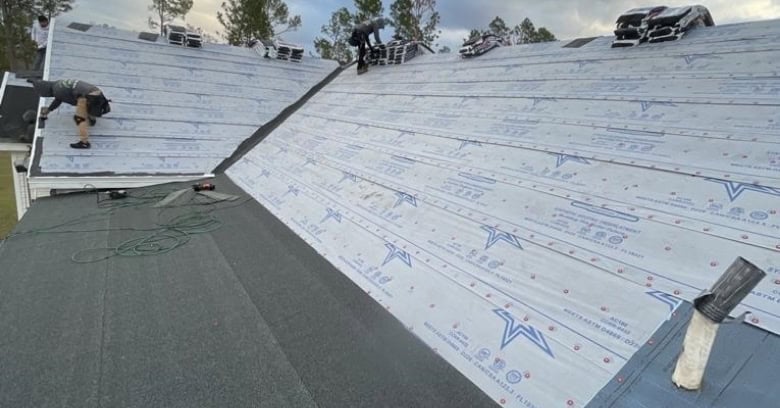
The rest of the deck gets covered with underlayment, usually a synthetic sheet today. It’s a second line of defense under the shingles, and it keeps the deck dry if rain shows up partway through the job. Each row laps over the one below it so water always runs downhill over a seam, never into one.
Starter strip and nailing
The first row of shingles at the edge sits on a starter strip that seals the bottom edge down. That edge is where wind gets its grip in a storm. Each shingle then needs the right number of nails in the right spot, as the manufacturer specifies. Nails placed too high or driven crooked are a common reason shingles blow off in spring storms.
Flashing at walls and chimneys
Wherever the roof meets a wall or chimney, layered metal flashing turns the water. On a new roof, this flashing should be new. Old, rusty flashing reused under fresh shingles is one of the most common causes of leaks on newer roofs. A chimney wide enough to block water often gets a small peaked section behind it, called a cricket, to split the flow around it.
Valleys and pipe boots
Valleys, where two slopes meet, carry the most water on the roof and get extra protection underneath. Every pipe that comes through the roof gets a new boot. These details take time, and they’re where a careful install and a rushed one look different a few years later.
Ridge caps
Special cap shingles finish the hips and ridge, the peaks of the roof. They’re thicker and shaped to bend over the top without cracking.
Choosing the right roof for your house
Most Ozarks homes get architectural shingles. Metal, including standing seam and stone-coated steel, is a common choice for homeowners who want strong hail performance and less upkeep. Nearly flat sections, like some porch roofs and additions, need a membrane made for low slopes. See shingle roof installation or metal roof installation in the Ozarks for more on each.
Getting ready for install day
A few things make the day smoother for you:
- Move cars out of the garage and driveway so materials and the dumpster can get close.
- Take down pictures and shelves on walls of upper floors. Hammering can shake them loose.
- Keep pets inside or away. The noise is a lot for them.
- Cover belongings in the attic if you store things there, since a little dust can fall through.
Many residential projects are finished in a single day. Bigger or more complex roofs take longer, and your estimate will say what to expect. When the work is done, the site gets cleaned up.
Your city or county may require a permit for a new roof. Ask any roofer you’re considering how they handle permits before you sign.
Questions to ask any roofer before you sign
- Will the old roof be torn off down to the deck?
- How is damaged decking handled and priced?
- Are new drip edge, flashing and pipe boots included?
- Where does ice and water membrane go?
- Who pulls the permit, if one is needed?
Good answers to these tell you a lot about the job you’ll get.
How roof installation works with APC Roofing
- Book your free inspection. Call 913-398-5020 or request a free estimate online.
- Get a clear, honest assessment and estimate. We inspect your roof and attic, measure, and give you a written estimate that spells out the materials and the scope of work.
- Your new roof goes on and the site gets cleaned up.
If you’d like to spread the cost out, financing is available through Aqua Finance, Fortifi, Hearth and Home Run Finance.
If your current roof is leaking while you plan, the damage can keep reaching the deck. The longer that goes on, the more boards need replacing when the new roof goes on.
If you’re still deciding whether you need a full replacement at all, our roof replacement in the Ozarks page walks through that decision.
Roof installation questions
How long does a roof installation take?
Many residential projects are finished in a single day. Larger, steeper or more complex roofs can take longer.
What happens if it rains during the install?
A well-run install only opens as much roof as can be covered the same day, and underlayment protects the deck if weather moves in. It’s fair to ask any roofer how they plan around the forecast.
Can a new roof go over my old one?
Sometimes code allows one overlay, but a full tear-off lets the decking be checked and repaired. For most homes, that makes for a better roof.
What’s ice and water shield, and do I need it?
It’s a sticky membrane that seals around nails at the eaves and valleys. In a freeze-thaw climate like ours, it helps stop leaks from ice backing up at the roof edge.
Book your free inspection
Call 913-398-5020 or book your free inspection online. You’ll get an estimate you can actually read and a roof built right from the deck up. That means a dry house, no surprise bill, and confidence the parts you can’t see were done right too.


















