Your low-slope roof needs replacing, and someone mentioned TPO. Now you’re trying to figure out whether it’s the right material for your porch, addition or building, and whether the person quoting it actually knows how to install it. If you’re researching TPO roofing in Springfield, MO, that’s exactly the right question to be asking before you sign anything.
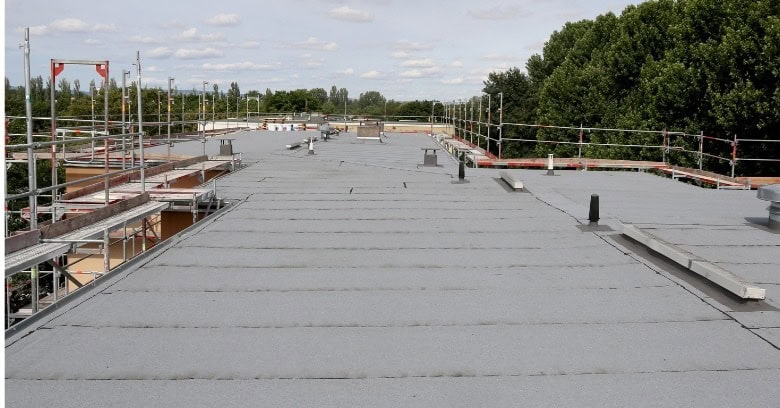
TPO performs well when it’s welded and detailed correctly. When it isn’t, the seams and edges are where it lets you down, and you won’t find out until water shows up on a ceiling.
APC Roofing is a GAF Certified contractor, licensed and insured, and we install and repair TPO and other low-slope roofs on Springfield homes and light commercial buildings. The inspection and estimate are free. Call 913-398-5020 to get started.
What TPO roofing is
TPO is a single-ply roofing membrane made of thermoplastic, usually white. It comes in wide rolls, and the sheets are joined by heating the overlapping edges with a hot-air welder until they melt together into one piece. That welded seam is the main reason people choose TPO. Once it’s fused and tested, the joint is as watertight as the sheet itself.
Under the membrane there’s usually a layer of rigid insulation and sometimes a thin cover board, all sitting on the roof deck. The membrane is either glued down or fastened through the insulation into the deck, depending on the building.
Thickness is measured in mils, or thousandths of an inch. Residential and light commercial jobs commonly use 45 or 60 mil, and heavier sheets are available for roofs that see foot traffic or equipment. You can’t tell the thickness from the ground, so it should be written on your estimate.
TPO roofing in Springfield, MO: why it works here
A white TPO roof reflects a good share of the sun’s heat. On a hot, humid Ozarks summer afternoon, that keeps the roof surface cooler than a dark roof would be, and the room underneath feels it. That matters most when the low roof sits over living space, like a sunroom, a bonus room or an addition.
Spring storms are the other test. Heavy rain sits longer on a low roof, so the seams need to be right, and welded seams hold up well under standing water when they’re done properly. Hail can still puncture or crack a membrane, more so once it’s aged, so a check after a big hailstorm is a good habit.
Cold weather is less kind to TPO than to rubber. It stiffens in the cold, which is one reason flashing details at walls and corners need care during installation.
What a good TPO installation looks like
Most TPO problems trace back to the install, not the material. A few things separate a roof that lasts from one that leaks:
- Welds set up for the conditions. The welder’s heat and speed have to match the day’s temperature. Too cold and the seam doesn’t fuse; too hot and it scorches. Every seam should be checked with a probe along its full length.
- Proper slope to drain. If the deck has low spots, tapered insulation or a cricket should correct them before the membrane goes down.
- The tie-in to the main roof. Where a porch or addition meets a shingled roof, the membrane should run up and under the shingles so water lands on top of it.
- Secure edges. Wind pulls hardest at the perimeter and corners, so the edge metal has to be fastened tight.
TPO repairs
Because TPO is welded, a repair is welded too. A patch of new membrane is heated onto the old one around a puncture or a failed seam. Older TPO picks up dirt and weathering on its surface, and that has to be cleaned and prepared first or the new weld won’t take. That’s one reason a TPO roof is easier to fix when small problems get caught early.
If seams are failing in many places, the membrane has cracked, or the insulation below is wet, replacement is usually the better choice. Our flat roof repair in Springfield page goes into how we sort that out.
TPO or EPDM?
The short version: TPO is white, reflective and welded. EPDM is black rubber, seamed with tape, and more flexible in the cold. Over living space in full sun, TPO often makes sense. Over a garage or shaded porch, rubber is often the simpler pick. Compare them on our EPDM roofing in Springfield page or see the full rundown on flat roofing in Springfield.
If you manage a townhome community or small commercial building with low-slope roofs, the same approach applies across multiple roofs. See our commercial roofing in Springfield page.
How it works with APC Roofing
- Book your free inspection. Call 913-398-5020 or request a free online estimate.
- Get a clear, honest assessment and estimate. We look at the drainage, the deck, the seams and the edges, and you get photos and a written estimate that spells out the membrane thickness and the plan.
- Get the roof installed and the site cleaned up. Rain stops membrane work, so the job is set around the forecast. Opened areas are sealed before the crew leaves each day.
You can spread out the cost through our financing partners, Aqua Finance, Fortifi, Hearth and Home Run Finance.
TPO roofing questions
Is TPO good for a residential flat roof?
Yes. It’s common on porches, additions and sunrooms, especially where the room below gets hot in summer.
What thickness of TPO should I get?
45 and 60 mil are common on homes. A thicker sheet resists punctures better, which helps if people walk on the roof or there’s equipment up there.
Can you repair an old TPO roof?
Usually, if the membrane is still sound. The old surface has to be cleaned and prepared so the new patch welds properly.
Do you handle low-slope roofs for HOAs and small buildings?
Yes. We repair and install low-slope roofs on light commercial buildings as well as homes.
A cooler, drier low roof
Holding off on a failing low roof usually means more wet insulation and decking to replace later. There’s no need to rush the decision, but it helps to know where you stand.
With a well-welded TPO roof, the room below stays cooler in July and dry through spring storms, and you’ll know the job was done right. Call 913-398-5020 to book your free inspection.