Shopping for Gutter Repair in Republic Missouri?
APC Roofing measures, builds, and services gutter and downspout systems for Republic Missouri homes.
Reach us at 913-398-5020 to get your roofline looked at.
Any Gutter Repair Bid Starts With Arithmetic – Not a Price Sheet
Most every struggling gutter run that needs replacing in and around Republic Missouri ran out of capacity for one reason: it was never sized for the roof above it. A rainwater system is a pipe with a job to do, and the size of that job is set by two measurements: how much roof drains into it, and the worst few minutes of rain that roof will ever see.
That second figure surprises people. Gutters are not sized against how much rain a place gets in a year. The tables the trade uses – the ones the sheet-metal trade has used for generations – run on how hard it rains in a five-minute burst. A gutter does not fail because the annual total was high. It spills through the ten minutes a summer storm stalls above the street.
That difference matters more than it might seem. One of the markets we work in takes upwards of fifty inches in a normal year; the dry end of the map records below twenty inches. It is easy to assume the drier markets on our map can get away with less gutter. The tables say otherwise. The peak burst differs far less than a rainfall map implies.
The Two Measurements That Settle What You Pay for Gutter Repair in Republic Missouri
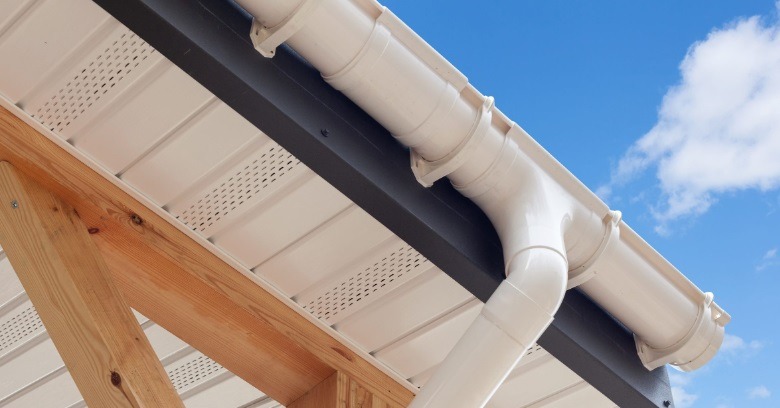
The first is the size of the trough. The two choices you will actually be quoted on most rooflines are the five-inch K-style and the six-inch. The step up is not a trim decision: the larger profile moves close to fifty percent more water than the five-inch. On a compact, shallow roof that margin is comfort. On a big, fast-shedding roof feeding one long run, the extra size is what stands between working and overflowing.
The second of them is how the water gets out. This is the figure that most quotes leave out, and it is where most of the trouble comes from. The 2x3 downspout – the one on the majority of older homes – is rated for about six hundred square feet of roof area. Go to the larger rectangular profile and it takes about twice as much, to something near twelve hundred. The four-inch round profile sits in similar territory. That is a real doubling, and the price difference is small.
Take the two numbers together and the calculation is plain. Calculate the square footage of roof feeding each length of gutter, and next count the downspouts. If the math says three downspouts are called for and the house has one, no amount of cleaning will keep that run dry. That is a sizing fault, not a matter of neglect.
Where the Fall Goes and Why It Matters
The trough is not hung flat, and a good one never looks sloped. The number the trade works to is roughly a quarter inch for every ten feet of run. Installers differ a little either side of that, but the aim is the same: enough to keep water on the move, slight enough that the run still looks level.
Not enough fall and water sits in the low spots. A trough that never fully empties is what finishes a gutter off: it holds debris, it stays against the seals, and it adds weight at the weakest point. Overdo the slope and the run looks wrong from the curb while the flow skips the drop when it really rains.
The distance a run covers bears on the result as much as slope. Once a run pushes much past forty feet, the fix is a second outlet, not a bigger gutter. Water traveling a long way gets to the downspout at a rate one opening cannot absorb, and it overflows wherever the lip sits lowest – commonly above an entry, which is how the problem announces itself.
What Holds It Up, and Why It Moves
Bracket spacing is among the few items a homeowner can see with a tape from below. Supports belong no further than roughly three feet apart. Where snow sits on the roof, we tighten that up – to around eighteen inches – because ice and packed snow stack above the lip and sit there for weeks, while rainwater drains away in minutes.
The other thing no estimate mentions is how much the metal moves. The aluminum moves through the seasons. Along a hundred feet of gutter through a full year of weather, the travel is more than an inch. That needs somewhere to go. A run pinned rigidly at both ends warps, opens a joint, or drags a hanger loose given a few cycles. That is in no way a defect in the metal. It is an install detail that was missed.
Where the Roof Edge Meets the Gutter
Here is a problem that presents as a leaking gutter and is nothing of the kind. Moisture shows on the woodwork at the edge, or streaks the siding behind the gutter, while the gutter is perfectly sound. What is causing it is the detail where the roof stops.
A standard drip edge is an L-shaped strip that pushes water off the deck. When that strip is the only flashing, runoff can still curl back into the space behind the run on surface tension alone. A gutter apron flashing is the deeper profile that reaches out and drops into the trough. It shuts the path that let water get behind. On a steeply pitched roof moving water in a hurry, the difference is not subtle.
The covering above the run changes what the edge detail has to be. Composition shingle is the simple case. A tile roof is heavier and stands taller, and the flashing at the edge belongs in the build-up before the tiles go down. A metal roof lets go of its snow load in a single slide rather than losing it a little at a time, and that is why keeping the snow up on the roof belongs in the gutter discussion and not just a roofing one. Flat and low-slope sections change the answer again. APC Roofing handles every one of those, which is why we raise it.
Freezing Weather and the Cold End of the Roof
In the colder markets we serve, this is the conversation. It also happens to be the one most often explained backwards.
An ice dam does not come from the gutter. The source is heat leaking out through the roof from the living space below. The escaping heat softens and melts the snow over the warm part of the deck; the melt travels down to the cold edge, with nothing warm below it, and freezes there. Run that cycle for several days and there is a ridge of ice at the edge, penning the water in above it.
None of it starts in the gutter, but a frozen run is not innocent either. A gutter full of ice leaves the melt no way out, and the dam builds quicker. The honest answer, when the question is put to us whether new gutters will end the ice problem, is that they will not. The fix lives in the attic. What drainage can do is clear the water away before it does a further round of damage as things warm up. Anyone offering a new gutter as the answer to ice damming is selling you the wrong repair.
The Last Five Feet
A perfectly sized system that discharges at the foot of the wall has just moved the damage and not solved it. It has taken water from hundreds of square feet, drawn it together into one discharge, and delivered it at the worst place available.
This is a rare case where the residential building code puts a number on it. On soils known to be expansive or collapsible, the roof discharge must be taken at least five feet away from the foundation, or to an approved drain. Read what triggers it: it is the ground, not the weather.
That single point explains why the driest place we work is exactly the market where discharge distance counts for most. Clay that swells when it takes on water and shrinks again when it dries moves a foundation up and down year after year. The water that drives it does not have to be heavy. It just has to be delivered time after time against one wall. An outlet that ends at the wall does precisely that.
A second number in the code applies to every house, not only the difficult ones: the grade has to fall six inches as a minimum in the first ten feet measured out from the wall. That is the ground level the downspout hands its water to. A perfect gutter delivering water to a reverse slope is beaten before it starts. The ground gets checked while we are measuring the roof – it is the same problem.
The Three Loads a Gutter Has to Take
What lands in a gutter is not all alike, which is the reason a single fixed schedule suits nobody perfectly. Broadly, three sorts of material collect in a trough.
- Leaf litter – big leaves and small branches. It drops over a short season, largely stays on the surface, and is the easiest to remove. That is largely the debris everyone imagines when gutter cleaning is mentioned.
- The soft load – needles, catkins, winged seeds, and flower drop. And this is the load that gives trouble. It drops through most screens and guards, settles in the low spots, and turns to a dense mat that will not flush out.
- Roof grit – the granules that come off an asphalt shingle roof for the roof's whole service life. A trace is perfectly normal. A sharp rise in what collects at the outlet is worth telling us about, because it is a roof-side signal and not a drainage one.
Covers and screens give with one hand and take with the other. They bring down how often the run needs clearing, which counts for something. Against that they shrink the opening the water must pass, and in a hard, driving burst water can sheet clean over them. Needle and seed litter still works its way in. Whether they make sense on your house depends on what is growing above the roof, which is something to look at together instead of guessing.
Getting the Water Clear of the House
You have three sensible ways to take the discharge away from the foundation, and they are not equal. A splash block at the base is the low-cost option and moves water the shortest distance. It kills the force of the water hitting it and throws it wide, but it moves it a very short distance. Where the ground slopes the wrong way the runoff returns to where it started.
A surface extension sits in the middle. The cost is small, it can be lifted for mowing, and it will genuinely take water some distance clear of the wall. The catch is that it sits on the lawn, and anything on the surface comes loose and is never put back. We turn up more detached extensions than we do failed runs.
An underground drain is the right answer when the ground demands it: a sealed pipe run clear to somewhere the water can safely go a long way from the house. Nothing shows, it stays connected, and it lasts longer than the gutters above it. The catch is that it can silt up with nothing to show for it above ground, and that is the reason a clean-out at the top of the line goes in at the start instead of being regretted later.
Fascia, Rafter Tails, and Soft Wood
A rainwater run has to be carried by something, and that something is the fascia board most of the time or the ends of the rafters. Where water has been getting behind the run or soaking the board for years, the board is often soft by the time the old gutter comes down.
We would sooner say so before the work starts than turn it up part way through the job. A bracket going into decayed board holds a little while before pulling out, typically under load – and that is when you need it to hold. Where the wood has rotted, we raise it, walk you to it, and price the repair separately so nothing is hidden in one number.
Flat Roofs and the Drainage They Need
Not every building sheds at an eave. Flat and low-pitch areas drain in another way: drainage happens through scuppers, internal drains, or tapered falls rather than over an open edge. The questions to answer stay the same, but the failures are less obvious and a good deal less forgiving.
On a sloped roof a blocked run goes over the side where you can see it. On a flat or low-slope roof a drain that has blocked backs water up on the membrane, and standing water runs to tons in weight before anyone sees it. APC Roofing works on both, so that a building with a mix of the two gets one drainage plan rather than two crews disagreeing at the junction.
What Severe Weather Does to a Gutter Run
Weather damage to a roof gets attention. The gutters get attention last, if they are checked at all. That is backwards on two counts.
Something worth knowing – the gutter is usually the best evidence of what the weather did. Impact marks along a run show how big the hailstones were and which way they came. That is evidence an adjuster can use when the shingle surface is harder to assess.
Another thing worth knowing – a length shifted by wind keeps quiet about it. Nothing appears out of place from the driveway, and it drains fine through everyday weather. You learn of it during the next serious storm, which may be a full year later – sometimes past the window for a claim. A look while it is fresh is far cheaper than the repair that follows.
What to Look For From the Ground
No climbing is required to catch the common ones. Take a slow lap of the building during or just after heavy rain, as that is when a run shows you what it is doing.
- Curtains of water spilling over the lip in a storm – undersized, blocked, or badly sloped.
- The trough pulling away from the house – the fasteners or their spacing, usually after a heavy load.
- Staining on the fascia board while the trough is doing its job – a missing apron, not a gutter fault.
- Splash marks and eroded ground below a drop – water landing too near the wall.
- Standing water up against the wall hours after the rain stops – grading and discharge together.
- A visible sag in a run – weight the hangers were never meant to take, and it does not recover.
The Places That Overload a Correctly Sized Gutter
Square footage alone takes you only so far, and roofs do not spread the load evenly. A roof valley takes runoff from two planes and drops the whole flow into a short length of trough. That short stretch can be carrying many times the load of the rest of the run, though it looks the same.
That is the reason a gutter can spill at exactly one point storm after storm while the remainder stays dry. The cure is rarely a bigger gutter. It is an outlet set exactly at where the valley lands, so the flow exits the moment it arrives instead of moving down a length never sized for that load.
Upper roof sections make the same problem another way. An upper-level downspout emptying onto a lower slope is seen everywhere, and it is often the wrong answer. It concentrates the entire area above onto a single spot of the lower covering, which wears the covering away and floods the gutter that serves the roof below. Taking the upper downspout straight past the lower roof solves both problems at once.
Comparing Two Gutter Quotes
Where you have two competing estimates and one is lower, the gap between them is usually not one company charging more for the same thing. It is almost always a different scope of work that neither document spells out clearly.
A quote you can trust sets out the gutter size and the material, the outlet count and profile, which hangers and how often, whether an apron or drip edge is specified and whether that is in the price, and where the discharge from each drop finishes up once it leaves the downspout. Five items. Where an estimate omits one of them, that is what the price difference is.
We write those down because that is the job. A price per foot with none of that behind it is just a number, not a specification.
Scheduling the Work
Most house gutter work is done in a day, two where the house is large or awkward. The run is rolled on site from a coil, cut to the exact length, and that is why the run has no joints anywhere in between. Corners, outlets, and end caps are still joints, and they are where sealing counts.
Weather sets the schedule more than we would like. The work calls for dry conditions – the sealant has to set and nobody wants to be up a wet ladder. We would sooner move a booking than rush it in poor weather and have you calling us back.
Getting to the work affects the day too. A narrow gap at the side, established beds below the run, porches and lean-tos, and shared boundaries all change how the work is staged. That gets noted while we are measuring, not after the crew arrives.
How APC Roofing Quotes Gutter Repair in Republic Missouri
We start with the roof, not the gutter. Roof area per run, roof pitch, how long the runs are, and where drops can sensibly discharge – those few numbers give us a specification. All that follows – the visible choices – is a decision you make knowing what the numbers require.
Because we roof as well as drain, the place where roof and gutter meet is designed, not assumed. Shingle, tile, standing seam, flat – every one changes how the edge is built. That is not tacked on at the end. It is where we begin.
Repairing or replacing is a genuine call, and you will get a straight answer. A well-sized run with a damaged section or a sag is a repair job. A run that never had the capacity for its roof is not a repair. Cleaning it more frequently does not change the numbers.
Get Gutter Repair in Republic Missouri Priced From the Numbers
Speak to APC Roofing right now at 913-398-5020 and start with a measurement.
Slab, Basement, or Crawl Space
One and the same fault carries a very different bill at different addresses, and what decides it is what sits below the ground floor.
A house built on a slab gives water nowhere obvious to collect. What goes wrong is less dramatic: water working under the slab edge, soil being carried out from below, and dampness rising where the wall meets the floor in a room nobody associates with the roof.
A basement or a crawl space gives the water a place to collect, and it will find it. Water through the wall, white salt marks on the block, a pump that runs much more than it should, and humid air carried up into the living space – all of those start at a single downspout discharging too close.
In both situations the answer is outside, and it is far cheaper than any cure done after the water is already in.
Gutter Materials, Briefly
Aluminum is what most homes get, and it has earned that: rust is not an issue, it is light on the supports, and it comes off a roll-former at the house into one continuous length. Cutting out the seams means fewer failure points. The trade is that it is a soft metal and it moves as it warms and cools, which the installation has to handle.
Galvanized steel is stronger and resists damage, which matters where hail is a fact of life, but the protective layer is the whole defense, so it needs looking after. Copper lasts the longest of the common options and it looks the part. Plastic is cheap to put up and hardens and cracks with sun and cold. We will walk you through which one suits your house without pushing the priciest option.
Cleaning: How Often, and What Else Gets Checked
The twice-yearly figure is the standard advice, and it is a reasonable starting point rather than a fixed rule. The interval that actually suits is decided by what is growing over the roof. A roof under pine takes needle drop the year round and will need clearing more often. A roof with nothing above it can go much longer.
The twice-yearly habit was inherited from colder climates, and it does not fit everywhere. The oaks that stay green across the southern end of our service area keep their leaves through the cold and drop them just as spring starts. Somebody living under one who treats the fall visit as the last one is doing the work right before the quiet season and letting it fill again for the leaf fall that counts.
What gets looked at is more than the leaves. How the outlets are flowing, seals at the joints and the ends, hanger tightness, the fall along the length, the condition of the edge flashing, and where that water finally lands. What happens at ground level is the thing most often skipped and equally the one most likely to be doing damage.
If you would rather it was handled, that is what the maintenance visit covers. A gutter looked over on a sensible interval generally lasts as long as the material will. A run only inspected after the damage is done does not.
To get started on Gutter Repair around Republic Missouri, dial APC Roofing at 913-398-5020. We do the measuring first and price it from what the tape says.
Verified

Verified
Verified
Verified