It rained last night, and now there’s a drip coming through the porch ceiling again, or a fresh stain spreading over the garage workbench. Someone patched that flat roof last year, and here you are. Good flat roof repair in Overland Park starts with finding where the water actually gets in, because on a flat roof that’s rarely right above the drip.
You don’t need another patch that buys a few months. You need the cause fixed and an honest answer about how much life the roof has left.
APC Roofing repairs flat and low-slope roofs on homes and light commercial buildings. We’re GAF Certified, licensed and insured, in business since 2017, and your inspection is free. Call 913-398-5020 and a roofer will come trace the leak.
Where flat roofs usually leak
The open middle of a flat roof is rarely the first thing to fail. Most leaks start at a seam, an edge or a spot where something passes through:
- Seams between sheets of membrane that have opened with age or movement
- Flashing where the flat roof meets a wall, a parapet or the shingle roof above
- Pipe boots, vents and other penetrations
- Drains, scuppers and gutters that are clogged or pulling loose
- Edge metal that has lifted in the wind
- Punctures from hail, branches or foot traffic
- Blisters that have cracked open
On homes, the joint where a porch or garage roof runs under the shingles above is one of the most common trouble spots. Water from the whole upper roof pours across that line every time it rains.
Why the leak isn’t where the drip is
Water that gets through a flat roof doesn’t always drop straight down. It can travel under the membrane, through the insulation and along the deck before it finds a seam in the ceiling. A drip in the middle of the porch might start at the wall flashing six feet away.
That’s why smearing sealant over the spot above the drip so often fails. A proper repair traces the water back to where it entered, checks how far it has spread, and fixes the source.
How Kansas weather causes flat roof leaks
Overland Park weather finds every weak spot on a flat roof. Hail can bruise or puncture a membrane without leaving anything obvious from the ground, and the leak may not start until weeks after the storm. Winter freeze-thaw cycles work at seams and flashing. Snow and ice can block drains, so meltwater backs up and sits against seams it was never meant to cover. Then the summer sun dries out older membranes until they crack.
What you can do before the repair
If water is coming in, move what you can out of the way and catch the drip with a bucket or towels. Take photos of the stain and of anything you can see on the roof from a window or the ground.
Please don’t climb onto the roof to look. Wet membranes are slippery, and a soft spot could mean the deck underneath is damaged. Avoid patching it yourself with a can of roof cement, too. Asphalt products don’t bond well to most modern membranes, and they make the real repair harder.
What a proper flat roof repair looks like
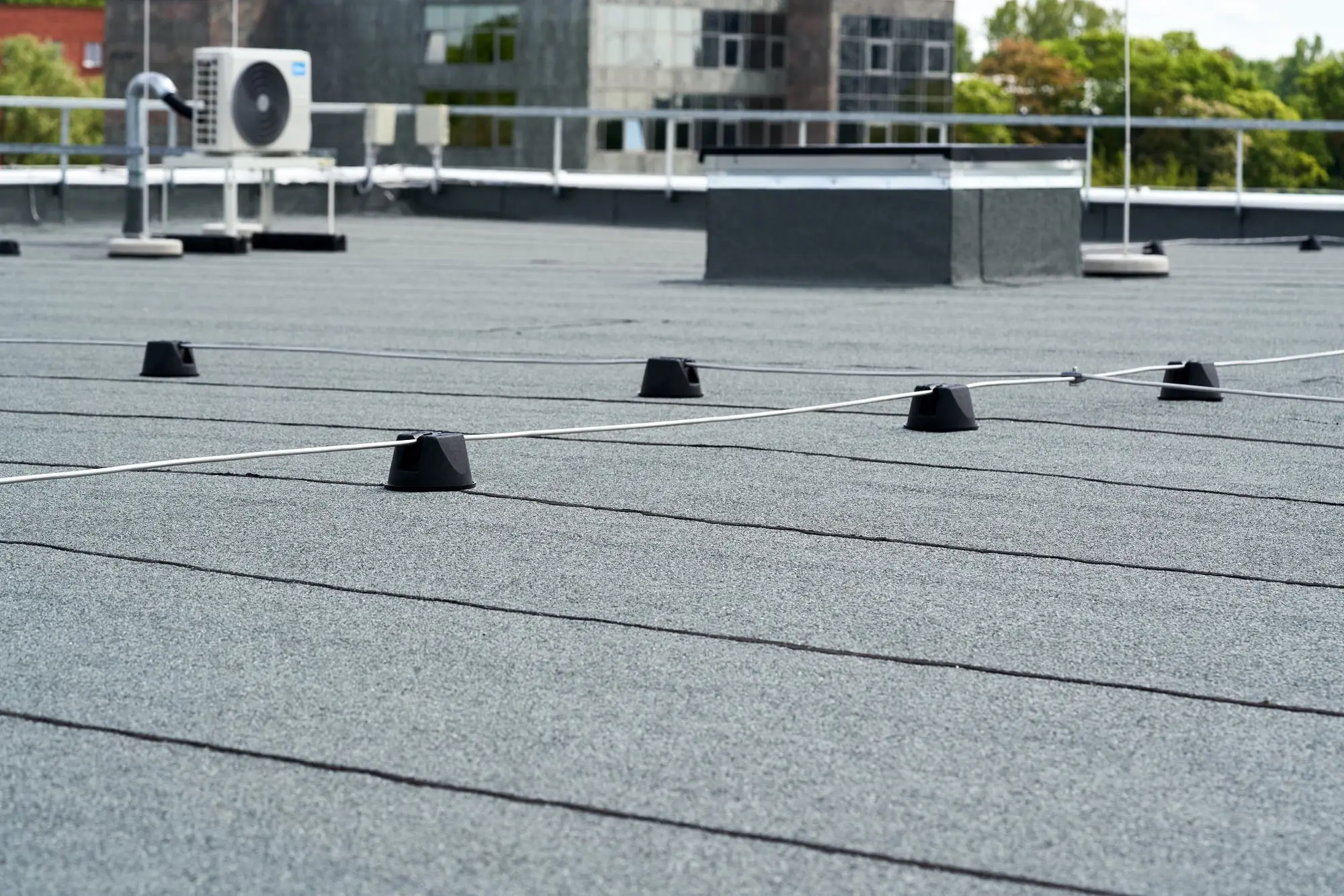
A good repair uses materials made for the roof you have. TPO seams get heat-welded. EPDM gets cleaned, primed and patched with EPDM tape or membrane. Older built-up roofs get repaired with compatible materials. Using the wrong product is one of the main reasons flat roof patches fail within a season.
The repair also covers whatever let the water in. That might mean new flashing at a wall, a new boot around a pipe, resealing a drain or replacing a section of membrane. If the insulation under the leak is wet, that section needs to be cut out and replaced. Leaving wet insulation in place keeps the leak alive even after the surface is sealed.
Ponding water: when it’s a problem
Some water after a storm is normal on a low-slope roof. Water that’s still there two or three days later isn’t. Standing water adds weight, wears seams faster and finds any small opening in the membrane.
Ponding usually comes from a sagging deck, compressed insulation or a blocked drain. Clearing a drain is a simple fix. Correcting a low spot may mean adding tapered insulation in that area during the repair.
Repair or replace?
A repair makes sense when the problem is at a few specific spots, the membrane is still flexible and the insulation is mostly dry. Replacement makes more sense when you’re chasing leaks every year, the membrane is brittle or shrinking, or a lot of the insulation is wet. If that’s your situation, our flat roof installation in Overland Park page explains how a new roof goes on. You’ll see photos either way and make the call yourself.
How it works
- Book your free inspection. Call 913-398-5020 or request a free estimate online.
- Get a clear, honest assessment and estimate. We trace the leak, check the insulation and look over the rest of the roof. You’ll get photos and a written estimate.
- The repair gets done and the site gets cleaned up. Old material and scraps leave with the crew.
A slow leak on a flat roof can soak insulation and decking well beyond the drip. The sooner it’s traced and fixed, the smaller the repair.
Flat roof repair questions
Can a flat roof be patched?
Yes, when the leak is at a seam, flashing, penetration or a small puncture and the area around it is dry. The patch has to match the membrane, or it won’t last.
How do I know if my flat roof needs to be replaced instead?
Leaks in different spots every year, a brittle or shrinking membrane, spongy spots and water ponding across large areas all point toward replacement.
Can you repair a flat roof in winter?
Many repairs can be done on dry days in cold weather. Some materials need warmer temperatures to bond, so a temporary repair may hold things until a full repair can be done.
Do you repair flat roofs on businesses?
Yes. For larger buildings, see our commercial roof repair in Overland Park page.
Book your flat roof repair inspection
You shouldn’t have to watch the ceiling every time it rains. Call 913-398-5020 or request your free estimate online, and we’ll come find the leak. To see every flat roof option, visit flat roofing in Overland Park.
Once the source is fixed, the ceiling stays dry through the next storm, and you can stop waiting for the drip.