Every summer afternoon the same thing happens. The sky opens up, water sheets off the edge of your roof, and it lands right where you don’t want it: on the front walk, in the flower beds, against the stucco and around the base of the house. Good gutters in Orlando fix that, but only if they’re sized and placed for the rain we actually get.
Maybe you have gutters that overflow, sag or drip at every corner. Maybe you have none at all, which is common on Central Florida homes. Either way, it’s hard to know whether you need a repair, a full set or just a couple of downspouts moved. You deserve a straight answer, not a sales pitch by the foot.
APC Roofing is a GAF Certified roofing contractor, licensed in Florida (CCC1337030) and insured. We install seamless gutters as part of the roof system, because the two work together. Your inspection and estimate are free. Call 407-270-1129.
What gutters in Orlando have to handle
A gutter’s job sounds simple: catch the water coming off the roof and send it somewhere harmless. In Central Florida, the stakes are mostly about what happens at ground level.
Orlando storms are short and heavy. Gutters aren’t sized for how much rain falls in a year. They’re sized for the hardest few minutes of a downpour, and a summer thunderstorm here can dump a lot of water in a very short time. A run that copes with a light shower can overflow in the first ten minutes of a real storm.
Without gutters, or with gutters that spill, that water digs trenches in sandy soil, splashes dirt and mildew up onto stucco walls, and pools along the foundation. Doorways and walkways take a waterfall every time it rains. Over the years, water that keeps running behind a gutter also soaks the fascia board it hangs from, and in Florida humidity that wood stays wet and starts to rot.
The gutter services we offer in Orlando
Different problems call for different work. Here’s how our gutter pages break it down:
- Gutter installation: new gutters for a home that doesn’t have them, or a full replacement of a system that’s failing.
- Seamless gutters: gutters formed in one continuous length for each run, so there are fewer joints to leak.
- Rain gutters: an overview of how a rain gutter system protects an Orlando home and what a good layout looks like.
What a well-designed gutter system looks like
Most gutter problems trace back to a few decisions made when the system went up.
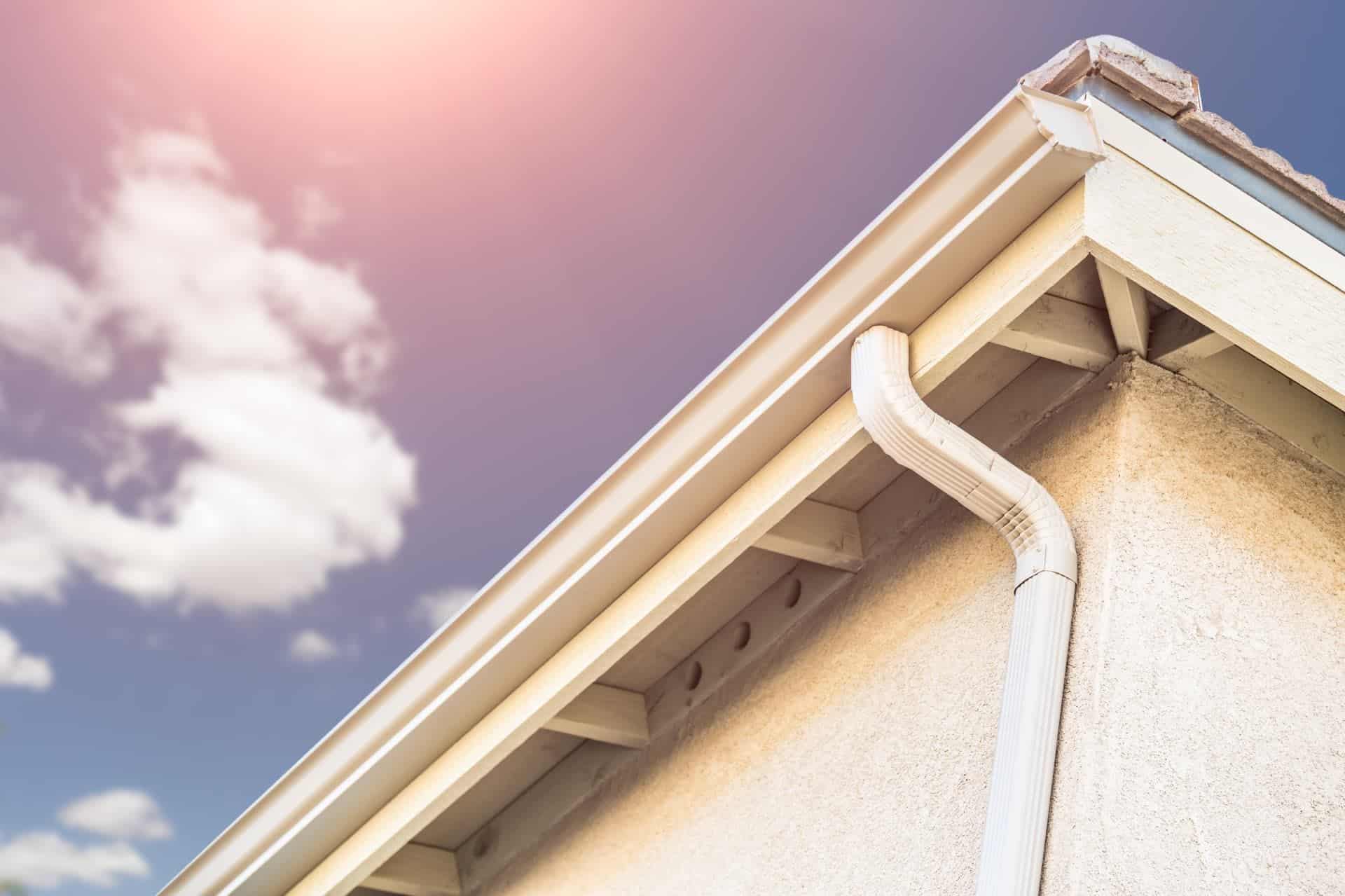
Size. The two common residential sizes are 5-inch and 6-inch K-style gutters. The 6-inch carries a lot more water. On a big or steep roof that empties into one run, that difference decides whether the gutter keeps up during a summer storm.
Downspouts. This is the part people forget to ask about. A larger downspout moves far more water than the small standard size, and adding one more outlet to a long run often does more than a bigger gutter would.
Slope. A gutter should fall gently toward its downspout, roughly a quarter inch every ten feet. Too flat and water sits in it. Too steep and it looks crooked from the street.
The roof edge. A strip of flashing called a gutter apron should run from under the roof’s edge down into the gutter. Without it, water can creep behind the gutter and stain or rot the fascia, even when the gutter itself is fine.
Where the water ends up. A downspout that dumps right at the wall just moves the problem. Extensions or a buried drain line carry water away from the foundation and out to a spot where it can soak in or drain off.
Gutters and hurricane season
High winds put real strain on gutters. A run that’s loosely attached, or hung on soft fascia, can pull away or fold in a storm. Hangers should be fastened into solid wood at close, even spacing.
Gutters also tell the story of a storm. After high winds or hail, dents and bends in the gutters can help show what the roof went through. If a storm damaged your roof and gutters, you file the claim with your insurance company and pay your own deductible. We document the damage with photos, write the estimate and work with your adjuster.
Your gutter project, step by step
- Book your free inspection. Call 407-270-1129 or request a free online estimate. We look at the roof edge, the fascia, the downspouts and where the water goes once it hits the ground.
- Get a clear, honest assessment and estimate. You’ll hear whether a repair will do or the system needs replacing, with the sizes and downspout locations spelled out. If the fascia is soft, you’ll see it and it’s priced as its own line. Financing is available through Aqua Finance, Fortifi, Hearth and Home Run Finance.
- Your gutters go up and the site gets cleaned up. The crew hangs the new system and cleans up the yard before leaving.
Gutter questions from Orlando homeowners
Do Florida homes really need gutters?
Many don’t come with them, and some homes get by fine. If water is pooling at the foundation, splashing up on walls, washing out beds or pouring onto doorways, gutters are worth it.
Should I replace my gutters when I get a new roof?
It’s a good time to look at them. The gutter apron and drip edge are installed with the roof, and old gutters often come down during the work anyway. Doing both together means the edge detail is done once and done right.
Can you fix just one bad section?
Often, yes. A leaking corner, a sagging stretch or a loose downspout can usually be repaired on its own. If the whole system is undersized or the fascia behind it is rotted, a repair won’t last.
Do gutters need to be cleaned in Florida?
Yes. Oak leaves, pine needles and shingle granules collect fast here. A clogged gutter overflows just like an undersized one.
Ignoring a gutter that spills over usually costs more later, in rotted fascia, stained walls and soil washed away from the foundation.
What you want is simple: rain that leaves your roof and ends up well away from your house, every storm. Call 407-270-1129 to book your free inspection.