
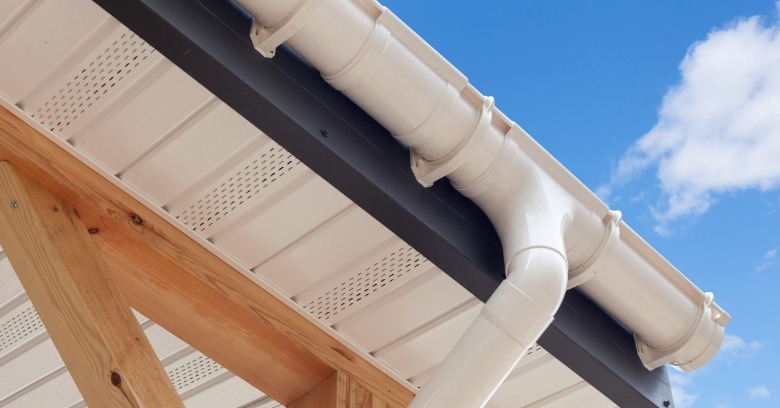
Searching for Rain Gutters in Ocala Florida?
APC Roofing plans, installs, and maintains gutter and downspout systems at Ocala Florida properties.
Phone 407-270-1129 and start with a measurement.
An Honest Rain Gutters Bid Starts With a Number – Not a Sales Pitch
Nearly every overwhelmed length of gutter that comes out for replacement throughout Ocala Florida failed for one reason: it was priced by the foot rather than sized to the area draining into it. A rainwater run is plumbing with a number attached, and that load comes from two figures: the roof area feeding it, and how hard it can rain.
The second of those catches most homeowners off guard. No one sizes a gutter from a twelve-month rainfall figure. The design tables – the ones every sheet-metal shop keeps on the wall – are keyed to the rate of the heaviest few minutes. A gutter run does not give up because the year was wet. It spills during the ten minutes a thunderstorm stalls above the street.
The distinction counts for a great deal in our service area. One end of our service area collects north of fifty inches in a typical year; the dry end of the map manages under twenty inches over the same year. It would be reasonable to assume the drier markets can get away with less gutter. That is not how it works. The intensity of a single hard cell is much closer across those markets than the yearly totals suggest.
The Two Figures That Determine What You Pay for Rain Gutters in Ocala Florida
The first is gutter size. The two sizes worth arguing about on a residence are a five-inch section and a six-inch one. The jump between them is not about looks: the larger profile moves around fifty percent more water than the five-inch. On a compact, shallow roof that margin is comfort. On a big, fast-shedding roof emptying into one run, the extra size is what stands between a dry wall and a waterfall.
The second is the outlet. This is the number people skip, and it is where the failures start. A 2x3 outlet – the common small section – is rated for about 600 square feet of roof area. Go to the larger rectangular profile and the capacity roughly doubles, to about twelve hundred square feet. A four-inch round section comes out close to the larger rectangular one. That is genuine capacity, and the price difference is small.
Take the two numbers together and the math is easy. Work out the area of roof shedding into each length, and count the outlets on the wall. If the answer says you need three downspouts and there is one on the house, no cleaning routine will make that run behave. That is a sizing failure, not a maintenance one.
Slope, Outlets, and Long Runs
A length of gutter does not sit level, though a good one looks like it is. The common working figure is roughly a quarter inch per ten feet of length. Installers differ anywhere from an eighth to a half inch in ten feet, but the intent does not change: enough fall to shift the water, little enough that the eye reads it as straight.
Not enough fall and water sits in the low spots. Water that sits is how a gutter dies: it collects grit, it sits on the joints, and it adds load to the run right where the run is weakest. Too much fall and the roofline looks off while the flow skips the drop when it really rains.
Run length is as important as the pitch. Somewhere beyond forty feet, the fix is a second outlet, not a deeper trough. Water heading down a long run comes to the outlet at a rate one opening cannot absorb, and the water goes over at whatever point the lip is lowest – frequently over the walkway, which is how most people find out.
What Holds It Up, and Why It Moves
The distance between hangers is one of a handful of things a homeowner can see without climbing anything. Supports should be no further apart than two to three feet. Up north in the territory we cover, tighter is better – eighteen inches or thereabouts – because ice and frozen snow pile above the rim and stay for weeks, while rainwater drains away in minutes.
The other thing that rarely comes up is expansion. A long aluminum run moves as the weather turns. Along a hundred feet of gutter and a full seasonal swing, the metal moves more than an inch. It has to be accounted for. A run with no allowance buckles, opens its seams, or tears its own brackets out given a few cycles. None of that is a problem with the metal. It is instead an installation choice that was never made.
Where the Roof Edge Meets the Gutter
Here is a fault worth naming that presents as a leaking gutter but has another cause entirely. Staining shows up on the woodwork at the edge, or runs down the face of the siding in the gap behind the gutter, while the gutter is perfectly sound. The reason is up at the drip line.
Standard drip edge is a folded metal strip that throws water clear of the deck. Where that is all there is, runoff can still curl back into the space behind the run simply by clinging to the metal. A gutter apron is the longer profile that runs past the deck and turns down inside the gutter. It removes the gap that let water get behind. On a steep roof throwing water hard, that detail decides the outcome.
Whatever is on the roof alters how the joint is made. A standard shingle roof is the simple case. Tile sits well above the deck, and the apron has to be worked in before the tile is set. Metal panel roofing lets go of its snow load in a single slide rather than losing it a little at a time, which is why holding the snow above the eave is part of the gutter conversation and not just a roofing one. Shallow and flat sections shift the geometry once more. APC Roofing works with all of those roof types, which is why we raise it.
Freezing Weather and the Cold End of the Roof
In the markets that see hard winters, this comes up every winter. And it happens to be the point most frequently explained backwards.
Ice at the eave is not something the gutter caused. It comes from heat finding its way into the roof from the house beneath. That heat thaws the snow up the slope; the melt runs down to the cold edge, where nothing underneath is heated, and freezes on the spot. Let that repeat for a few days and there is a ridge of ice at the edge, trapping the next thaw behind it.
The gutter is not the cause, but a frozen run is not innocent either. A run packed solid with ice gives that meltwater nowhere to go, and the backup gets worse. The straight answer, when someone asks whether new gutters will cure the ice, is that they do not. The remedy is sealing the air leaks and insulating. What drainage can do is give that water a route out so it does no further damage when the thaw comes. Anyone offering a new gutter as a cure for ice at the eave has told you something untrue.
What the Last Few Feet Decide
A perfectly sized system emptying at the base of the wall has moved the problem rather than dealt with it. It has picked up water from hundreds of square feet, drawn it together to a single outlet point, and placed it at the worst place available.
This is one of the few points where the code is explicit. Where the soil swells or gives way, water off the roof is required to go five feet or more from the foundation walls, or into an approved drainage system. Mark what the rule turns on: the ground, not the rain.
That difference explains why the market with the least rainfall of any we serve is exactly the market where what happens at ground level matters more than anywhere. Ground that expands when saturated and shrinks back as it dries will raise and settle a foundation over each wet and dry swing. The rain that causes it need not be plentiful. All it has to be is concentrated again and again at a single spot. A downspout that stops at the wall does precisely that.
A second code figure applies everywhere, whatever the soil: the grade must fall six inches at minimum across the first ten feet out from the foundation. That is the slope the downspout hands its water to. The best-built run emptying onto ground that falls the wrong way is fighting a losing battle. We take a look at the grade while we are measuring the roof – it is one problem, not two.
Why Cleaning Schedules Are Not One Size Fits All
What lands up there does not all behave alike, which is why a single fixed schedule fits few houses exactly. Roughly speaking, three things fill a gutter.
- The heavy stuff – leaves and woody bits. It lands over a few weeks, mostly sits on top, and lifts away cleanly. That is largely the material people picture when gutter cleaning is mentioned.
- Fine debris – needles, catkins, winged seeds, and flower drop. That is the load that gives trouble. It passes straight through the majority of guards, works down into the water that stands there, and sets into a sludge that rain will not move.
- Granule wash – the mineral granules coming off a shingle roof across the roof's service life. A modest amount is normal. A sudden increase in the grit collecting at the outlet is worth a phone call, because it is a roof-side signal rather than a gutter one.
Covers and screens are part of the answer, not a cure. They lower the cleaning frequency, which is worth having. Against that they narrow the opening for the water, and when the rain comes down hard a portion sheets past. The small stuff still gets underneath. Whether guards are right for your roof comes down to what is growing nearby, which is something we look at rather than guess.
The Options Below the Downspout
There are three workable ways to move discharge out beyond the wall, and they differ a good deal. The splash block is the least expensive and does the least. It softens the fall of the discharge and fans it out, but it takes it a very short distance. Where the ground tilts toward the house the discharge returns to the wall.
A surface extension is the sensible middle ground. It does not cost much, it can be lifted for mowing, and it takes the discharge well away from the wall. The catch is that you can see it, and anything underfoot gets knocked off and is then forgotten. We find more disconnected extensions than we ever do failed troughs.
An underground line is the lasting answer where it is justified: a rigid pipe run clear to somewhere the water can safely go at a good distance from the house. Nothing shows, nobody can knock it off, and it will outlast the gutters. The cost is that it can clog without any visible sign, and that is why an inspection point is put in at the outset and not added after the fact.
Fascia, Rafter Tails, and What We Find
A trough hangs from something, and that something is the fascia in most cases or the rafter tails behind the board. If a run has been overflowing or running down the back for years, the board is often soft by the time we take the old gutter down.
We would rather say so at the quote stage than uncover it part way through the job. A screw set into a soft board holds for a season before it lets go, typically under load – which is exactly when you need it to hold. Where the wood has rotted, we raise it, take you to it, and quote it as its own item so you can see what you are paying for.
Drainage on Low-Slope and Commercial Work
Not every building uses a gutter. Shallow and flat roof areas behave differently: the water is carried away by scupper, internal drain, or a tapered fall rather than over the roof edge. The questions to answer are the same, but the failures are easier to miss and much harder to spot early.
On a sloped roof a blocked gutter spills over and you see it. On a flat or low-slope roof a blocked outlet leaves the roof ponding, and water standing on a roof runs to tons in weight while nobody is looking. APC Roofing works on both, so that a building with a mix of the two gets one plan instead of two trades pointing at each other over the junction.
After a Storm
Damage from wind and hail to a roof gets noticed. The gutters below come last, when they are checked at all. That order is wrong for a couple of reasons.
One thing worth knowing – a run is frequently the clearest record of what actually hit the property. Dents in a metal trough show how big the hailstones were and which way they came. That is evidence an adjuster can use when the roof itself is difficult to read from below.
One more thing worth saying – a run shifted out of line keeps quiet about it. Nothing appears out of place from the driveway, and it drains well enough in the weather it usually sees. You learn of it in the next heavy burst, and that may be a full year later – by then possibly past the deadline for a claim. A look after the storm runs to a fraction of the repair that follows.
What to Look For From the Ground
Standing on the ground is enough to see most of these signs. Walk the outside of the house just after heavy rain, which is when the run tells you the truth.
- Water pouring over the front lip in a storm – a capacity, blockage, or pitch problem.
- Daylight between the run and the board behind it – spacing or fastener failure, frequently after a season of heavy loads.
- Staining on the fascia board with the run itself in good order – the flashing at the edge, not the run.
- Eroded ground or a splash pattern beneath an outlet – discharge too close to the wall.
- Water pooling at the base of the house long after the rain has passed – grading and discharge together.
- A dip in the middle of a length – water standing where it should not be, and it does not improve on its own.
The Spots That Overwhelm a Correctly Sized Run
The area figure by itself does not settle it, given that roofs do not hand the water over evenly. A roof valley brings two slopes together and drops the whole flow onto a short length of gutter. That section can be carrying many times the load of the lengths on either side, while looking identical.
This is why a gutter can spill at a single point in every storm while everything else behaves perfectly. The remedy is rarely a bigger gutter. It is a downspout set exactly at where the valley discharges, so the flow leaves the moment it arrives instead of running down the length of a gutter never intended to carry it.
Second-story roofs produce the same effect in a different form. An upper-level downspout emptying onto a lower slope is common, and it is frequently a bad arrangement. It puts a whole upper roof at one place of the lower covering, which strips the surface and then overwhelms the run serving the lower roof. Carrying the upper discharge straight to the ground clears both problems together.
How to Compare Two Estimates
If you are holding two estimates and one is lower, the price gap is usually not the contractor's margin. It is almost always a difference in materials and sizes that neither document puts in writing.
A quote you can trust should state the size of the gutter and what it is made of, the number and size of downspouts, which hangers and how often, the detail where the roof meets the gutter and who is paying for it, and where the discharge from each drop is carried at ground level. Five things. If an estimate leaves any of them blank, that is where the difference lies.
All five go on our quotes because they are the job. A price per foot with nothing behind it is a number, not a quote.
Scheduling, Access, and the Day Itself
The average job takes a day, two on a larger or more complicated property. The gutter is rolled at the house from a coil, cut to fit each run exactly, which is why the length carries no joints part way along. The corners, the drops, and the end caps remain joints, and they are the places where sealing counts.
The weather sets the timing more than anyone would like. The work calls for dry conditions – sealant has to cure and nobody belongs on a wet edge. We would sooner move a date than install in the rain and have you calling us back.
Getting to the work shapes the day. Tight clearance at the side, mature landscaping under the eaves, attached structures, and boundary lines all change how the work is staged. We look at that when we measure, rather than on the morning of the job.
What You Get When APC Roofing Quotes Rain Gutters in Ocala Florida
The first thing we do is measure the roof. The roof area on each run, the pitch, the run lengths, and where outlets can actually land – those figures set what the house needs. Everything after that – the choices you can see – is yours to settle knowing what the numbers require.
Because the roof and the drainage are both ours, the seam between roof and gutter gets designed rather than inherited. Asphalt, tile, metal, low-slope, commercial – every one changes the way the edge detail is made. None of that is something added later. It happens to be the beginning of the job.
Repair or replace is a judgment, and we will say which it is. A properly sized run with a damaged length or a bad hang is worth a repair. A run that was too small to begin with for the area it drains is not a repair at all. Cleaning it more often will not change the math.
Schedule Rain Gutters in Ocala Florida Priced From the Numbers
Call APC Roofing right away at 407-270-1129 and we will start with a measurement.
Slabs, Basements, and Crawl Spaces
One and the same fault costs very different amounts across different homes, and the difference is what sits below the ground floor.
A house built on a slab has no basement to fill. What goes wrong is less dramatic: moisture working beneath the edge of the slab, soil being carried out from below, and water coming up at the wall-floor junction in a room nobody associates with the roof.
A house over a crawl space hands the water a destination, and it takes it. Seepage through the wall, white salt marks on the block, a sump pump that keeps running much more than it should, and humidity carried up into the living space – every one of those begins at a downspout discharging too close.
Either way the repair belongs outside, and it is far cheaper than any of the repairs done after the water is already in.
Material Choices and What They Actually Buy You
Roll-formed aluminum is the usual choice, and deservedly so: rust is not a concern, it asks little of the hangers, and it can be rolled on site into one continuous length. Losing the joints means fewer places to fail. The trade is that it scratches and it moves as it warms and cools, which the installation has to handle.
Galvanized or coated steel is stiffer and takes a hit better, which matters in hail country, but the protective layer is the only thing keeping rust off, so it repays attention. Copper sits at the durable end and it looks the part. Vinyl gutter goes up cheaply and grows brittle in sun and cold. We are glad to talk through what makes sense for your roof without steering you to the expensive end.
Cleaning: How Often, and What Else Gets Checked
The twice-yearly figure is what gets repeated, and it is a fair starting point rather than a hard rule. The right interval depends on what grows above the roof. A roof under pine takes needle drop nearly year-round and will need clearing more often. A house with nothing overhanging can go a long time between visits.
The two-visit habit was inherited from colder climates, and it does not travel well. Semi-evergreen oaks across the southern end of our service area hold their leaves through winter and shed them in late winter as the new growth pushes. Somebody living under one who stops at a fall visit is getting the work done at the wrong point in the year and leaving it to fill through the heaviest drop of the year.
What we look at goes beyond clearing leaves. Outlet flow, sealant at the joints and end caps, hanger tightness, whether the pitch is still right, how the apron and drip edge are holding up, and what happens at ground level. What happens at ground level is the one most often skipped and the one most likely to be doing damage.
If you would sooner not keep track of it, that is what we are for. A run that gets looked over regularly generally lasts the life of the material. A run that is only checked once something has gone wrong seldom does.
To get started on Rain Gutters across Ocala Florida, phone APC Roofing right now at 407-270-1129. We take the roof measurement first and the quote follows the numbers.
Verified

Verified
Verified
Verified
Verified


















