
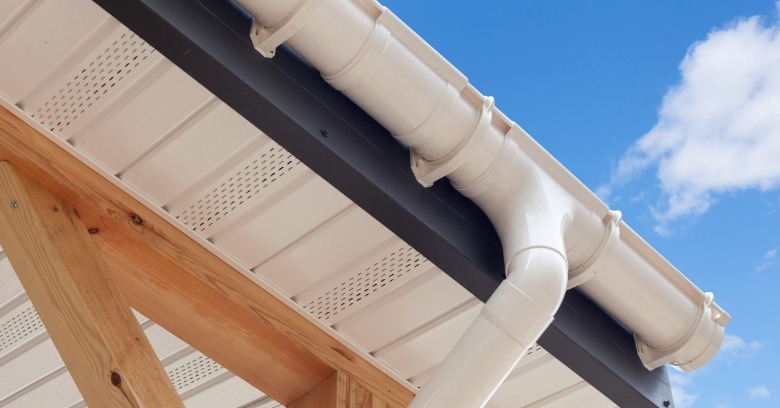
Shopping for Rain Gutters in Minneola Florida?
APC Roofing specifies, installs, and services gutter systems around Minneola Florida residences.
Call 407-270-1129 to get your roofline looked at.
Any Rain Gutters Proposal Begins With the Roof Area – Not a Price Sheet
Nearly every struggling rainwater system that has to come down throughout Minneola Florida failed for the same reason: it was sold by the foot instead of sized to the area draining into it. A rainwater system is a drain with a workload, and the volume it carries is decided by a pair of numbers: the roof area feeding it, and the worst few minutes of rain that roof will ever see.
That second figure catches most homeowners off guard. No one sizes a gutter from the total that falls in a year. The design tables – the ones every sheet-metal shop keeps on the wall – are keyed to the rate of the heaviest few minutes. A downspout will not overflow because of a wet year. It overflows in the ten minutes a downpour hangs over the roof.
That difference shows up plainly across the map we cover. One market on our list catches more than fifty inches of rain a year; a different market is left with under twenty inches over the same year. You might assume the low-rainfall markets need smaller gutters. The tables say otherwise. The heaviest burst moves much less than the annual figures imply.
The Pair of Numbers That Determine What You Pay for Rain Gutters in Minneola Florida
The first of them is the size of the gutter. The two choices you will see on a quote on a home are a five-inch section and a six-inch one. The jump between them is not about looks: the six-inch section carries about fifty percent more water than the narrower profile. On a small roof with little pitch that headroom is spare capacity. On a broad roof with real pitch dumping into one length, that extra capacity is the difference between coping and failing.
Number two is the outlet. This is the figure that gets skipped, and it is where the failures start. A 2x3 outlet – the one on most older houses – is rated for about six hundred square feet of roof area. Go to the larger rectangular profile and you get close to double, to nearer 1,200 square feet. The four-inch round downspout sits in similar territory. That is arithmetic, not sales talk, and it costs very little more.
Combine them and the calculation is plain. Measure the area of roof draining into each run, and then count your outlets. If the answer says three outlets are needed and only one is there, no cleaning schedule in the world will stop the overflow. That is a sizing failure, not poor upkeep.
Pitch, Outlets, and the Length of a Run
A length of gutter does not sit level, though a good one looks like it is. The usual rule of thumb is close to a quarter of an inch per ten feet of length. Trades vary from an eighth to a half inch per ten feet, but the principle holds: enough slope to keep the water moving, subtle enough that nobody notices.
Hang it flat and water sits in the low spots. Standing water is what kills a gutter: it collects grit, it works on the seams, and it adds load to the run right where the run is weakest. Pitch it too hard and the run looks wrong from the curb while water can run past the outlet when the rain comes hard.
The length of a run matters as much as pitch. Beyond roughly thirty-five to forty feet, you want a second downspout, not a bigger gutter. Water moving down a long length arrives at the bottom at a rate one opening cannot absorb, and the water goes over at the lowest point of the lip – commonly above an entry, which is how the problem announces itself.
What Holds It Up, and Why It Moves
The distance between hangers is one of the few details anyone can inspect without climbing anything. The supports belong no further than roughly three feet apart. Where winter loads the run, closer spacing is the right call – to around eighteen inches – because packed snow and ice mound above the rim and linger for weeks, where rain is gone within minutes.
The other thing nobody mentions is thermal movement. The aluminum moves through the seasons. On a long run through a full year of temperature change, the travel is more than an inch. That much has to be accounted for. A length with nowhere to move warps, opens a joint, or drags a hanger loose over a few seasons. This is not a problem with the metal. That is a detail somebody skipped.
The Detail That Decides Whether Water Gets Behind
There is a failure mode that reads as a leaking gutter but is not one. Water appears on the board behind the run, or tracks down the wall face at the back of the gutter line, and the trough itself is not leaking. The reason is up at the drip line.
Standard drip edge is a bent metal strip that throws water clear of the deck. Where no apron backs it up, runoff can still curl back behind the gutter on surface tension alone. A gutter apron flashing is the longer piece that carries over the edge and into the trough. It closes the gap the water was using. On a steep roof moving water in a hurry, the difference is plain.
The roof above the gutter alters how the joint is made. Asphalt shingle is the easy one. Concrete or clay tile is thicker and heavier, and the edge detail goes in ahead of the tile rather than after it. Metal panel roofing sheds a whole roof of snow at once instead of letting it melt away, and this is why keeping the snow up on the roof is a drainage decision as much as a roofing one. Shallow and flat sections behave differently once more. APC Roofing works with all of those roof types, which is why we raise it.
Ice at the Eave
In the colder markets we serve, this is the conversation. It is also the one most often turned on its head.
A dam of ice at the eave does not come from the gutter. The cause is heat leaking out through the roof from the rooms below. The escaping heat turns snow to water up the slope; the runoff travels down to the edge of the roof, with nothing warm below it, and sets as ice. Go around that cycle across several cold nights and there is a ridge of ice at the edge, holding water back behind it.
The gutter is not to blame, though a blocked run does not help. A run already frozen solid takes away the last route out, and the dam builds quicker. What we tell people, when someone asks whether new gutters will cure the ice, is that they will not. The remedy is insulation and stopping the air leaks. What a properly built system does is stop the meltwater before it causes a second round of damage when the weather turns. Anybody quoting a new run as a cure for ice at the eave has told you something untrue.
What the Last Few Feet Decide
A perfectly sized system that dumps hard against the foundation has shifted the problem rather than solved it. It has gathered water from hundreds of square feet, funneled it into a single stream, and dropped it at the worst spot on the property.
Here is one of the rare places where the building code sets an actual figure. Where the soil swells or gives way, discharge from the roof must be taken five feet or more from the foundation walls, or to a proper drainage arrangement. Mark what the rule turns on: it is the ground, not the weather.
That distinction is why the driest place we work is the one where what happens at ground level matters more than anywhere. Clay that swells once it is wet and shrinks back as it dries will lift and drop a foundation year after year. The rain behind it need not amount to much. It only has to be delivered time after time beside one wall. A short downspout does it every single storm.
One more code number applies to every house, not only the difficult ones: the ground itself has to drop half a foot inside the first ten feet out from the foundation. That is the slope the discharge lands on. A faultless gutter emptying onto ground that slopes back toward the house is undone before it begins. The ground gets checked on the same visit – it is the same problem.
What Ends Up in the Trough, and How Often
Not all debris behaves the same way, and so a single cleaning schedule suits nobody perfectly. Roughly speaking, three things fill a trough.
- The heavy stuff – whole leaves, twigs, and seed pods. It drops over a short season, tends to float, and clears easily. That is what comes to mind first when a gutter is called blocked.
- The soft load – litter from conifers and flowering trees. Here is the difficult one. It runs straight through the majority of guards, beds down in the low spots, and sets into a sludge that rain will not move.
- Roof granules – the mineral granules that wash off an asphalt shingle roof over the whole of the roof's life. A little of it is entirely normal. A sudden increase in what gathers at the downspout is worth telling us about, because it is a roof signal rather than a gutter one.
Gutter guards buy you something and cost you something. They cut down the number of times you go up, which has real value. In trade they shrink the opening that water must get through, and during an intense burst a portion sheets past. The small stuff still ends up underneath. Whether they make sense on your house depends on what is growing above the roof, which is something to check instead of guessing.
Extensions, Splash Blocks, and Buried Lines
In practice there are three common methods to get the discharge away from the foundation, and each comes with a drawback. The concrete or plastic splash block is the least expensive and does the least. It kills the force of the flow leaving the downspout and fans it out, but it takes it only a foot or two. Where the grade is poor the water ends up right where it started to the wall.
A hinged or roll-out extension sits between the two. The cost is small, it rolls back when you cut the grass, and it takes the discharge several feet out. The weakness is that it sits on the lawn, and anything on the surface gets knocked off and is left that way. We find more loose extensions than we do gutters that leak.
A buried pipe is the proper answer when the site calls for it: a continuous pipe taken out to an open outlet well away from the building. Nothing shows, nobody can knock it off, and it will outlast the gutters. The trade-off is that it can fill with silt without any visible sign, which is the reason an access point is part of the design rather than added later.
What a Gutter Job Sometimes Uncovers
A gutter hangs from something, and the thing it hangs from is generally the fascia or the rafter tails behind the board. Where water has been getting behind the run or tracking down the back over time, the wood behind is often soft when we pull the old system away.
We would rather flag it up front than turn it up once the crew is on site. A bracket set into a soft board lasts a season or two before it lets go, normally when the run is heaviest – and that is when you are counting on it. Where we find rot, we point it out, show you, and quote it as its own item so you can see what you are paying for.
Low-Slope Work and Larger Drainage
Not every roof we are asked about sheds at an eave. Shallow and flat roof areas work another way: the water leaves by parapet openings, internal drains, or a built-in fall rather than over the roof edge. The design problems stay the same, but what goes wrong is less visible and considerably less forgiving.
On an ordinary sloped roof a blocked run overflows and you see it. On a low-slope roof a drain that has blocked leaves water standing, and standing water runs to tons in weight before anybody notices. APC Roofing works on both, so that a property with a bit of each gets one plan instead of two trades arguing about the junction.
Storm Damage and the Drainage Below It
Weather damage to a roof gets noticed. The gutters underneath are checked last, if they are checked at all. That is backwards on two counts.
Something worth saying – the gutter is often the plainest evidence of what the weather did. Impact marks in the metal are sized and directional. That is a record an adjuster can use where the roof itself is harder to read from the ground.
Another point worth making – a run knocked out of true says nothing. Nothing appears out of place from the ground, and it does its job through everyday weather. The problem shows up in the next heavy burst, and that could be months later – sometimes past the deadline for a claim. A look while it is fresh is a fraction of the bill that follows a late discovery.
What You Can See From the Yard
You do not need a ladder to spot most of these. Take your time and walk around in the middle of a downpour, which is when a run shows you what it is doing.
- Water pouring over the front lip in heavy rain – a capacity, blockage, or pitch problem.
- A gap opening between the gutter and the fascia – hanger spacing or fasteners, commonly after ice or a debris load.
- Paint lifting on the fascia while the run itself is sound – a missing apron, nothing to do with size.
- A washed line or bare earth below a drop – water landing too near the wall.
- Ponding up against the wall hours after the rain stops – grade and discharge together.
- A run with a belly in it – weight the hangers were never meant to take, and it accelerates.
The Spots That Overwhelm a Correctly Sized Run
Roof area alone only gets you part of the way, since roofs do not hand the water over evenly. A roof valley takes runoff from two planes and delivers all of it onto a few feet of gutter. That section can be carrying several times the flow of the rest of the run, though nothing about it looks different.
That is the reason a run can overflow at a single point every time it rains hard while the remainder stays dry. The right move is not usually more profile. It is a downspout positioned at or close to where the water arrives, so the flow exits right where it lands rather than traveling along a trough that was not built for that load.
Upper roof sections throw up the same problem by another route. A downspout off a higher roof emptying onto the roof below is seen often, and it is regularly the wrong arrangement. It concentrates a whole upper roof onto one point of the lower covering, which strips the surface and then overwhelms the gutter system serving the lower roof. Taking the upper downspout past the lower roof entirely clears both problems together.
What a Real Quote Should Tell You
Once you have a couple of quotes and one is cheaper, the difference is rarely one company charging more for the same thing. It is very nearly always a specification difference that neither document sets out clearly.
An estimate worth reading tells you the profile size and what it is made of, the number and size of downspouts, the hangers and how far apart they go, whether an apron or drip edge is specified and whether it is in the price, and where the rainwater ends up after it leaves the downspout. Those five items. Where a quote says nothing about one of them, that is the difference.
All five appear on the estimate because that is the work. A price per foot with nothing behind it is only a number, not a specification.
Scheduling, Access, and the Day Itself
The average job is done in a day, two where the house is large or awkward. The trough is roll-formed at the house from a coil of metal, cut exactly to fit, and that is why the length carries no joints along the way. The corners, the drops, and the end caps are joints all the same, and those are where care is needed.
Weather sets the schedule more than anybody would choose. The install needs dry conditions – sealant has to cure and nobody ought to be on a wet roof edge. We would sooner move a booking than hurry it in bad weather and have you calling us back.
Getting at the work affects the day too. Narrow side passages, shrubs and beds under the eave line, attached structures, and neighbors' boundaries all change the way the work is staged. We check that at the measuring visit, rather than on the morning of the job.
What It Means When APC Roofing Tackles Rain Gutters in Minneola Florida
We measure the roof before quoting the gutter. The area feeding each run, roof pitch, how long each run has to be, and where the downspouts can actually go – those figures give us a specification. All that follows – the visible choices – is a choice you get to make against a known requirement.
Because we work on the roof as well, the detail where roof and gutter meet is drawn, not guessed. Shingle, tile, metal, flat, commercial – every one changes the way the edge detail is made. None of that is something we bolt on later. That is the first thing we settle.
Fixing or replacing is a real judgment call, and we will say which one applies. A correctly sized system with one bad length or a hanging fault is worth a repair. A run that never had the capacity for the area draining into it cannot be repaired into a working system. More frequent clearing will not change the arithmetic.
Book Rain Gutters in Minneola Florida Without the Guesswork
Phone APC Roofing right now at 407-270-1129 for a clear look at your roofline.
Slabs, Basements, and Crawl Spaces
The same shortfall in drainage costs very different amounts across different homes, and what decides it is what sits below the ground floor.
A house built on a slab has nothing underneath to flood. What actually happens is more hidden: moisture working beneath the edge of the slab, soil washing away underneath, and dampness coming up through the floor far from where it came in.
A house with a basement or crawl space gives the water somewhere to go, and it will find it. Wall seepage, efflorescence on the block, the sump pump cycling more often than it ought to, and moisture pulled up into the living space – every one of those begins at a single downspout that stops at the foundation.
Whichever it is the remedy is outside, and it is far cheaper than any cure done after the water is already in.
What the Trough Is Made Of
Roll-formed aluminum is the default on most homes, and for good reason: rust is not an issue, it is light enough to be kind to the hangers, and it can be rolled on site in one unbroken length. Taking the joints out means fewer places for a leak to start. The trade is that it scratches and it moves as the temperature changes, which the install has to allow for.
Galvanized or coated steel is stronger and resists damage, which matters in hail country, though the coating is what stands between it and rust, so it needs looking after. A copper system is the long-life choice and it carries a premium. Plastic is inexpensive to install and becomes brittle with sun and cold. We are happy to go through what suits your roof and your market without selling you more than you need.
Cleaning: How Often, and What Else Gets Checked
Spring and fall is the usual advice, and it is a fair place to start and not an answer in itself. The correct interval comes down to the trees over the house. A roof beneath conifers takes needle drop most of the year and will need clearing more often. A house with nothing overhanging may go considerably longer.
The twice-yearly habit was borrowed from colder places, and it fits some markets poorly. Live oaks in the southern part of our territory hold their leaves through winter and drop them just as spring starts. Anyone with one of those over the house who cleans in October and forgets about it is having the gutter cleared just before the quiet months and leaving it packed through the year's heaviest drop.
What we actually check is not only whether it is clear. Whether the outlets are moving water, sealant at the joints and end caps, the fasteners, whether the pitch is still right, the state of the edge flashing, and where that water finally lands. The last of those is the thing most often skipped and equally the one most likely to be doing real damage.
If you would rather not think about it at all, that is the service. A gutter inspected on a sensible schedule tends to last as long as the metal allows. A gutter only looked at after the damage is done does not.
To get moving on Rain Gutters throughout Minneola Florida, phone APC Roofing at 407-270-1129. We take the roof measurement first and quote from the numbers.
Verified

Verified
Verified
Verified
Verified


















