Considering Standing Seam Metal Roofing Across Lee's Summit Missouri?
APC Roofing builds and maintains coverings made of coated sheet and aluminum, across homes as well as sheds and barns.
Dial 913-398-5020 and a roofer will come out and describe what the metal shows.
Which System Is Up There: Visible Clues
Screw-down panels, corrugated or ribbed, are fastened with screws through the exposed metal, whereas standing seam hangs on clips hidden under tall ribs. Steel with a protective coating covers most houses that have metal, and aluminum and copper are less frequent choices.
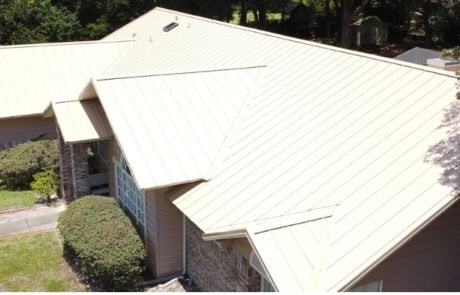
From a driveway, lines of screw heads across the panels mark a through-fastened roof, and clean flats between raised joints, bare of hardware, belong to standing seam. Corrugated sheet is a regular choice on barns, shops and porches, though a house can suit either.
Shapes Rolled Into Steel – Span and Style
Corrugated sheet ripples in smooth, repeating curves, while ribbed designs show angular ribs and wide flats. Neighboring sheets overlap at a side edge by a single crest, and every screw lands where a maker's layout calls for.
Ribbed stock is stiffer and spans further between supports, and corrugated remains popular for a traditional farm look. Rib height governs how much water a long slope can move, while a low pattern handles short runs like a porch or lean-to.
Fasteners in the Open: Every Detail Counts
Every screw draws a panel down onto a support, while a washer at each head keeps rain from following a shank. Rubber in steady sunlight hardens and cracks with age, and the panels can go on for decades more.
An overdriven screw squashes a washer flat, while an underdriven or tilted fastener never seals all the way around.
Hardware Swaps: Worth Doing, With Limits
Every washer across a ribbed or corrugated field weathers at the same rate, so eventually a full new set of seals is needed. Tired fasteners are pulled one by one, and a bigger diameter is driven in to grip where an old thread stripped.
Re-fastening stops water at every head and holds down sheets that lift, but rust damage, open laps and failed flashing are untouched. Screw length and thread are chosen for what sits below, wood or a steel purlin, and color-matched tops blend in with a painted finish.
A Covering in Motion: Why Slack Matters
Sunshine stretches steel slightly and a chilly night pulls the metal back, and forty feet of panel shifts roughly a quarter inch or more, and aluminum reaches about double. A panel pinned at both ends slowly slots every screw opening, and seals start to fail.
Ticking heard as morning sun lands on steel is ordinary expansion, and a careful installation suffers no damage.
Anchoring Standing Seam: Out of the Weather
Every lengthy pan is secured firmly in only one zone, while floating clips elsewhere allow the pan to slide. Trim at an end that travels is bent with clearance underneath, and a pan held rigid throughout tears loose or buckles.
Each pan is set in place, and clips are driven through into the deck along one side, so each new pan conceals all hardware below.
Quick-Fit or Heavy-Duty – Suited to Pitch
A basic profile engages with a firm push along a full length, while machine-rolled designs get folded over by a motorized seamer. A double-lock grips harder against wind-driven rain, and approvals extend to flatter roofs.
Every product line has distinct spacing and rib size, and a home's design and a buyer's taste guide selection. Clips, trim and closures are bought to suit one particular panel, so parts are not mixed between makers.
Choosing a Weight: Dents and Ripples
A steel panel is rated by gauge, and numbers fall as sheet gets thicker. A shop or barn frequently has twenty-nine, while houses often take twenty-six or twenty-four.
Aluminum uses decimal figures rather than gauge, and more material means fewer marks and less waviness. A light grade and a heavy grade are indistinguishable from a driveway, so a product data sheet is a reliable guide.
Factory Protection: What Lasts
Roofing steel leaves a mill with a zinc or aluminum-zinc layer over plain sheet, and baked-on primer and color follow. Scrapes confined to paint are harmless, but a sheared edge exposes steel that will corrode.
PVDF finishes hold color for decades, but silicone-modified polyester goes dull and powdery earlier. Wet masonry corrodes aluminum-zinc coated sheet, so panels are kept away from a new chimney or stone wall.
Base Material: Matching a Location
Aluminum carries less weight and does not redden, but softness means a heavier grade for equal toughness. At the coastal end of our territory, salt spray breaks down galvanized coatings faster, so a marine-rated system often goes up near a beach.
A copper accent over a bay window is a familiar touch, and the metal weathers to a natural patina with no paint.
Mixing Metals – Isolation and Compatibility
Runoff from copper eats through coated steel downhill, and staining shows up well ahead of pinholes. Aluminum on pressure-treated boards turns white and pits, and a mismatched fastener rusts quickly.
Flashing added later should match whatever metal is already installed, or a strip of membrane goes between dissimilar metals.
A Matter of Taste – Surface, Not Structure
Oil canning is a gentle waviness across the flat of a standing seam pan, and a midday sun hides what a low evening sun reveals. A slightly distorted pan sheds rain like any other, and the roof ages no faster.
Thicker metal, a slimmer width and striations rolled into every pan tame rippling, and an installer who does not overdrive clips helps as well. Photos of finished roofs give a fair idea of how much oil canning shows, and the final pick is yours.
Indoor Comfort – Day and Night
A shed with bare purlins under the panels rings like a drum, because nothing there soaks up impact. A home has sheathing, a membrane and an insulated ceiling under steel panels, and indoors, few people notice more noise than under asphalt.
Cool-pigment coatings return the bulk of the sunshine, and the attic beneath stays cooler on a summer afternoon. A charcoal or black panel gets hot, and airflow and insulation lower down count just as much. Thin steel cools off right after dusk, so evenings indoors feel better sooner.
Holding a Load Up There – Clamped or Fastened
At the colder end of our territory, snow slides readily off smooth coated steel, and a single release can take out a gutter or strike someone nearby. Guards set along a roof hold a load in place until a thaw, and hardware sits over entries, paths and meters.
Standing seam takes clamp-on brackets that grip each rib without piercing the metal, while exposed-fastener sheet takes mounts screwed into framing, and at the warm end of our range snow gear is unnecessary.
Pounding From the Sky – A Record of What Happened
At the colder end of our range, hail arrives most years, and panels with an impact rating are an option. Paint knocked off at a crease leaves base metal exposed to corrosion, while a seam or trim edge pushed out of line may open.
After a storm, we photograph and measure what we find, so the extent of damage is clear.
Storm-Ready Attachment: Layout Matters
Corners and borders see heavy suction, an open field much less, and air that gets under a loose edge can peel a sheet back. Trim along every outer line is hemmed and hooked onto a continuous cleat, and nothing is left free to flap.
Screw and clip spacing tightens at corners and around a perimeter, set by a maker's tested layout for each exposure. At the coastal end of our territory, hurricane country asks for more holding power still, and products are chosen with a wind rating to match.
Vents and Stacks: Detail Work
A pliable-based collar is shaped to fit a panel and clamped onto a pipe, and a level stretch, not a peak, is chosen for a hole. A bigger penetration is framed with a curb and a small cricket upslope, so runoff is steered aside.
Sealant backs up flashing and never stands in for folded metal, as ultraviolet light turns soft compounds brittle in a few seasons.
Changes of Direction – No Screws in the Water
Each valley gets a separate pan in advance of the panels, and panels are sheared to a matching slant. Exposed ends are bent back and gripped by cleats, so no fastener sits where water collects.
A sealed endlap connects consecutive lengths on an extended run, and uphill metal always goes on top, screwed through.
Limits Near Flat: Where Membrane Takes Over
Most ribbed sheet is specified for about three in twelve or steeper, since anything less lets rain back up at overlaps. Machine-folded seams go much lower, and some products are allowed on nearly flat decks.
Many homes have a gentle stretch over a porch or a later addition, and each incline is measured on site, and a part too low for any panel gets a membrane instead.
Under Everything – Out of Sight Once Done
Residential panels are laid on a solid deck, and a high-temperature underlayment sits beneath the panels, because old felt bakes and sticks under hot steel. Sheds and barns often fasten directly to purlins, and distance between supports sets a minimum gauge.
On a tear-off, soft or rotted boards are cut out and replaced, because screws in decay have nothing to grip.
Leaving the Old Roof in Place – Battens and Underlayment
Where code allows, metal can be installed over one layer of shingles, and the mess and hauling of removal are avoided. Steel panels weigh well under two pounds per square foot, and ordinary framing copes without trouble. Battens over a fresh membrane go across existing shingles, and screws reach through into solid wood.
A roof that was recovered once before, or a deck with decay underneath, comes off entirely, because a problem covered with steel keeps growing out of sight.
Completing the Job: Done Properly
Strips cut to match a profile close off space under each rib at high and low points, and driving rain and wasps are blocked. A cap along a peak comes vented or solid, according to how an attic sheds heat and moisture.
Gutter aprons and rake trim wrap up a roof's outline, and runoff is steered clear of a fascia board.
Working at Height – Sheet by Sheet
Standing seam is produced to fit each run from bottom to top, and no cross joint interrupts runoff. A long panel calls for several people spaced along the metal, and a crimped or creased pan is no longer usable.
Weight should go only into pans over framing, as a seam under a boot can bend open. Moisture turns a painted panel into a slide, and nobody without a harness should go up.
What Homeowners Can Spot: Plain to See
- Orange halos at fasteners, partway down a pitch.
- Loose screws riding high, on a south exposure.
- Trim bent up at a corner, over a front door.
- A flue collar sitting crooked, on a back slope.
- Corrosion along a cut, next to a skylight.
- Uneven fading, on a sunny slope.
- Water marks lined up on drywall, down a hallway.
- An endlap gaping, at the low end of a panel.
How APC Roofing Approaches Standing Seam Metal Roofing in Lee's Summit Missouri – Our Method
We start by identifying which panel type is installed and how the panels are held, followed by every screw or clip, edge, boot, valley and lap. We note thickness, coating and hardware along the way, and the attic is searched for water marks.
Findings come to you in a report with pictures, and each repair is explained. A sound covering is called sound, and a roof past saving is described plainly.
Standing Seam Metal Roofing in Lee's Summit Missouri: A Careful Look
Call 913-398-5020 and we will book a day that suits you.
Deciding on Scope: Guided by Evidence
A panel torn by a falling limb can be changed individually, though new metal looks brighter than weathered neighbors. A new pipe boot or a resealed lap ends a local drip, and a full set of screws fixes tired rubber.
When corrosion has gone through across a whole field, a tear-off is due, and a covering riddled with failed seams is no better off. Redoing one face of the house is a middle path, provided trouble goes no further.
Longevity – Exposed Screws Versus Hidden Clips
Properly installed panels regularly reach forty years, but estimates of service are a rough guide only. Standing seam, with no holes through a pan, gets by on less maintenance, whereas screw-down sheet has washers changed out at some point.
Mixed metals, raw cut edges and caulk doing the job of flashing all shorten a roof's service, and a periodic look finds problems while minor. Piles of leaves behind a chimney keep a patch of metal damp for days, so clearing debris away helps paint last.
For a roofer's view on Standing Seam Metal Roofing in Lee's Summit Missouri, call APC Roofing at 913-398-5020. Every screw or clip, edge and boot gets a close look, and findings come to you written up, with any choice left to you.
Verified

Verified