Weighing Architectural Shingle Roofing Throughout Kissimmee Florida?
APC Roofing re-covers slopes with laminated or flat strip products for homes of every age and size.
Call 407-270-1129 and a visit will show what condition everything is in.
Components and Construction – Raw Ingredients
Strength in a shingle comes from a glass-fiber mat, while the asphalt in the sheet makes it waterproof, and granules rolled into the surface shade everything beneath from ultraviolet rays.
Two lines that appear matched may be put together quite differently, and a heavier build generally adds years on a house. Hue is all a sample chip can show, while published data covers the wind and impact classes.
Comparing the Styles – Setting Them Apart
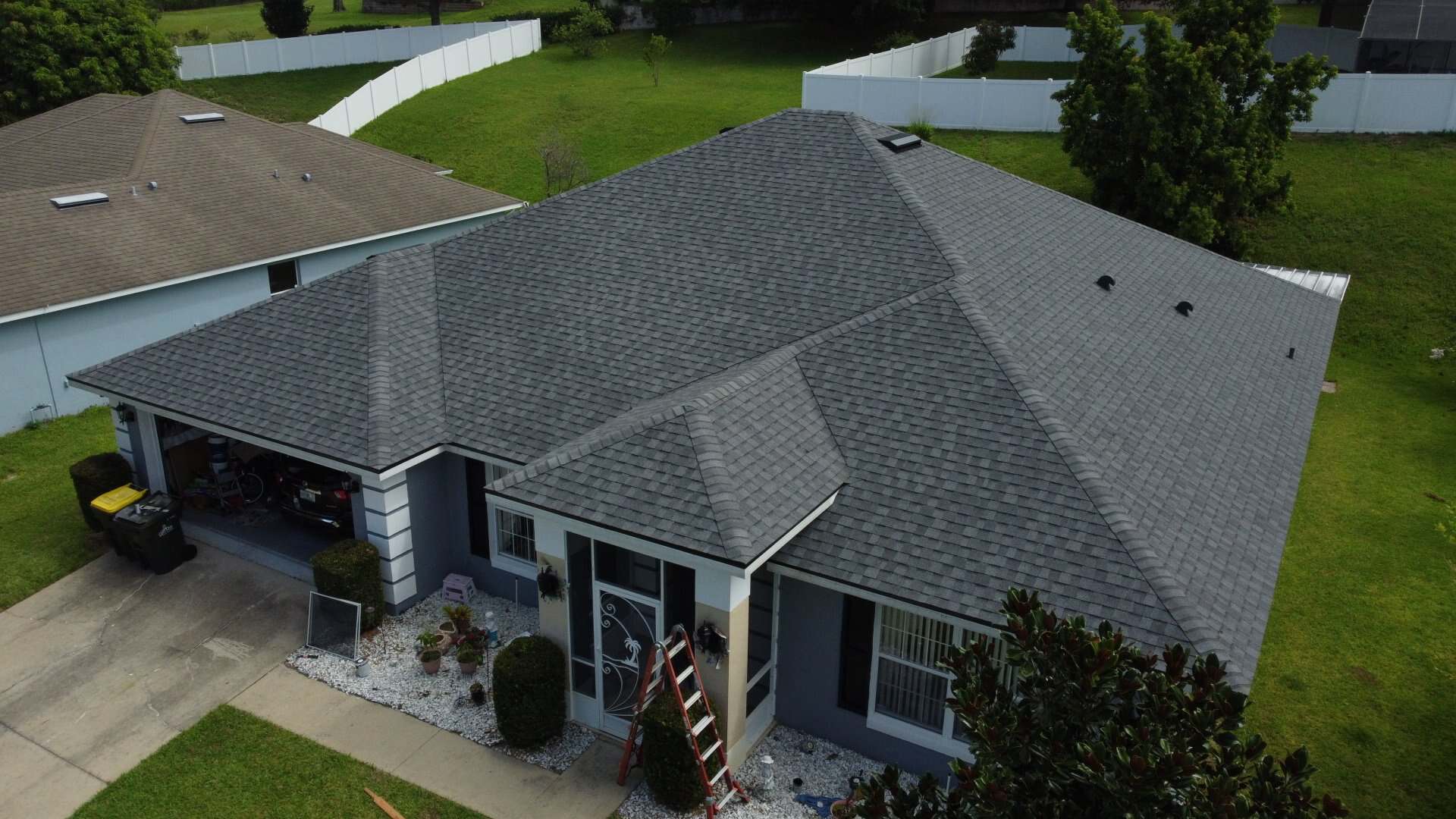
A three-tab shingle is one thin layer with two slots cut into its lower half, and courses laid this way form tidy straight bands. Architectural shingles are built as a base with a second, trimmed ply fused on top, and the offset design reads as depth from the street.
A laminated bundle holds considerably more asphalt than a strip bundle, and listed wind classes are generally higher. Nailing on a two-ply shingle aims at the strip where the plies are joined, and the maker marks the correct spot on each piece.
The Case for Strip Shingles – A Smaller Selection
Outbuildings and porches are frequent homes for three-tab, and a patch can match the rest of an older house. Many manufacturers have narrowed their ranges of that style, so an exact replacement can be hard to find.
Textured shingles mask slight waves in the boards beneath, while single-ply rows show every ripple. Either style is laid over identical underlayment and metal details, while the shingle alone sets the two apart.
Loose Grit – Early and Late Stages
Some surplus grains rinse off a recently installed covering, and the amount tapers off quickly. Thick deposits of grit below an old covering show that its surface is worn, and the naked asphalt goes on to crack.
South- and west-facing planes bake the longest each afternoon, so the damage is usually heaviest on them.
The Factory Sealant Band: Resisting Uplift
A shingle comes from the plant with a glue stripe already applied, and heat from sunshine turns it tacky enough to grip the row above. A stuck course stands up to gusts that would otherwise flip its edge, and nailing still carries the load year after year.
At the colder end of our territory, shingles laid in late fall may not seal for weeks, and strong wind may raise tabs in the meantime. Manufacturers’ instructions call for dabs of roofing cement in that situation, and a drawing on each wrapper gives the amount and location.
Holding Pieces Down: Tools and Technique
Roofing nails go into a narrow band marked by the manufacturer, where the shank also catches the headlap of the row below. Four fasteners per shingle meets the basic requirement, and high-wind or steep work moves the number to six.
A nail set too high misses the row underneath, a head pounded too far breaks the mat, and a slanted shank lifts the shingle laid over it. Every wind rating on a wrapper presumes the pattern was met, while one misadjusted compressor can spoil every drive on a job.
The Structural Base – Older Houses
Shingles are fastened to a deck of plywood or OSB, and each shank has to land in solid material. Homes that once wore wood shakes may still have spaced slats up top, so a layer of sheathing comes before shingles.
During a tear-off, weak or water-damaged pieces are swapped for sound ones, since a nail in punky fibers pulls loose. Adjacent sheets are spaced slightly apart at their edges, as boards butted tightly lift into ridges when they absorb moisture.
The Secondary Layer: Modern Options
Building rules in most places require a water-resistant membrane over the deck, and it goes down in horizontal runs that lap downhill. Synthetic material has taken over from traditional felt on most jobs, because the replacement is lighter to carry and harder to rip.
Moisture that sneaks beneath a shingle is carried off by the membrane, though sunlight breaks it down if it stays exposed too long.
Membrane at the Eaves – How Far Up
At the colder end of our territory, a heated attic thaws rooftop snow, and the meltwater refreezes at the unheated lower margin. Pooled water behind the obstruction travels uphill under the courses, and nails through ordinary underlayment give it an easy path.
Colder-market codes call for a peel-and-stick membrane along the lower edge, and it continues until it passes the wall line inside the house. In all of our territory, installers also lay it in valleys and around penetrations, as water collects and lingers there.
Border Protection – A Code Item
Formed metal strips line the eaves and rakes of every slope, so rain falls free beyond the woodwork. The underlayment covers the lower flashing, and at the gable ends that sequence is reversed.
Current codes in many places make edge metal mandatory along every border of a shingled plane, since rain creeps back onto the decking where nothing guards it.
Beginning at the Gutter: A Common Shortcut
A starter strip goes down beneath the first visible course, and it places sealant right at the drip line. A reversed field piece puts its sticky band too far up, so nothing but nails holds the lowest border down.
The sloped gable edges frequently get starter strips too, because suction acts along the outer rims.
Junctions of Adjoining Planes – Keeping Nails Clear
In an open design, a formed metal liner carries water down the valley, while the closed-cut type runs shingles from one side across and trims the other side along a chalk line. A woven junction interlaces rows from both planes, which works with three-tab, but most laminated shingles are too stiff for that.
Installers keep nails several inches back from the centerline, while a self-sealing sheet runs beneath from top to bottom. A mat of leaves lodged in a valley traps water and grime, which can push rain beneath the trimmed shingles.
Tie-Ins to the Structure – Frequent Leak Points
Step flashing along a wall is set one to a course, and the exterior finish hangs down across the standing half. Where the eave stops against the house, a kickout diverter goes in, because otherwise rain soaks the framing.
The flashing around a chimney is an apron below, steps on each side and counterflashing embedded in mortar, and a wide stack also needs a cricket upslope to split the flow.
Roof Penetrations – Sequence and Laps
A typical boot is a metal or plastic plate carrying a flexible collar that grips the pipe, and ultraviolet exposure dries the gasket out and cracks it. Courses above lap over the flange’s top edge, and the exposed foot lets water pass over rather than behind.
Neoprene collars regularly fail well before the field shingles do, so new boots come with every new covering.
The Topmost Seams: Cold and Cracking
The ridge and every hip are closed with cap shingles, and a dimensional line comes with its own heavier companion product. Tabs sliced out of flat strips are far thinner, and at the colder end of our territory a freeze can open splits along the bend.
Many peaks hide an exhaust vent under the cap row, and nail length is chosen to pass that gap and grip the boards.
Circulation Upstairs: Balance
Air should be drawn in along the eaves through soffit openings, while a slot along the ridge lets it rise and exit. Batts pushed hard against the sheathing at the wall line can block movement, so a baffle in each rafter bay keeps the way clear.
A stuffy attic adds heat beneath the deck, and moisture from the living areas lingers up there. On frigid nights at the colder end of our territory, condensation freezes on the nail tips, and the melt drips down when the sun comes out. A powered fan or gable vents alongside a ridge vent can scramble the pattern, so the lower part of the space goes stagnant.
One Product Everywhere: Algae and Hard Winters
Our service area stretches from high plains to subtropical towns, so the forces working on a shingle change from city to city. At the coastal end of our territory, hurricanes bring hours of sustained wind, and makers publish a tougher fastening pattern for that exposure. Strong sun, season after season, makes the coating brittle, while damp air in the humid markets feeds algae.
At the colder end of our territory, water that seeps into a crack freezes and widens it, while deep snow loads the deck for weeks.
Pelting From Above: Lab Testing
At the colder end of our territory, hail is a familiar part of the storm calendar, so shingles designed to resist impact are widely sold. A single stone can leave a dark circle where the granules came off, and a heavy blow may fracture the fiberglass below.
Laboratories rate impact resistance by dropping steel balls from set heights, and a higher grade means passing a tougher trial. Some companies add rubber polymers to the asphalt, and the extra give absorbs part of each blow.
Strong Gusts – Putting Things Right
Uplift concentrates at the outer margins and the corners, so a piece with a failed bond begins to lift and drop. A tab flipped over by a gust carries a scar across it afterward, and the mat never regains its strength along that line. A shingle in that condition gets replaced, but one that lifted cleanly can be stuck back down.
An empty spot in the courses puts the underlayment in direct sun, and daylight starts breaking it down at once.
Living Things Up Top – Cleaning Without Harm
The inky bands seen on so many houses come from algae, which survives by feeding on limestone filler. Growth spreads quickest on shady faces at the humid end of our territory, but the streaking by itself is largely about looks.
Moss is a different matter, since it holds water against the surface, and as it creeps it breaks the tabs’ seal. High-pressure spraying rips the grit away with the growth, while a soft rinse with a roof-safe cleaner does the job without damage. Copper-bearing mineral is blended into algae-resistant lines, while a strip of zinc at the ridge helps keep the stains from returning.
Picking a Hue: Mixing Bundles
A black or charcoal covering absorbs more of the sun’s energy, and lighter shingles reflect more of the light. Some product lines use specially coated granules that turn back more radiation, and a tested reflectance figure goes with them.
Shingles from separate production runs may not match exactly, and the recommended practice is to shuffle packs during installation. Variegated patterns make those changes hard to see, while a solid, even finish reveals them more readily.
Walking on Asphalt – Weighing the Risk
Midday sun softens the surface noticeably, and a twisting heel tears the mineral layer. At the colder end of our territory, a frozen shingle can snap under a knee or a boot, while dew that freezes overnight leaves a slippery glaze.
A homeowner is far safer staying on the ground, and a look from across the street tells a great deal.
A Second Layer – Hidden Trade-Offs
Local regulations commonly accept an overlay over an old roof, but not where two are already stacked or the wood is damp and decayed. A layover keeps the worn shingles sitting on top, and damaged sheets end up sealed beneath the added material.
An uneven base gives the new shingles a wavy face, and flashing past its prime is usually kept. A second covering adds weight to rafters that were sized for one, while the fasteners need more length to bite into the boards.
Things That Turn Up – Worth a Closer Look
- Grit collects at the foot of a downspout, and the heaps come back after each cleaning.
- Gaps appear where pieces have blown off, so the adhesive strip has given way.
- Bottom corners curl upward, and the asphalt is drying out.
- Cracks run across the tabs, and rain then finds a path to the mat.
- Dark, smooth patches appear on the surface, so the base is bare to sunlight.
- The seal around a plumbing stack has cracked, so moisture can track down inside.
- A strip of flashing at a dormer is rattling free, which lets wind-driven rain in behind it.
- A stain spreads across the ceiling of an upstairs room, though the entry is often some distance off.
How APC Roofing Works on Architectural Shingle Roofing in Kissimmee Florida – Plain Talk, Clear Photos
An inspection begins with a walk across each slope, and each valley, vent, flashing and edge is looked at closely. Up in the attic, stains and daylight are sought out, since the underside of the deck keeps the marks of any old leak.
Trouble of any kind is photographed, and damaged areas are measured. The results are put in writing in everyday words, with a reason beside every recommendation. A little problem is never made to sound big, and a failing covering is not dressed up. Which way to go is up to the homeowner, whether that means a repair, a replacement or waiting.
Architectural Shingle Roofing Throughout Kissimmee Florida: Straight Answers From Up Top
Dial 407-270-1129 and say what you have noticed.
Keep or Tear Off – Matching Old and New
A split collar, a gap at a wall or some torn tabs makes a routine repair, and the remaining shingles are untouched. Patched areas show a visible contrast at first, and the original product line may have been discontinued.
Stiff, dried-out shingles split when raised for nailing, and one fix can turn into several. When shedding and fractures appear on every face, a patch simply moves the problem along.
Life Expectancy: Extending the Span
On three-tab, fifteen to twenty years is normal, while laminated lines often reach close to thirty. Attic airflow, sun exposure and the quality of the nailing move that figure, and a severe storm can cut a covering’s life short.
Checking the flashings and pipe seals now and then is sensible upkeep, because minor gaps closed promptly spare the sheathing.
If you are thinking about Architectural Shingle Roofing in Kissimmee Florida, dial APC Roofing at 407-270-1129. Each slope is walked and every detail checked, and a plain written report puts the next step in your hands.
« All Services in Kissimmee Florida