Thinking About Standing Seam Metal Roofing in Kissimmee Florida?
APC Roofing works on ribbed sheet and concealed-clip panels alike, for houses as well as workshops and barns.
Dial 407-270-1129 and a visit ends with a straight account of what was found.
Telling Systems Apart – Surface Clues
Exposed-fastener roofing is pinned by screws passing through every panel, while standing seam is attached with clips tucked inside raised joints. Nearly every residential job uses coated steel, though aluminum and copper have a place too.
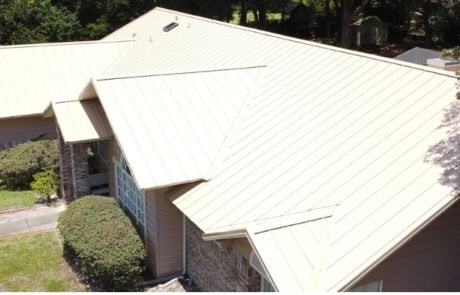
Seen from a sidewalk, dotted lines of screws signal an exposed-fastener system, while plain pans and tall ribs with nothing in sight are standing seam. Farm buildings and garages commonly have ribbed or wavy sheet, and houses carry both styles.
The Cross-Section: Old Look, New Look
A corrugated sheet curves up and down in regular round waves, while ribbed designs show angular ribs and wide flats. Side by side, adjoining lengths overlap by one crest, and fastener placement follows a published pattern.
Ribbed stock is stiffer and spans further between supports, and corrugated suits older buildings and a farmhouse look. High ribs carry a heavy downpour across an extended slope, while modest runs need little depth.
Exposed Hardware: Aging in Sunlight
Every screw draws a panel down onto a support, and a washer under each head keeps rain out. Ultraviolet light slowly bakes neoprene brittle, long before the painted metal gives out.
Overdriving tears a washer and dishes the metal, and a shallow or off-square setting never seals fully.
Fresh Fasteners: Part of Upkeep
On corrugated or ribbed sheet, every washer ages at one pace, so a complete re-screw comes due at some point. Worn hardware is taken out in turn, and a bigger diameter is driven in to grip where an old thread stripped.
Re-fastening stops water at every head and holds down sheets that lift, yet rusted panels, opened laps and poor flashing still need separate repairs. Thread type follows whatever support lies below, since lumber and steel purlins take different screws, and tops painted in a panel color keep new work from standing out.
Movement Through the Day: Oval Holes and Loose Seals
Steel swells with heat and draws back as temperatures fall, and a long run can gain a quarter inch between noon and midnight, and aluminum reaches about double. A tightly fixed panel enlarges fastener holes a little with every cycle, and a washer stops sealing.
Ticking heard as morning sun lands on steel is ordinary expansion, and nothing is damaged where every detail allows for slack.
Under Upright Joints: Tucked Away
Each long pan is fixed solid in one short zone, and floating clips everywhere else let the pan glide. A finishing piece at an opposite end has room built in underneath, and a pan held rigid throughout tears loose or buckles.
Pans go down one at a time, with clips screwed along a single side, and an adjacent pan then covers every anchor point.
Seam Styles: Which Suits the House
A snap-together rib engages when an installer presses down, and heavier-duty versions are folded over by a motorized tool. A double-lock seam rides out storms and sheds pooled water, and maker approvals cover shallower slopes.
Every product line has distinct spacing and rib size, and a choice depends on the home and a preferred style. Parts made for one system rarely suit a rival brand, so any repair hinges on knowing exactly which panel is installed.
Heavier and Lighter Stock – Beyond Appearances
Coil for roofing is sold by gauge, and numbers fall as sheet gets thicker. Outbuildings commonly get twenty-nine, while houses often take twenty-six or twenty-four.
Aluminum is specified in thousandths of an inch instead, and in both cases a heftier panel stays straighter and tougher. Standing in a yard, nobody can judge weight by eye, so a product data sheet is a reliable guide.
Corrosion Defense – Finishes That Hold Up
Raw steel is galvanized, or given an aluminum-zinc treatment, before shipping, and a color coat is baked on afterward. Paint scuffed but not broken through is fine, but an unprotected cut or a gouge to bare steel is where red rust starts.
Fluoropolymer finishes remain true to color for many years, and polyester families fade and chalk more quickly. Uncured concrete and mortar harm an aluminum-zinc coating, so panels are kept away from a new chimney or stone wall.
Which Metal Suits: Matching a Location
Aluminum is light and free of red rust, though an impact leaves a deeper mark. Salt air at the coastal end of our territory attacks zinc-based layers, and some makers limit steel products by distance from a shoreline.
Copper usually goes on small accent roofs over bays and entries, and the metal is left bare to weather.
Incompatible Neighbors – Isolation and Compatibility
A copper pipe or flashing above steel sends corrosive drainage down over the panels, and a stain shows up before a leak does. Chemicals in treated lumber pit any aluminum resting on top, and an ordinary screw of an unsuited alloy fails as well.
Replacement flashing should come from a metal already present, or tape and membrane keep dissimilar metals from meeting.
Looks, Not Leaks – Why Installation Counts
Oil canning means a slight bow in a wide stretch between seams, and faint hollows show at sunrise and fade by noon. A warped look in the metal lets no rain through, and service life is unaffected.
Stiffening ribs, a stouter grade and a smaller pan width lessen waves, and careful handling on a true deck makes a difference. Photographs of finished houses show how noticeable oil canning can be, and you decide what to order.
Indoor Comfort: What Reaches Living Space
A shed with bare purlins under the panels rings like a drum, because a single thin skin vibrates freely. Metal on a home rests on a deck and underlayment, over an insulated ceiling, and loudness indoors is close to what asphalt gives.
A light-colored panel sheds much of the sun’s warmth, so the attic runs noticeably cooler. Deep shades absorb as much as dark asphalt, and venting and insulation under the deck do as much for comfort as color. Metal loses daytime warmth shortly after the sun sets, so upstairs rooms settle sooner at night.
Guards and Placement – Only Where Needed
Where winters bring real snow in our territory, slick panels shed a snowpack quickly, and a single release can take out a gutter or strike someone nearby. Stops attached to the metal let a load leave slowly, and a doorway, walkway or meter below decides placement.
Standing seam takes clamp-on brackets that grip each rib without piercing the metal, whereas corrugated panels get mounts anchored through to purlins, and homes where snow seldom falls go without.
Damage From Above – Photographs and Measurements
At the colder end of our range, hail arrives most years, and thicker steel shows fewer dents. A sharp blow that chips a color coat leaves metal bare to weather, and a flattened rib or a shifted cap can leak.
Once a storm has passed, a roofer photographs and measures every mark, so the size and position of each dent are known.
Storm-Ready Attachment – A Denser Pattern
Gusts tug harder at corners and along a perimeter, and once air slips under an unsecured edge, pressure can roll the metal up. Trim along every outer line is hemmed and hooked onto a continuous cleat, and no gap is left to work into.
Screw and clip spacing tightens at corners and around a perimeter, following a maker’s layout for a site’s exposure. At the coastal end of our territory, hurricane country asks for more holding power still, and panel and hardware are rated as one assembly.
Openings in a Covering: Sealant as Backup
Each pipe takes a boot made for panel roofs, with a base pressed to follow corrugations, and a level stretch, not a peak, is chosen for a hole. A bigger penetration is framed with a curb and a small cricket upslope, so runoff is steered aside.
A bead of sealant supports a properly formed detail rather than working alone, as ultraviolet light turns soft compounds brittle in a few seasons.
Meeting Planes: Hooked and Clear
A valley pan goes down ahead of any panel, and panels are trimmed on a diagonal to match. Ends are hemmed and held by cleats, and no screw goes through any path where water flows.
Where a long run needs more than one length, a lap is sealed between layers, and fasteners pass through both thicknesses, with uphill metal on top.
Limits Near Flat: Where Locked Seams Help
Makers of exposed-fastener sheet commonly list three in twelve, and at anything less, rain creeps sideways across laps toward screws. Double-lock standing seam is rated for far shallower roofs, with certain lines suited to decks that are nearly flat.
Many homes have a gentle stretch over a porch or a later addition, and a measured angle decides what goes on, and where metal does not belong, a membrane does.
Under Everything – Purlins on Outbuildings
Metal on a dwelling is installed over full sheathing, and a synthetic sheet rated for heat is sandwiched between, because traditional felt degrades quickly up there. Farm buildings frequently carry metal over bare purlins, and support distance dictates grade.
With an old roof gone, damaged sheathing is cut away and rebuilt, because screws in decay have nothing to grip.
Old Roof Off, Deck First
We tear the old roof off down to the deck before any metal goes on, so we can see and fix the wood first. Steel panels weigh well under two pounds per square foot, and ordinary framing copes without trouble.
Finishing Off – Tight Against Weather
Shaped closures fill spaces under every rib at an upper line and a lower line, so wind-blown rain and nesting animals stay out. A ridge cap can be vented to let warm air escape or left solid, and attic airflow needs are what decide.
Rake trim, drip edge and an apron into a gutter close off a roof’s outline, so rain does not run down behind fascia.
Care With the Metal: Where to Step
Standing seam is produced to fit each run from bottom to top, so no crosswise joint sits in the path of runoff. Big panels need a team so nothing buckles in transit, and a creased pan should not be installed.
Feet go in a flat where something solid lies below, since a heel on a rib crushes a fold. A damp or dew-covered pan gives a shoe nothing to hold, and nobody without a harness should go up.
Clues to Watch: Easy to Notice
- Rust circles where screws go in, just above a gutter line.
- Screws backed out of holes, mid-panel.
- Flashing flapping in a breeze, following a gusty night.
- A collar gapping around a stack, on a back slope.
- Corrosion along a cut, at a hip.
- Faded paint, on a sunny slope.
- A leak tracking one line of fasteners, under a porch roof.
- A gap along a rib, above a gutter.
How APC Roofing Takes On Standing Seam Metal Roofing in Kissimmee Florida: Order of Work
Everything begins with identifying which panel system is installed and how the panels are fastened, followed by every screw or clip, edge, boot, valley and lap. Panel grade, paint and hardware are recorded, and the attic is searched for stains and soft decking.
Findings come to you in a report with pictures, and each recommendation carries reasons. When a small fix works, nobody pushes a bigger job, while a worn-out roof is named as such.
Standing Seam Metal Roofing in Kissimmee Florida: Plain Findings
Reach us at 407-270-1129 and someone will arrange to stop by.
Keeping the Roof – When a Tear-Off Makes Sense
A panel torn by a falling limb can be changed individually, although new paint never quite matches older metal. New sealant at a lap ends trouble at an overlap, and a full set of screws fixes tired rubber.
Rust through sheet after sheet calls for a new covering, and a covering riddled with failed seams is no better off. Sometimes one weathered side is re-covered alone, as long as nothing else shows wear.
Looking Down the Road: What Cuts Life Short
A carefully installed panel system can pass forty years, though any figure is an estimate, not a promise. Standing seam, with no holes through a pan, gets by on less maintenance, whereas screw-down sheet has washers changed out at some point.
Metals of different kinds touching, unhemmed cuts and sealant used in place of flashing shorten a roof’s service, and a visit now and then spots trouble early. Wet leaves left sitting on panels stain and dull a colored finish, so clearing debris away helps paint last.
When you are weighing Standing Seam Metal Roofing in Kissimmee Florida, get hold of APC Roofing at 407-270-1129. Someone will go over every panel, fastener and piece of trim, and you get photographs, notes and a recommendation to consider.
« All Services in Kissimmee Florida