Searching for Standing Seam Metal Roofing Throughout Holly Hill Florida?
APC Roofing works on ribbed sheet and concealed-clip panels alike, for houses as well as workshops and barns.
Call 386-356-2111 and a visit ends with a straight account of what was found.
Sorting Out Types: Clues From Below
Ribbed and corrugated panels take screws through a flat or a crest, whereas standing seam relies on clips that sit under locked joints. Most metal on houses is coated steel, and aluminum and copper are less frequent choices.
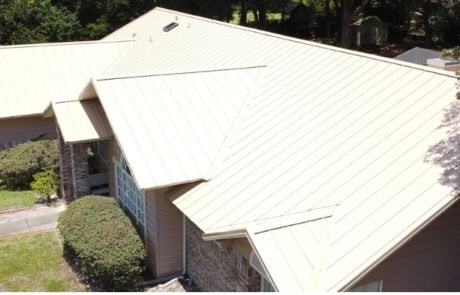
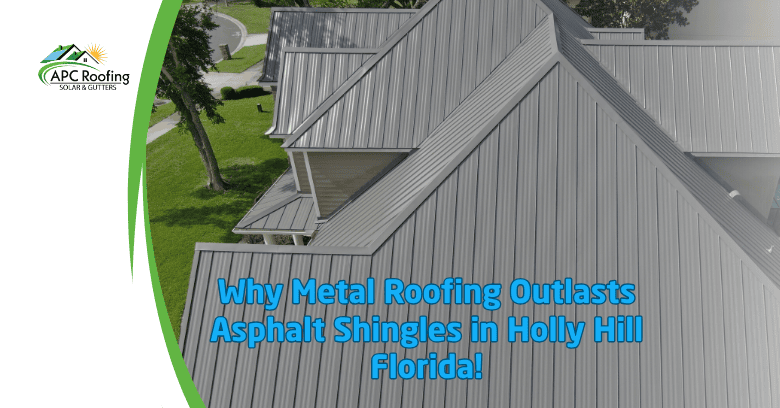
From a driveway, lines of screw heads across the panels mark a through-fastened roof, and uninterrupted pans separated by raised folds mean standing seam. Outbuildings and porches lean toward ribbed or corrugated sheet, though a house can suit either.
Shapes Rolled Into Steel: Matching a Building
Corrugated sheet rises and falls in rounded, evenly spaced waves, and ribbed panels pair tall square ribs with broad flat areas. Side by side, adjoining lengths overlap by one crest, and fastener placement follows a published pattern.
Ribs make a stiffer panel that crosses longer spans, while corrugated keeps a place on vintage buildings and farmhouse designs. High ribs carry a heavy downpour across an extended slope, while a low pattern handles short runs like a porch or lean-to.
What Keeps Sheet Down: Aging in Sunlight
Each screw clamps a panel down onto wood or steel framing, and a gasketed washer under each head does the sealing. Synthetic rubber ages in the sun, going hard and then cracking, and the panels can go on for decades more.
An overdriven screw squashes a washer flat, and a slack or crooked fastener leaks on one side.
Fresh Fasteners – Where Help Stops
Rubber rings across a ribbed or corrugated field wear out together, and a whole-roof re-screw is routine over the years. Tired fasteners are pulled one by one, and a slightly fatter screw goes into each hole so a thread bites fresh wood or steel.
A full re-screw with new washers closes leaks at each head and tightens loose sheets, though perforations, split laps and faulty trim remain as before. Thread type follows whatever support lies below, since lumber and steel purlins take different screws, and a factory color on every top suits most finishes.
Movement Through the Day: Room to Travel
A steel panel stretches in sunshine and draws in after dark, and a longer run shifts farther still, and aluminum changes nearly twice as much. A tightly fixed panel enlarges fastener holes a little with every cycle, and water gets past a washer.
Creaks as the day warms come from steel adjusting, and nothing is damaged where every detail allows for slack.
Attachment Beneath Folded Seams – Out of Sight
A long pan is locked down at a single band, and sliding clips everywhere else let the metal move with temperature. Trim at an end that travels is bent with clearance underneath, and a pan held rigid throughout tears loose or buckles.
A pan is positioned and clips are screwed to the deck beside a long edge, so each new pan conceals all hardware below.
How Seams Close: A Choice With Consequences
Snap-together panels latch by hand, and mechanical versions are turned over with a powered seamer. A double-lock seam holds far better against strong gusts and standing water, and published ratings run down to lower slopes.
Widths between ribs and the height of each rib differ by line, so the house and a preferred look guide a decision. Clips, trim and closures are bought to suit one particular panel, so a repair calls for knowing exactly which panel is up there.
How Much Material Is Up There: Reading a Label
Steel is described by gauge rather than inches, and higher numbers mean thinner sheet. Twenty-nine is a regular sight on sheds and pole barns, while houses often take twenty-six or twenty-four.
Aluminum is called out in decimal inches, and more material means fewer marks and less waviness. A light grade and a heavy grade are indistinguishable from a driveway, so a label on a bundle shows what was delivered.
Protection Built In: Choosing a Finish
Coil stock is dipped in molten zinc or an aluminum-zinc alloy, and a color coat is baked on afterward. A scratch that stays within paint does no harm, but an unprotected cut or a gouge to bare steel is where red rust starts.
A PVDF finish stands up to sunlight for a long time, and polyester families fade and chalk more quickly. An aluminum-zinc surface is damaged by contact with fresh mortar, so metal and new brick are kept apart.
Weighing Options – Trade-Offs
Aluminum is light and free of red rust, but a soft sheet dents from smaller blows. Beside salt water at the coastal end of our range, protective layers wear away faster, and makers restrict certain products near surf.
Copper appears mainly as small roofs on bays and cupolas, and years outdoors take bare metal to brown and then green.
Metals That React – Isolation and Compatibility
Rain rinsing off a copper detail wears through coated steel downhill, and a dark streak shows long before any hole. Treated wood touching aluminum pits the metal at each contact, and a bare steel screw in soft sheet breaks down too.
Replacement flashing should come from a metal already present, or an isolating layer separates unlike metals.
A Matter of Taste – Surface, Not Structure
What the trade calls oil canning is a mild wave in a flat pan, and faint hollows show at sunrise and fade by noon. A panel that looks uneven sheds rain as well as a perfect sheet, and useful life is unchanged.
Thicker metal, a slimmer width and striations rolled into every pan tame rippling, and an even deck beneath helps as well. Photographs of finished houses show how noticeable oil canning can be, and you decide what to order.
Everyday Comfort: Noise and Heat
An outbuilding with bare framing under the metal makes a loud din in rain, since a single skin is the only barrier. On a house, a solid deck, underlayment and ceiling insulation sit below the panels, and loudness indoors is close to what asphalt gives.
Light tones and cool pigments bounce a large share of sunlight away, so the space under the roof runs cooler. Dark metal heats up like any black roof on a clear day, and vents and insulation weigh as heavily as the choice of color. Metal loses daytime warmth shortly after the sun sets, and the attic below catches up before long.
Guards and Placement – Only Where Needed
Across the colder end of our territory, snow does not cling to painted steel, and a heavy sheet coming off in one piece can hurt a person or tear away a gutter. Stops attached to the metal let a load leave slowly, and typical spots are above doors, walks, decks and gas meters.
On standing seam, brackets clamp onto a rib without a hole, while exposed-fastener sheet takes mounts screwed into framing, and where snowfall is rare, nothing is added.
What Ice Does – Photographs and Measurements
At the colder end of our territory, hail is a regular event, and stouter panels with striations hold shape better. Where a blow splits paint, bare metal can corrode, and a bent seam or a dislodged trim piece can let water in.
Once a storm has moved on, affected spots get photographed and measured, so the extent of damage is clear.
Resisting Uplift – Rated Assemblies
Perimeter bands of a roof take a heavier pull than a central field, and air that gets under a loose edge can peel a sheet back. Trim hooks over a continuous strip fastened to the deck, and no gap is left to work into.
An attachment pattern grows denser toward every corner, set by a maker's tested layout for each exposure. At the coastal end of our range, where hurricanes come ashore, rows of screws draw in further, and panel and hardware are rated as one assembly.
Breaking Through the Metal: Keeping Water Out
A plumbing pipe gets a flexible boot with a base that bends to a panel profile, and placement is down in a pan rather than on a crest. A chimney or skylight is built up on a curb with a cricket above, and water from higher up is divided and sent past.
Caulk plays a supporting role to folded metal, as ultraviolet light turns soft compounds brittle in a few seasons.
Where Slopes Meet: Made to Shed
Valley metal is laid before a single panel, and panels are trimmed on a diagonal to match. Each raw end is hemmed back and hooked onto a cleat, and fasteners stay clear of wherever rain concentrates.
On a run too long for one sheet, an endlap joins pieces with sealant between, and uphill metal always goes on top, screwed through.
Limits Near Flat: Where Membrane Takes Over
Most ribbed sheet is specified for about three in twelve or steeper, because on less, runoff lingers long enough to wick past laps. A mechanically locked seam can be installed far lower, with some lines cleared almost down to flat.
A barely tilted roof over a porch or addition is common on houses, and a measured angle decides what goes on, and a part too low for any panel gets a membrane instead.
What Lies Underneath: Checked on a Tear-Off
A house takes panels on a solid, continuous deck, and a high-temperature synthetic underlayment goes between, since felt paper cooks under summer metal. Pole buildings commonly have metal spanning between purlins with air below, and wider spacing calls for heavier stock.
A stripped roof is probed, and weak sections are replaced, since punky fibers offer a screw no bite.
Going Over the Existing Roof: Condition Decides
Panels can often go on top of one shingle layer where code permits, so the house is spared a tear-off and debris. At well under two pounds per square foot, steel is a light load, so reinforcement is rarely needed. Battens over a fresh membrane go across existing shingles, and clips or screws go down into solid structure.
If the decking flexes, or earlier leaks show from the attic, the old roof comes off, since trapped dampness under metal has no way to dry.
Completing the Job: All Around
Profile-cut closures fill openings beneath each rib at the upper and lower lines of a run, and wind-driven rain, wasps and birds stay out. A ridge piece either breathes or is left solid, depending on how an attic is ventilated.
Drip edge, rake trim and a gutter apron finish every outer line, and fascia boards stay dry.
Working at Height: Slick When Wet
Standing seam is produced to fit each run from bottom to top, and one pan spans eave to ridge with no joint across. Carrying an extended panel takes people spaced along the metal, and a pan that gets bent should not go on the roof.
A foot goes only in flats directly above supports, since a heel on a rib crushes a fold. Morning dew alone can make metal treacherous, so the safest place for the household is indoors.
What to Watch For – No Ladder Needed
- Red staining around each screw, low on a slope.
- Loose screws riding high, on long panels.
- A peeled drip edge, facing prevailing wind.
- A collar gapping around a stack, over a kitchen.
- Rust creeping from a trimmed end, in a valley.
- Blotchy color, on a sunny slope.
- A leak tracking one line of fasteners, under a porch roof.
- An endlap gaping, near a valley.
How APC Roofing Approaches Standing Seam Metal Roofing in Holly Hill Florida: What Happens on a Visit
The first thing we do is identify which panel system is on the house and what holds the panels down, before each fastener, edge, boot, valley and lap is read in sequence. Thickness, coating and hardware style go into notes, and the attic is searched for water marks.
You receive a report, pictures included, and each repair is explained. If a covering needs only new screws, we say exactly that, and a roof at the end of service life is named as such.
Standing Seam Metal Roofing for Holly Hill Florida Homes – Straight Answers
Call us at 386-356-2111 and a visit gets put on the calendar.
Fix or Redo – Knowing Limits
One badly damaged sheet can be swapped alone, and a difference in shade stays visible. New sealant at a lap ends trouble at an overlap, while new fasteners seal screw holes again.
Rust through sheet after sheet calls for a new covering, and a covering riddled with failed seams is no better off. Sometimes one weathered side is re-covered alone, provided trouble goes no further.
Longevity – Exposed Screws Versus Hidden Clips
A well-built steel covering commonly serves forty years or more, though climate, care and material all make a difference. Concealed-clip panels require less upkeep because no rubber seal sits in the sun, while corrugated and ribbed sheet calls for fresh screws in time.
Copper runoff, bare edges and caulked joints where flashing belongs shorten the life of a roof, and a periodic look finds problems while minor. Leaves and twigs that collect against a curb or in a valley hold moisture against coated steel, and sweeping debris clear helps a finish.
Whenever Standing Seam Metal Roofing in Holly Hill Florida comes up, get hold of APC Roofing at 386-356-2111. We will inspect all hardware, every edge and each penetration, and a written summary lays out what we saw so you can choose.
Verified

Verified
Verified
Verified