Looking for Steel Roofing Here in Holly Hill Florida?
APC Roofing works on ribbed sheet and concealed-clip panels alike, on houses, garages, porches and outbuildings.
Call us at 386-259-8425 and a roofer will look closely and explain plainly what is up there.
Sorting Out Types: Hints in Plain Sight
Screw-down panels, corrugated or ribbed, are fastened with screws through the exposed metal, whereas standing seam hangs on clips hidden under tall ribs. Coated steel is what the great majority of metal-roofed homes carry, and aluminum or copper appears now and then.
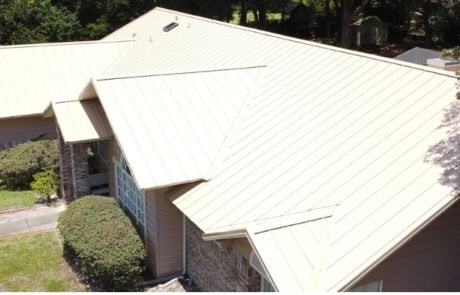
From a driveway, lines of screw heads across the panels mark a through-fastened roof, while flat pans divided by upright folds with no hardware showing are standing seam. Outbuildings and porches lean toward ribbed or corrugated sheet, and dwellings use both.
Profile Options: Which Suits a Building
A corrugated sheet curves up and down in regular round waves, while ribbed panels carry squared ribs with wide flats between. One length rides over a neighbor at a side lap, and every screw lands where a maker’s layout calls for.
A squared profile resists bending and reaches further between purlins, while corrugated fits a period barn or a farmhouse style. A tall rib keeps heavy rain inside a channel on a broad roof plane, while a low pattern handles short runs like a porch or lean-to.
Hardware in the Weather – Why Installation Matters
A single screw pins the metal firmly to framing below, and a sealing washer beneath each head closes a drilled hole. Rubber in steady sunlight hardens and cracks with age, and the panels usually last a great deal longer.
Driving a screw past snug crushes a washer and dimples the metal, and a fastener stopped short or angled leaves a gap for rain.
Refreshing Hardware: Worth Doing, With Limits
Washers dotted across a ribbed field grow old together, so eventually a full new set of seals is needed. Old fasteners are backed out one at a time, and a bigger diameter is driven in to grip where an old thread stripped.
A re-screw stops drips around screw heads and draws lifting sheets back down, yet rusted panels, opened laps and poor flashing still need separate repairs. Screw style depends on what lies beneath, with coarse threads for wood and self-drilling tips for steel, and a painted cap keeps new work inconspicuous.
Thermal Movement: Why Slack Matters
Steel lengthens on a hot afternoon and shortens on a cold night, and a long run adds up to a measurable distance, while aluminum goes about twice as far. A tightly fixed panel enlarges fastener holes a little with every cycle, and washers then stop sealing.
Snapping sounds at sunrise come from panels shifting against clips, and a well-built roof takes no harm from some noise.
Under Upright Joints: Hidden Hardware
One short stretch of every long pan is pinned tight, and sliding clips everywhere else let the metal move with temperature. Flashing at an unanchored end is shaped with space beneath, while a pan fastened hard along every foot pulls loose or ripples.
A pan is positioned and clips are screwed to the deck beside a long edge, and an adjacent pan then covers every anchor point.
Seam Styles: Which Suits the House
Snap-together panels latch by hand, while machine-rolled designs get folded over by a motorized seamer. A double-lock seam holds far better against strong gusts and standing water, and maker approvals cover shallower slopes.
Pan width and rib height vary from product to product, and a home’s design and a buyer’s taste guide selection. Clips, trim and closures are bought to suit one particular panel, and a mismatch shows up as gaps and loose joints.
Stock Weight: Reading a Label
Panel thickness in steel is stated in gauge, and a smaller number means a thicker sheet. Twenty-nine is a regular sight on sheds and pole barns, while a dwelling generally takes twenty-six or twenty-four.
Aluminum is called out in decimal inches, and more material means fewer marks and less waviness. Different grades look identical once installed, so a label on a bundle shows what was delivered.
Factory Protection: When Damage Matters
Roofing steel leaves a mill with a zinc or aluminum-zinc layer over plain sheet, and baked-on primer and color follow. A scratch that stays within paint does no harm, while a sheared edge or a deep gouge lets rust begin.
High-end fluoropolymer finishes keep a bright look for years, and polyester types chalk white sooner. An aluminum-zinc surface is damaged by contact with fresh mortar, and a barrier belongs wherever panels meet new stonework.
Base Material – Trade-Offs
Aluminum has less mass than steel and cannot turn red with rust, but a soft sheet dents from smaller blows. Close to salt water, at the coastal end of our range, metallic coatings break down faster, and some makers limit steel products by distance from a shoreline.
Copper usually goes on small accent roofs over bays and entries, and the metal weathers to a natural patina with no paint.
Chemistry on a Rooftop: A Slow Chemical Fight
Runoff from copper eats through coated steel downhill, and a dark streak shows long before any hole. Pressure-treated framing corrodes aluminum laid directly on top, and fasteners of an unsuited metal leave a ring of damage.
Any added flashing or trim should be the same metal as what is up there, or an isolating layer separates unlike metals.
A Frequent Complaint: What Can Be Done
In trade terms, oil canning describes soft ripples across a broad flat between seams, and raking light early or late in the day brings out each rise and fall. A panel that looks uneven sheds rain as well as a perfect sheet, and useful life is unchanged.
Stiffening ribs, a stouter grade and a smaller pan width lessen waves, and an installer who does not overdrive clips helps as well. Images of real houses show oil canning from obvious to barely there, and the choice of panel is yours.
Everyday Comfort: Rattle and Warmth
A racket many recall comes from sheet over open framing, since a single skin is the only barrier. On a house, a solid deck, underlayment and ceiling insulation sit below the panels, and indoors, few people notice more noise than under asphalt.
Light tones and cool pigments bounce a large share of sunlight away, so upstairs spaces bake less. A deep hue absorbs heat like any dark surface, and venting and insulation under the deck do as much for comfort as color. Within an hour of sundown, a metal covering is cool, and the attic eases off soon afterward.
Retention Hardware: Position Matters
Across the colder end of our territory, snow does not cling to painted steel, and a single release can take out a gutter or strike someone nearby. Guards break a load into small harmless chunks, and positions are chosen where anything below could be hit.
Brackets on standing seam bite an upright fold, not a flat, while exposed-fastener sheet takes mounts screwed into framing, and in our warmer markets a house goes without.
Damage From Above: Documented Plainly
Hail visits the colder end of our range with some regularity, and thicker steel shows fewer dents. A sharp blow that chips a color coat leaves metal bare to weather, while a seam or trim edge pushed out of line may open.
Once a storm has passed, a roofer photographs and measures every mark, so the extent of damage is clear.
Holding On in a Gale: Built to a Pattern
Suction gathers along rakes and eaves, and a blast under a raised lip can tear a panel away. Finish trim is hemmed and caught on a cleat, so nothing sticks out to be grabbed.
Fasteners go in closer together near corners and a roof’s rim, following a maker’s layout for a site’s exposure. At the coastal end of our territory, hurricane country asks for more holding power still, and a whole assembly has to carry a matching rating.
Breaking Through the Metal: Detail Work
A round pipe receives a rubber or silicone boot molded to follow each rib, and placement is down in a pan rather than on a crest. A bigger penetration is framed with a curb and a small cricket upslope, and water cannot pool at an upper edge.
Caulk is a secondary barrier behind formed metal, since the steel outlasts any compound many times over.
Channels Between Roof Planes – Joining Long Runs
Each valley receives a wide flashing before panels arrive, and sheets are cut on a diagonal to suit. Each raw end is hemmed back and hooked onto a cleat, and no screw goes through any path where water flows.
Long runs made of more than one piece get an endlap with sealant sandwiched inside, and fasteners through both thicknesses keep water from backing up.
Near-Flat Areas: Where Locked Seams Help
Screw-down panels typically call for roughly three in twelve, since anything less lets rain back up at overlaps. Machine-folded seams go much lower, and product literature states an exact minimum.
Porches, additions and back rooms often carry a barely tilted section, and we measure pitch on site, and anything under a panel’s limit is finished in a membrane.
Substrate: Wood or Open Framing
Metal on a dwelling is installed over full sheathing, and a heat-rated synthetic membrane goes in between, since felt paper cooks under summer metal. An outbuilding may have nothing but purlins under the metal, and support distance dictates grade.
A stripped roof is probed, and weak sections are replaced, because crumbling plywood cannot anchor a clip.
Why We Tear Off First
We tear the old roof off down to the deck before any metal goes on, so we can see and fix the wood first. Clips or screws go down into solid structure.
If the decking flexes, or earlier leaks show from the attic, the old roof comes off, because a problem covered with steel keeps growing out of sight.
Finishing Off: All Around
Closures matching a panel shape stop up hollows under each rib at both extremes, so wind-blown rain and nesting animals stay out. A ridge piece either breathes or is left solid, and attic ventilation is what decides.
Trim at every rake plus a drip edge over a gutter finish a roof’s border, and water falls clear of fascia instead of running behind.
Working at Height – Sheet by Sheet
A seamed panel comes off a forming machine cut to the length of a run, so no crosswise joint sits in the path of runoff. Big panels need a team so nothing buckles in transit, and a crimped or creased pan is no longer usable.
Feet go in a flat where something solid lies below, because ribs and seams crush under a boot. Morning dew alone can make metal treacherous, and nobody without a harness should go up.
Clues to Watch – A Look From Below
- Brown rings at fastener heads, just above a gutter line.
- Screws backed out of holes, by a peak.
- Trim bent up at a corner, following a gusty night.
- A boot pulled away from a pipe, on a back slope.
- Red streaks at a raw end, at the bottom of a run.
- Blotchy color, on a south exposure.
- A ceiling stain in a straight line, in a garage.
- A joint gaping open, where slopes meet.
How APC Roofing Tackles Steel Roofing in Holly Hill Florida: What Happens on a Visit
We begin by figuring out which system is up there and how the panels are anchored, and after that every fastener, trim piece, penetration, valley and lap gets a close look. Thickness, coating and hardware style go into notes, and the attic is searched for water marks.
Every finding goes into a report with images, and a reason sits beside every recommendation. A sound covering is called sound, and a roof past saving is described plainly.
Steel Roofing Around Holly Hill Florida – Straight Answers
Reach us at 386-259-8425 and someone will arrange to stop by.
Keeping the Roof – Knowing Limits
A single ruined panel can come out and a sound panel go in, but brand-new paint stands out against faded neighbors. A properly resealed lap closes a drip, while new fasteners seal screw holes again.
Widespread perforation puts replacement on the table, and a covering the wind has twisted out of shape is in the same position. Sometimes one weathered side is re-covered alone, as long as nothing else shows wear.
Aging Gracefully: Upkeep Over Time
A carefully installed panel system can pass forty years, and every estimate is approximate. Standing seam asks for less attention, with no hardware exposed, while corrugated and ribbed sheet calls for fresh screws in time.
Galvanic contact, unfinished cuts and caulk in place of flashing hasten replacement, and a check every few years catches small faults early. Piles of leaves behind a chimney keep a patch of metal damp for days, and sweeping debris clear helps a finish.
When you are weighing Steel Roofing in Holly Hill Florida, get hold of APC Roofing at 386-259-8425. Every detail, including how the panels are fastened, is read in person, and a write-up leaves every decision in your hands.
« All Services in Holly Hill Florida