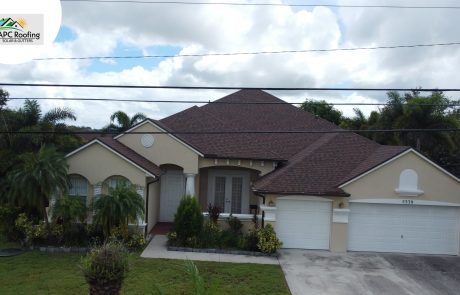
Researching Tile Roof Repair for Your House in Sanford Florida?
APC Roofing lays kiln-fired and cement-based coverings and restores worn ones, whether the job is a single slipped piece or an entire slope reset.
Call us at 407-270-1129 and somebody experienced with clay and concrete will explain what is needed.
How the Covering Is Built – Worth Knowing
The clay or concrete pieces you see from the street shed most of the rain, but an underlayment beneath the surface is what keeps the house dry. In a driving storm, some moisture always blows in beneath the courses, and the layer beneath leads that seepage down and off the slope.
A split tile is not the same thing as a leak indoors, because the waterproofing underneath is still sound. Water through torn underlayment can track across the boards before it lets go, and the visible mark and the way in do not always line up.
Weighing the Materials: Sun and Moisture
A clay piece starts as earth pressed to a profile and baked, and there is no painted coat on the face to wear off. Sunlight over many decades barely alters how the roof appears, and a well-made piece absorbs very little rain.
A concrete piece is cast from a wet mix of sand and cement and left to harden, and a good share of brands color the face alone. Constant sun slowly bleaches the brightest side, while a broken corner shows the gray inside. Any replacement dropped into an aged roof is easy to spot, and the contrast narrows as time ages the newcomer.
Concrete is thirstier in a rainstorm than fired clay, and toward the colder end of our territory, moisture taken in swells as it freezes. Repeated cycles like that can flake the face away, so each product is graded for how it copes with that stress.
Profiles on the Market – What Differs Up Close
Traditional barrel work alternates a trough turned up with a cap turned down, and the look goes back to old Spanish colonial buildings. A single S-shaped tile does the work of the older two-piece layout, and many recent houses wear this version.
The flat kind sits nearly level on the deck and resembles slate or thick shake, and rain runs over the face of each course instead of along a channel. Needles and leaves gather in the dips of a rolled pattern, but a smoother surface gives a breeze the chance to blow debris off.
Weight and Structure: Conversions and Options
Ordinary tile presses down with several times the mass of shingles, and a home planned for tile was given rafters to match. Trading a light covering for a heavy one puts new demands on an older house, and an undersized frame can sag under it over the years.
Ahead of a conversion, a structural engineer checks the rafters, the spans and the walls they bear on, and a few homes call for stiffening before the new covering is laid. Lightweight concrete weighs noticeably less than the regular kind, which puts the look of tile within reach of more houses.
Securing the Covering – Code and Exposure
Many pieces take a nail or screw through a hole at the upper end, and a lot of installations lay each course over a wooden batten. Other roofs rely on a roofing foam adhesive under each tile, and a full mortar bed carries the pieces on others. A clip at the exposed end adds resistance to lifting in several designs, and the manufacturer's instructions plus local code decide what is allowed.
Wind pulls hardest at the eaves, rakes, hips and ridges, and attachment there is increased. Hurricane rules at the coastal end of our territory call for firmer anchoring, and installers use tested layouts for foam and screws. Mending a roof means matching the method that keeps its neighbors in place, since forcing loose a glued unit tends to break the ones next to it.
Waterproofing Underneath – Heat and Sunlight
Doubled asphalt felt was the norm for a very long time, while self-adhered bitumen and synthetics are the newer options. Summer heat builds up below the covering and bakes the underlayment, so the wrong sheet cracks years too soon.
Tile acts as a sunshade for the layer under it, so a knocked-out tile opens a patch that degrades fast. The absence of a leak inside is no reason to leave a missing piece alone, because once the sheet beneath has failed, rain goes into the boards.
New Waterproofing – the Process
The existing pieces on a major project are frequently hand-removed and set aside, and weak spots in the sheathing are repaired. A new underlayment is laid across the whole area next, and the saved tile is relaid over it. The home keeps the appearance it was built with, while everything that stops water is starting over.
Some breakage in handling is unavoidable, and the rate climbs with the age of the roof. Fresh units must lock into the pattern already on the roof, and a design that is still manufactured can be matched exactly. When a style has been dropped by its manufacturer, salvage or a near equivalent fills the gaps, though the tone can still differ a little.
Damaged Pieces: Reducing the Risk
Somebody's shoe accounts for a large number of the fractures, and the walker is often a contractor there for a dish, a chimney or a gutter. A ladder leaned on the eave can crack the lowest course, and a standoff bracket that bears on the wall avoids that.
Branches that come down in wind smash entire sections, and cutting back overhanging growth heads off most of that harm. At the colder end of our territory, large hail can crack a tile outright, though pea-sized pellets usually do nothing.
Stepping Safely – Boards and Routes
The lapped end of each piece bears weight well, while the center has no backing and fractures under a shoe. With a curved profile, feet go in the low pan and stay off the hump, and a path used over and over gets boards so the load is shared.
The fracture left by a misplaced heel is frequently on the back face, so breakage builds up on a roof without anyone knowing. Before panels or a dish go up, the installer is wise to bring in a roofer, and every bracket then rests on flashing rather than on broken tile.
Valley Framing – Points Worth Knowing
The fold between neighboring slopes carries their combined runoff, and on tile a sheet-metal channel runs down it. Where the pieces are cut back decides how wide the open strip is, and a narrow gap can overflow under the covering in a heavy storm.
Pieces along the edge end up small and often lose their nail holes, so foam or clips secure them instead. Litter that piles up in the valley dams the flow, and the water then works sideways beneath the pieces.
Hip and Ridge Work: Signs of Age
Each outside joint, at the peak or down a corner, gets a run of rounded trim, and on many roofs it sits in mortar. Old bedding splits as the roof warms and cools, and pieces work loose while grit collects in the gutters.
Many newer roofs mechanically fasten the trim to a raised support rail, and a flexible closure or foam seals the gap beneath. Certain versions breathe, letting attic air escape at the peak, while baffles inside turn back rain and insects.
Walls and Chimneys – Sealant Shortcuts
Where a slope meets something vertical, sheet metal is bent up against the upright face, with a counterflashing set above it to cover its upper edge. A tile roof needs a broad pan there, finished with a raised rim, while shortened tile sits clear so runoff drains freely.
A smear of roof cement along a chimney hardens and splits, and the leak comes back where it was. A durable repair removes the pieces nearby and reshapes or replaces the metal, while the underlayment there is redone before the covering goes back.
Pipes and Vents – Mounts and Skylights
Each plumbing stack has a base flashing attached to the underlayment below, with a soft lead or aluminum skirt molded to the tile above. A standard neoprene boot cannot follow the rise and fall of a rolled piece, so water runs in under its flange.
Every skylight, vent and panel mount requires flashing suited to the tile, and a rail foot fastened through a piece without it takes on water.
The Eave Edge – Keeping the Line Straight
A rolled profile leaves an open arch under the end of each piece at the gutter, where birds and wasps nest and blown rain enters if nothing blocks the way. A closure made for the purpose is installed along the fascia, and drain holes let water run free.
Pieces in the last course have nothing under them for the same tilt, so a riser or raised board makes up the difference. Without that support, the end pieces hold water on their faces, and an uneven line at the bottom shows from the ground.
Heat Control: The Warm-Weather Advantage
On battens or through their own curve, many coverings sit up off the wood, so moving air runs beneath the courses. The draft strips heat away before it travels downward, so the waterproofing stays cooler.
Over a scorching summer, indoor comfort holds steadier, while the weight of the material delays warmth reaching the living areas. Nests and litter at the lower edge, or solid mortar up top, stop the flow, and the pieces then hold heat against the deck.
Growth and Stains: Safe Cleaning
A chalky white bloom on newer concrete pieces is efflorescence, salts drawn out of the mix, and weather tends to clear it without help. Growth in the laps traps water against the pieces, so at the colder end of our territory freezing can wear the face away.
Pressure washing strips the color coat from concrete, and it pushes water past the pieces. A cleaner made for roofs, rinsed off gently, removes growth more safely, and it helps even more to clear valleys and gutters by hand.
What Shows Inside and Out: A Homeowner's Guide
- A single piece hangs crooked below the course, which points to a broken fastener or a failed bond.
- A gap shows where a piece is missing altogether, and the sun is reaching the membrane below.
- Fragments land on the lawn or among the shrubs, and the source can be on a back slope.
- Mortar pieces sit in the grass below a ridge, which suggests the bedding at the top is deteriorating.
- A damp patch shows on the ceiling after heavy rain, and the source is often several feet away.
- A wall next to the chimney has swollen drywall, and the metal along that joint may have failed.
- Moss has spread along the overlaps on the north side, which keeps the pieces damp between storms.
- The eave line looks uneven from across the street, and the board under the last course may have softened.
How APC Roofing Takes On Tile Roof Repair in Sanford Florida: Our Method
Every slope is walked before anything else, with the material, profile and fastening noted. Along the way, the valleys, ridge, walls and eave are gone over in turn, and where the answer depends on the underlayment, a few pieces come up so it can be seen. The attic is checked from inside for water marks and weak boards, because discolored plywood shows the path of any leak.
Any problem is photographed, and each damaged area is measured. A plain written report sums up the findings, and the reasoning behind each suggestion is spelled out. Cracked pieces on a sound sheet are described as repair work, while a failed underlayment is named plainly. The next step is chosen by the owner, and waiting is also on the table.
Tile Roof Repair in Sanford Florida: Explained Plainly
Phone 407-270-1129 to ask about a visit.
Mending or Relaying – Sound Slopes and Failed Ones
Single faults, like a broken piece or a loose cap, usually sit in one place, so the surrounding covering is left as it is. The layer under the pieces decides whether a relay is due, while the look of the pieces tells very little.
A slope with a failed sheet from top to bottom is relaid, while slopes that are still sound are left in place. A layer put down in one go tends to reach the end of its life all over, and what remains may not be far behind.
Aging Well: Estimates, Not Promises
Well-made clay can remain on a house for generations, and concrete lasts for decades, though usually not as many. Beneath the pieces, the underlayment gives out sooner, and its condition usually sets when major work comes due.
Routine checks and clean valleys let a tile roof go the distance, while an open gap left alone can ruin the sheet early. A quoted number is an estimate rather than a promise, since grade, attachment and flashing quality push it up or down.
Slope, Deck and Drainage – Code and Maker Rules
A tile covering works by overlap, with no sealed joints between pieces, and the roof needs a steep enough angle to clear water. At lower slopes, manufacturers ask for extra underlayment protection, and beneath the stated minimum another material belongs.
Every board under the tile needs to be firm, so damaged sheets are swapped out while everything is exposed. Gutters are part of how the roof drains, and a clogged run can back water up under the lowest pieces.
For a roofer's read on Tile Roof Repair in Sanford Florida, reach out to APC Roofing at 407-270-1129. The slopes are walked and the findings are put in writing, with the decision left in your hands.
Verified

Verified
Verified
Verified
Verified