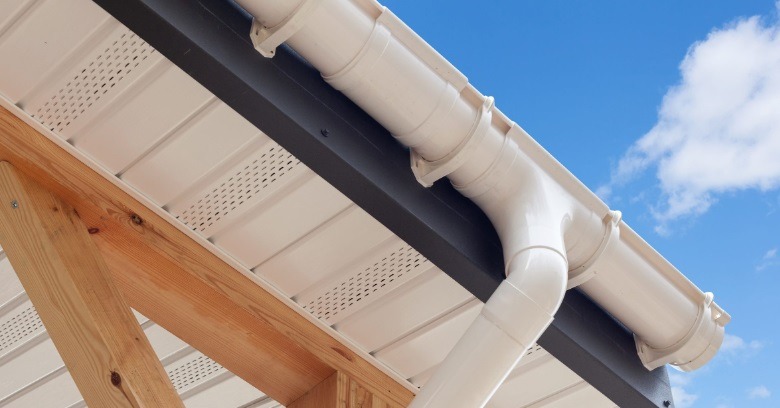
Shopping for Gutters in Deltona Florida?
APC Roofing measures, builds, and services roofline drainage at Deltona Florida homes.
Call 386-356-2111 and start with a measurement.
Any Gutters Job Starts With Arithmetic – Not a Catalog
Nearly every overwhelmed roof-drainage setup that comes out for replacement throughout Deltona Florida stopped coping for the same reason: no one ever sized it to the area draining into it. The trough is a channel with a duty, and the volume it carries comes from a pair of numbers: how much roof drains into it, and how hard the rain can fall.
The second of those takes homeowners by surprise. No one sizes a gutter from a twelve-month rainfall figure. The standards contractors work from – the same figures commercial buildings are drained by – are built on how hard it rains in a five-minute burst. A gutter run will not overflow because the year was wet. It spills through the ten minutes a thunderstorm parks over the house.
That distinction shows up plainly across the map we cover. One corner of the map we cover takes north of fifty inches in a typical year; another market manages under twenty. It is easy to assume the drier markets on our map can be drained with smaller sections. The arithmetic disagrees. The intensity of a single hard cell is far closer between them than the annual totals would suggest.
The Two Figures That Set What You Pay for Gutters in Deltona Florida
The first is the width of the gutter itself. The two choices that actually get quoted on most rooflines are the five-inch and the six-inch K-style. Moving up a size is not a trim decision: the six-inch trough carries around fifty percent more water than the smaller one. On a small roof with little pitch that headroom is never called on. On a wide, steeply pitched roof emptying into one run, it is the difference between a dry wall and a waterfall.
The second is the size of the downspout. Here is the figure that gets skipped, and it is the one that fails. The small rectangular downspout – the common small section – copes with roughly 600 square feet of roof. Step up to a three-by-four and it takes about twice as much, to twelve hundred square feet or so. The four-inch round downspout is in the same territory. That is real capacity, and it is one of the cheapest upgrades on the job.
Put those together and the math is easy. Calculate the area of roof that empties into each run, and only then divide by what each downspout can take. If the answer says three downspouts are called for and the house has one, no cleaning schedule in the world will make that run behave. That is a design fault, not a cleaning problem.
Fall, Outlets, and Run Length
The trough is never dead level, though nobody should be able to see the fall. The figure we work from sits near a quarter of an inch for each ten feet of gutter. Installers differ from an eighth of an inch up to a half inch in ten feet, but the principle holds: enough to carry the flow to the outlet, not so much that the roofline looks crooked.
Hang it flat and water stands in the trough. Standing water is the beginning of the end: it holds debris, it stays against the seals, and it weighs on the hangers exactly where you least want it. Overdo the slope and the eye picks it up from the street while water overshoots the outlet when it really rains.
The length of a run matters as much as slope does. Once a run pushes much past forty feet, you want a second downspout, not more profile. Water heading down a long run arrives at the downspout faster than it can be cleared, and the water goes over wherever the lip sits lowest – typically over the front step, which is how the problem announces itself.
What Holds It Up, and Why It Moves
The distance between hangers is among the few items a homeowner can see standing on the lawn. Supports should be no further apart than two to three feet. In the markets that get real snow, we bring that in – eighteen inches – because ice and packed snow pile above the rim and stay for weeks, where rain is gone within minutes.
The second thing nobody mentions is expansion and contraction. The aluminum expands and contracts as the weather turns. Across a hundred-foot length and a full seasonal swing, the travel is more than an inch. All of that has to be allowed for. A run held tight at both ends distorts, splits at the joints, or pulls its brackets loose in a couple of years. That is in no way a defect in the metal. That is a detail somebody skipped.
Drip Edge, Gutter Apron, and the Gap Behind the Trough
This is a fault that reads as a leaking gutter but is not one. Moisture turns up on the fascia, or runs down the face of the siding behind the trough line, and the trough itself is not leaking. The fault is the flashing at the edge.
The common edge flashing is an L-profile strip that kicks runoff away from the roof edge. Where nothing else is done, runoff can still curl back onto the fascia through surface tension alone. A gutter apron is the longer piece that reaches out and drops into the trough. It closes the gap that was letting water behind. On a steep pitch moving water in a hurry, that one detail settles it.
The roof above the gutter changes the joint. A shingle roof is the least trouble. Concrete or clay tile is thicker and heavier, and the edge detail has to be worked in before the tile is set. Standing seam sheds a whole roof of snow at once rather than melting it away gradually, which is precisely why putting snow guards above the eave belongs in the gutter discussion every bit as much as a roofing one. Shallow and flat sections shift the geometry once more. APC Roofing works on all of them, which is why we raise it.
What Actually Causes an Ice Dam
Across the northern half of our service area, this is the cold-weather conversation. It also happens to be the topic most reliably explained backwards.
The ice at the roof edge is not caused by the gutter. The cause is heat escaping through the roof deck from the house beneath. The heat that gets through turns snow to water up the slope; the runoff runs down as far as the cold overhang, where there is no warmth beneath, and refreezes. Run that cycle over a few days and a wall of ice forms, damming meltwater where it cannot drain.
None of it starts in the gutter, though the trough is part of the story. A gutter full of ice leaves the water with nowhere to drain, and deepens the backup. So the honest answer, when the question comes up whether new gutters fix it, is that they cannot. The remedy lives in the attic. What a properly built system does is give the meltwater somewhere to go before it does damage a second time as things warm up. A contractor who sells a gutter job as an ice-dam cure is telling you something that is not so.
Where the Water Goes After It Leaves the Downspout
A correctly sized system that dumps at the base of the wall has just moved the damage rather than solved it. It has taken water off a big span of roof, concentrated it into one discharge, and set it down precisely where it does most damage.
This is one of the few points where the residential building code sets an actual figure. Where the soil swells or gives way, water off the roof is required to go at least five feet away from the foundation, or into an approved drain. Note what triggers that: the ground, not the rain.
That single point explains why the driest place we work is precisely the place where how far the water is taken counts for more than anywhere. Ground that swells once it is wet and shrinks back as it dries moves a foundation up and down season after season. The moisture behind it does not need to be much. It merely has to be concentrated again and again at a single spot. A downspout that stops at the wall does exactly that.
A second number in the code applies everywhere, not just on difficult soil: the finished grade must fall six inches as a minimum inside the first ten feet out from the wall. That is the ground your downspout empties onto. A faultless gutter emptying onto ground that slopes back toward the house is fighting a losing battle. We take a look at the grade on the same visit – it is one problem, not two.
Three Kinds of Debris
What ends up in a trough is not all the same, which explains why one schedule for every house is a rough guide at best. Roughly speaking, three different loads fill a gutter.
- The coarse load – full leaves, small twigs, pods and cases. It comes in a seasonal burst, generally rides on the surface, and is the easiest to remove. This is what most people picture when a clogged gutter is mentioned.
- Fine debris – needle drop, catkins, and flower litter. This is the difficult one. It passes straight through the usual mesh, works down into the water that stands there, and turns to a dense mat that will not wash through.
- Granules off the roof – the fine mineral grains coming off a shingle roof for the roof's whole service life. A little of it is normal. A marked increase in the sediment at the drop is worth telling us about, because that is a roofing signal and not a gutter one.
Screens and covers are part of the answer, not a cure. They significantly reduce the number of times you go up, which counts for something. In return for that they cut down the gap the water has to pass through, and during an intense burst part of the flow goes straight past. Needle and seed litter still gets through on most designs. Whether the trade suits you depends entirely on your trees, which is why we look before recommending instead of guessing.
What Goes Under the Downspout
You are left with three real options to carry water out to where it does no harm, and each has a catch. The splash block is the cheapest and achieves the least. It takes the punch out of the water coming down and spreads it, though it carries it only a foot or two. Where the grade leans toward the wall the runoff finds its way home again to the foundation wall.
A surface extension is the sensible middle ground. It costs little, it lifts out of the way for mowing, and it does move water several feet out. The problem with it is that you can see it, and anything underfoot tends to get disconnected and stays that way. We find more loose extensions than we do failed runs.
An underground line is the right answer when the site calls for it: a continuous pipe led out to an open discharge point well clear of the structure. It is out of sight, it cannot be kicked loose, and it will outlast the gutters. The cost is that it can silt up without any visible sign, and that is why a clean-out at the top of the line goes in at the start and not left as an afterthought.
Fascia, Rafter Tails, and What We Find
A rainwater run has to hang from something, and that support point is usually the fascia board or the ends of the rafters. Where water has been getting behind the run for any length of time, that board is frequently soft once the old run is off.
We would sooner say so up front than turn it up once the crew is on site. A hanger screw driven into rotten wood lasts a season or two before pulling out, typically under load – and that is when it has to hold. Where we find rot, we say it plainly, show you, and price the repair separately so the cost is clear.
When the Roof Is Not a Simple Pitch
Not every roof drains at a gutter. Low-slope and flat sections work another way: water is taken by parapet openings, internal drains, or a built-in fall instead of spilling off the edge. The questions to answer do not change, but the failures are less obvious and a lot harder to catch early.
On a roof with pitch a full trough runs over in plain sight. Where the roof is flat a plugged outlet leaves water standing, and that pond adds serious weight long before it is noticed. APC Roofing works on both, so that a building with a mix of the two gets a single drainage plan rather than two crews pointing at each other over the junction.
After a Storm
Impact damage to a roof gets looked at. The gutters are checked last, if they are checked at all. That order is wrong for two good reasons.
A point worth making – the gutter is often the clearest evidence of what actually hit the property. Impact marks in the metal carry size and direction with them. They are a record that supports a claim when the shingle surface is harder to assess.
Something else worth knowing – a run knocked out of true says nothing. It reads as normal from the street, and it does its job through everyday weather. The problem shows up during the next big storm, which might be the following year – sometimes past the window for a claim. A look after the storm runs to a fraction of the bill that follows a late discovery.
Reading a Roofline From Below
You can stay on the ground to spot most of these. Walk the perimeter while it is actually raining hard, which is when a run shows you what it is doing.
- Water sheeting over the front edge when it rains hard – too small, clogged, or wrongly hung.
- A gap opening behind the run – hangers that have let go, often after an ice or debris load.
- Staining on the fascia board with nothing wrong inside the gutter – a missing apron, nothing to do with capacity.
- A washed line or bare earth below a drop – the discharge stops short.
- Puddles standing against the foundation hours after the rain stops – drainage and grading.
- A visible sag in a run – weight the hangers were never meant to take, and it gets worse by itself.
Valleys, Upper Roofs, and Concentrated Flow
Square footage alone does not tell the whole story, because roofs do not hand the water over evenly. A roof valley takes runoff from two planes and puts the entire flow at one short stretch of run. That section can be carrying many times the load of the run on either side of it, though nothing about it looks different.
That is why a run can spill at one spot every single storm while everything else behaves perfectly. The fix is rarely a larger trough. It is a drop set exactly at where the valley lands, so the water gets out the moment it arrives instead of running the length of a gutter never sized for that load.
Higher roofs make the same problem in another shape. An upper-level downspout discharging onto a lower roof is seen often, and it is more often than not a poor arrangement. It dumps the whole upper roof onto a single spot of the lower roof, which wears the covering away and then swamps the trough the lower roof drains to. Carrying the upper discharge down past the lower roof clears both problems together.
What a Good Estimate Tells You
Where you have a pair of quotes and one comes in lower, the gap is seldom profit margin. Time and again it is a specification difference that neither estimate spells out clearly.
An estimate you can compare states the size of the trough and what it is made of, the downspout count and size, which hangers and how often, whether an apron or drip edge is specified and whether it is in the price, and where the discharge from each drop finishes up once it exits the pipe. That is the short list. Where an estimate omits one of them, that is the difference.
We set those out in writing because that is the job. A price per foot and nothing spelled out is a bare number, not a specification.
Scheduling, Access, and the Day Itself
The average job is done in a day, sometimes two. The gutter is formed on site from coil stock, cut exactly to fit, and that is the reason there are no joints part way along. The corners, the outlets, and the ends are joints, and those are the points where the sealing work matters.
Weather drives the schedule more than anybody would choose. The install needs dry weather – sealants need to cure and nobody wants to be up a wet ladder. We would sooner move a date than work through rain and have it leaking by spring.
Getting at the work affects the day too. Narrow side passages, mature landscaping under the eaves, single-story additions, and the property line all bear on the order of work. We look at that when we measure, not the morning we arrive.
What Happens When APC Roofing Handles Gutters in Deltona Florida
We begin at the roof, not the gutter. Roof area per run, roof pitch, the length of each run, and where the downspouts can actually go – those few numbers set what the house needs. Everything else – the visible choices – is a decision you make against a known requirement.
Because roofs are part of what we do, the seam between roof and gutter is worked out rather than inherited. Shingle, tile, metal, low-slope – all of them change the way the edge is built. This is not tacked on at the end. It happens to be where we begin.
Repair against replacement is a real judgment call, and we will say which one applies. A well-sized run with one failed length or a hanging fault is a repair. A run that was never big enough for the roof it serves is not a repair. More frequent clearing cannot fix a sizing shortfall.
Arrange Gutters in Deltona Florida From a Measurement, Not a Guess
Phone APC Roofing right away at 386-356-2111 for a clear look at your roofline.
Why the Same Fault Costs More on Some Houses
The same shortfall in drainage costs very different amounts at different addresses, and the deciding factor is what the house sits on.
A slab-on-grade house leaves water nowhere obvious to gather. What goes wrong is slower: moisture working beneath the edge of the slab, soil being carried out from below, and water wicking up where the wall meets the floor somewhere nobody connects to the gutters.
A crawl space gives the water somewhere to go, and it takes it. Moisture coming through the wall, salt staining on the block, a sump pump running almost without stopping, and damp air drawn up into the rooms above – each of those starts at a single downspout putting water too near the wall.
In both situations the fix is outside, and it costs far less than any work carried out after the water is in.
What a Gutter Is Made Of
Aluminum gutter is the usual choice, and deservedly so: rust is not an issue, it puts little load on the brackets, and it comes off a roll-former at the house in one unbroken length. Losing the joints means fewer failure points. The trade-off is that it dents easily and it expands and contracts a good deal, which the bracket layout has to allow for.
Coated steel holds its shape better under load, which is worth something where hail is common, but the protective layer is the one thing holding corrosion off, so it needs looking after. A copper system sits at the durable end and it carries a premium. Vinyl gutter costs the least to install and hardens and cracks under UV and cold. We will talk you through what fits your roof and your weather with no sales pressure.
Keeping a Run Working
The twice-a-year figure is the standard advice, and it is a sensible default rather than a fixed rule. The right interval is set by the trees over the house. A house with pines above it gathers needles through much of the year and needs clearing more often. A house with no trees close by can go a long time between visits.
The twice-yearly habit fits colder places best, and it fits some markets poorly. The semi-evergreen oaks in the warmer part of our map hold their leaves through winter and drop them just as spring starts. A homeowner in those markets who stops at a fall visit is clearing the run right before the quiet season and letting it pack solid through the heaviest drop of the year.
What we look at is not only whether it is clear. How the outlets are flowing, the seals at joints and caps, the fasteners, whether the slope has held, the edge detail, and what becomes of the discharge. What happens at ground level is the one that gets missed most and it is the one quietly doing the expensive damage.
If you would rather not think about it at all, that is what we do. A gutter inspected at sensible intervals tends to last as long as the metal allows. A gutter only looked at once the damage is visible does not.
For Gutters throughout Deltona Florida, call APC Roofing right away at 386-356-2111. We do the measuring first and the quote comes from the numbers.
Verified

Verified
Verified
Verified