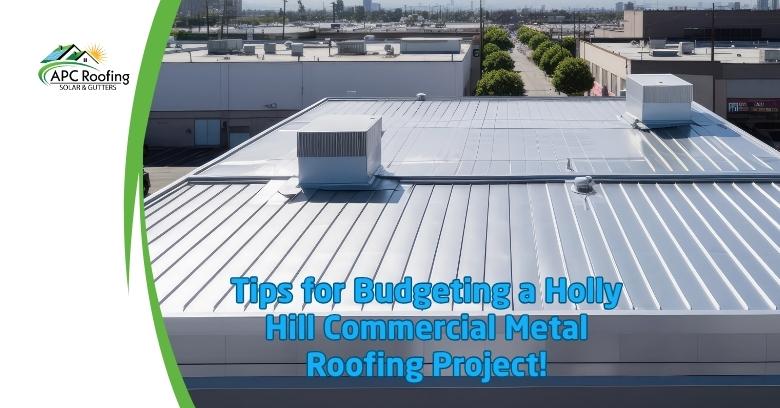
Commercial building owners along the Halifax River corridor tend to approach metal roofing the same way: they get a number, flinch, and set the project aside for another year. Two seasons later, the mod-bit is ponding, a tenant reports ceiling stains, and they decide under pressure — which is the most expensive way to buy a roof. Budgeting a commercial metal roofing project in Holly Hill, Florida, or nearby Palm Coast isn’t really about finding the lowest price per square foot. It is about understanding which line items are fixed, which are discovered after tear-off, and which are driven by wind code rather than by the contractor’s margin.
Volusia County’s coastal exposure, an aging stock of 1950s–70s concrete block buildings, and Florida Building Code requirements all push commercial roofing costs in directions that surprise owners who last replaced a roof a decade ago. Two bids on the same building can differ widely purely because one assumes a tighter clip spacing at the corners and the other does not. Neither is dishonest — one is simply engineered to the uplift zones and the other has not been.
This article walks through the real cost drivers of commercial metal roofing, the code and permitting steps that affect scheduling and cash flow, how coastal salt air changes material specification, when to schedule work around hurricane season, and how to compare bids from roofing companies so the cheapest number does not become the most expensive outcome.
What Actually Drives the Price Per Square Foot
System Type and Panel Specification
The single biggest fork in a metal roofing budget is standing seam versus exposed fastener. Commercial standing seam commonly costs noticeably more installed than exposed-fastener R-panel or corrugated profiles. The gap is not arbitrary. Standing seam has no field penetrations through the panel face, so service life generally runs 40 to 60 years compared with 20 to 35 for exposed-fastener systems.
Within either system, four variables move the number most:
- Gauge. 26-gauge is the economy option; 24-gauge is the commercial standard; 22-gauge is for high-uplift or long-span conditions.
- Finish. PVDF (Kynar 500) holds color far longer than SMP, and the premium is modest relative to a repaint twenty years out.
- Insulation. Adding or upgrading insulation changes both cost and the energy case for the project.
- Curb count. Every HVAC curb, pipe boot, and skylight adds flashing labor.
Penetrations, Tear-Off, and the Deck Underneath
Owners routinely forget to count what is already on the roof. HVAC curb flashing, pipe boots, and skylight curbs are priced individually, and each one adds to the bid. A building with nine rooftop units is a materially different job from one with two.
Tear-off and disposal of existing built-up or modified-bitumen roofing is priced by the square foot, with gravel-surfaced BUR the most expensive to remove. Then there is the deck. Much of the commercial inventory around Holly Hill, Florida is CMU with wood or lightweight-concrete decking, and rot or delamination only becomes visible after the old system comes off. Deck repair is priced by the square foot, so ask for that unit price in writing. A 5 to 10 percent contingency line is not padding — it is the difference between a change order conversation and a project that stalls.
Wind Uplift Engineering
Volusia County’s ultimate design wind speed is roughly 140 mph, Risk Category II, with Exposure C or D conditions near the river. Uplift pressures at corner and perimeter zones can run two to three times the field pressure, which drives tighter clip and fastener spacing exactly where most owners never look. On older decks, fastener pullout values often dictate the entire attachment design. A structural or uplift engineering letter, frequently required for retrofit-over-existing assemblies, is its own line item on the bid. Experienced roofing companies price that in from the start rather than discovering it at permit review.
Code, Permits, and Paperwork in Volusia County
Permits and inspections for commercial work run through the City of Holly Hill building department under the Florida Building Code, 8th Edition (2023). Every panel, clip, fastener, and underlayment in a metal roofing assembly needs a current Florida Product Approval number or a Miami-Dade Notice of Acceptance on file at permit. Substituting a panel mid-project because of a lead-time problem can mean re-submitting the package.
Two other requirements affect cash flow directly:
- Notice of Commencement. Any job over $2,500 requires a recorded Notice of Commencement with the Volusia County Clerk before the first inspection. Missing this step stops inspections cold.
- The 25 percent rule. Under FBC 706.1.1 and SB 4-D, repairing more than 25 percent of a roof section within twelve months can trigger full code compliance for that entire section. This matters enormously to owners planning to phase work across fiscal years.
Phasing is legitimate, but only if each phase stays below that threshold and the sections are genuinely separate. Owners in Holly Hill, Florida, who try to repair their way around a replacement usually end up triggering the rule and paying for the full assembly anyway, just later and under worse conditions. The same code logic applies to buildings up the coast in Palm Coast, where similar flat-roofed commercial stock faces the same decision.
Does Metal Even Fit the Building?
This question deserves an honest answer before you build any budget. Standing seam requires mechanical seaming below a 3:12 pitch and generally needs at least 1/4:12; snap-lock profiles want 3:12 or steeper. Much of the light industrial and retail inventory along Mason Avenue and the Ridgewood/US-1 corridor is dead-flat BUR or mod-bit on a structural deck with effectively no slope at all.
Putting metal roofing on those buildings means retrofit sub-purlins and sloped framing — a real structural scope with its own engineering, its own permit path, and a cost that can rival the roofing itself. Sometimes that investment makes sense because the owner wants the service life and the appearance. Sometimes a single-ply membrane such as TPO is the better value, and a candid contractor will say so. The pattern repeats in Palm Coast, Florida, and throughout the Central Florida market: the right system follows the building’s geometry, not the owner’s preference.
Specifying for Salt Air
Proximity to the Halifax River and the Atlantic changes the metallurgy conversation for a metal roof. Galvalume AZ-55 substrate consistently outperforms G-90 galvanized in coastal exposure, and the price difference is small compared with premature red rust at the panel edges. PVDF finishes resist chalking and fade far better than polyester-based coatings under Florida UV.
The quieter risk is galvanic corrosion. Mixing dissimilar metals — copper flashing against steel panels, bare steel fasteners, or direct contact with pressure-treated lumber — can produce visible deterioration within a few years. Specifications should name the fastener metallurgy and the isolation details, not leave them to the installing crew. Exposed-fastener systems also carry a maintenance obligation: gasketed screws generally need re-torquing or replacement somewhere around year 12 to 20. That should be a budget line in the building’s operating plan, not a surprise.
Coastal performance is one of the main reasons metal roofing remains popular with commercial owners from Holly Hill through Palm Coast, Florida, as long as the assembly is specified for the environment rather than ordered from a generic catalog page.
Timing, Lead Times, and Storm Season
Atlantic hurricane season spans from June 1 to November 30, which leads to several important consequences:
- Insurance carriers suspend binding once a storm is named, which can freeze a project mid-stream.
- After a regional hit, permit queues lengthen, and material prices climb for months.
- Custom-color coil and formed panels typically carry 4- to 12-week lead times, and longer after a named storm.
- June through September afternoon thunderstorms shrink the area a crew can safely open in a day.
The most favorable dry-in window for metal roofing work is roughly January through April, when humidity is lower and convective storms are less frequent. When evaluating bids, owners should ask two specific questions: how much roof does the crew open per day, and what is the nightly dry-in plan? That answer reveals more about storm-season risk than any warranty document.
Comparing Bids and Choosing Among Roofing Companies
A bid comparison should be a line-item comparison, not a bottom-line comparison. Before signing, confirm each proposal states:
- Panel profile, gauge, substrate, and finish system by name.
- Florida Product Approval or NOA numbers for the full assembly.
- Clip and fastener spacing by zone — field, perimeter, and corner.
- Tear-off scope, disposal, and the unit price for deck replacement.
- Count and detail for every curb, boot, and skylight.
- Who pays for the engineering letter and the Notice of Commencement recording.
- Warranty terms, both manufacturer and workmanship.
Financing options and free estimates make the evaluation process easier, and extended warranty coverage ranging from 10 to more than 25 years should factor into the lifecycle math. Section 179 also lets you expense nonresidential roof replacement rather than depreciate it over 39 years, up to the annual cap—a CPA should confirm the specifics for the building’s ownership structure, because the tax treatment can meaningfully change the real cost. Roofing companies that handle insurance claims regularly can also help determine whether any portion of the work is claim-eligible before finalizing the budget.
Final Thoughts
A commercial metal roof is a long-term investment, lasting between 40 and 60 years, but the decision must be made quickly, usually within a few weeks. Owners who plan effectively consider what will happen once the old roof is removed, not just the cost of the panels per square foot. Calculate total costs, including the full scope of work: tear-off, deck contingency, uplift engineering, curb flashings, permitting, and lead time. Compare proposals from reputable roofing companies item by item, not just the total cost.
To ensure timely installation in the Holly Hill, Florida, area, start the planning process in the fall or early winter. This approach allows you to address engineering, permitting, and material lead times before the January to April installation window, ideally before hurricane season begins. Delaying this process typically means paying higher prices for materials and scheduling during storm season, and it prolongs the risk of water leaks in buildings tenants rely on. A free metal roofing estimate and detailed proposal can turn a vague financial concern into a clear, defensible budget line.
Key Takeaways
- Budget a 5 to 10 percent contingency specifically for deck repair discovered after tear-off, and get the per-square-foot repair price in writing.
- Confirm every panel, clip, fastener, and underlayment has a current Florida Product Approval or Miami-Dade NOA before submitting the permit.
- Repairing more than 25 percent of a roof section in twelve months can trigger full code compliance, so phase projects carefully across fiscal years.
- Specify Galvalume AZ-55 substrate and a PVDF finish for coastal buildings, and name the fastener metallurgy to prevent galvanic corrosion.
- Schedule custom panel orders early, because lead times of 4 to 12 weeks stretch further after any named storm.
- Ask each bidder how much roof is opened per day and what the nightly dry-in plan is.
Frequently Asked Questions
Can we install over the existing roof and skip tear-off?
Sometimes, using retrofit framing over the existing assembly. The Florida Building Code limits total layers and requires verification of deck condition, and retrofit-over designs almost always need an engineering letter confirming attachment and uplift capacity.
Will a metal roof lower commercial property insurance premiums?
It can, depending on the carrier and the documented wind rating of the installed assembly. Provide the underwriter with the product approval numbers, the fastening schedule, and the final inspection records, then ask for a re-rate.
How noisy is a commercial metal roof, and does it attract lightning?
Over a structural deck with insulation, noise is minimal and nothing like metal over open purlins in a barn. Metal does not attract lightning; it is non-combustible and conducts energy safely to ground if struck.
What is oil canning, and is it a defect?
Oil canning is the visible waviness in flat areas of a metal panel, and it is a cosmetic characteristic rather than a structural defect. Heavier gauges, striations or ribs, and tension-leveled coil all reduce its appearance.
Does a cool-rated finish actually reduce cooling costs?
Reflective finishes are commonly credited with cutting cooling load by roughly 7 to 15 percent, though results vary with insulation and building use. Ask for the specific SRI value of the color being quoted rather than accepting a general claim.
Can the project be phased across multiple budget years?
Yes, provided each phase stays under the 25 percent threshold for its roof section within any twelve-month period. Have the contractor and the building department confirm how they define the sections before the first phase begins.
Will tenants need to close during installation?
Usually no, since commercial roof work happens overhead and access is staged from the exterior. Schedule noise and crane or lift activity around peak business hours, and coordinate interior work near penetrations in advance.