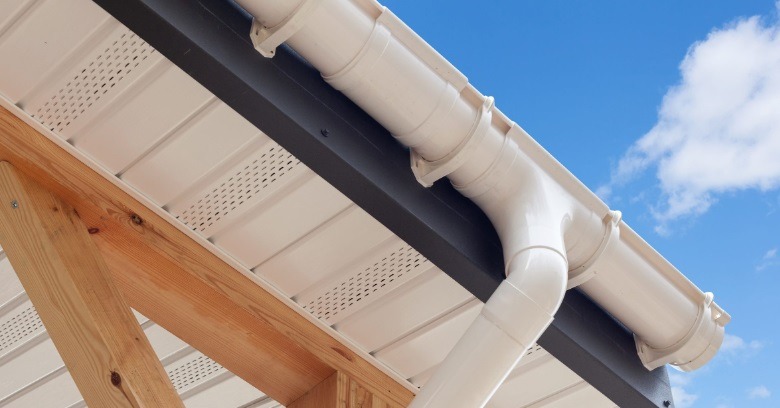
Comparing quotes on Seamless Gutters in Shawnee Kansas?
APC Roofing measures, builds, and services gutter systems for Shawnee Kansas properties.
Phone 913-398-5020 and start with a measurement.
Any Seamless Gutters Quote Starts With a Number – Not a Catalog
Practically every undersized gutter run that comes out for replacement across Shawnee Kansas ran out of capacity for one reason: no one ever sized it for the roof it serves. A rainwater run is a pipe with a job to do, and the size of that job is fixed by two figures: the roof area feeding it, and the heaviest burst that roof will ever take.
That second number catches most homeowners off guard. Drainage is not sized on a twelve-month rainfall figure. The tables the trade uses – the ones every sheet-metal shop keeps on the wall – are built on short-burst rainfall intensity. A trough does not give up during a wet year. It fails through the ten minutes a heavy shower hangs over the roof.
The distinction matters more than it might seem. One end of our service area catches north of fifty inches in a typical year; a different market logs less than twenty inches. It would be reasonable to assume the low-rainfall markets can be drained with smaller sections. The arithmetic disagrees. The peak rate differs far less than a rainfall map implies.
The Pair of Numbers That Set What You Pay for Seamless Gutters in Shawnee Kansas
Number one is the width of the gutter itself. The two options you will see on a quote on a residence are the five-inch K-style and the six-inch. Going from one to the other is not a trim decision: the six-inch section carries close to fifty percent more water than a five-inch gutter. On a small roof with little pitch the extra capacity is simply margin. On a wide, steeply pitched roof emptying into one run, it is the difference between keeping up and giving up.
The second figure is how the water gets out. Here is the figure almost nobody asks about, and it is where the failures start. A small rectangular outlet – the one on the majority of older homes – handles somewhere around six hundred square feet of roof area. Go to the larger rectangular profile and the capacity roughly doubles, to twelve hundred square feet or so. The four-inch round profile sits in similar territory. That is arithmetic, not sales talk, and the extra cost is minor.
Combine them and it is not hard to work out. Calculate the roof area draining into each run, and then count the downspouts. If the figures say three downspouts are called for and only one is there, no cleaning schedule in the world will put it right. That is a design fault, not a cleaning problem.
Pitch, Outlets, and the Length of a Run
A gutter run is not hung flat, and a good one never looks sloped. The common working figure is roughly a quarter inch per ten feet of length. Practice varies from an eighth of an inch up to a half inch in ten feet, but the intent does not change: enough fall to shift the water, gentle enough that nothing looks off from the curb.
Too little slope and water sits in the low spots. Water left standing is what kills a gutter: it holds silt and leaf litter, it sits on the joints, and it loads the hangers at the one place it cannot take it. Excessive pitch and the line looks wrong from the ground while water can run past the outlet in a hard storm.
The length of the run matters as much as pitch. Once a run pushes much past forty feet, the run needs another downspout, not a wider section. Water moving down a long length reaches the outlet at a rate one opening cannot absorb, and it overflows wherever the lip sits lowest – commonly above an entry, which is how it gets noticed.
Hangers, Brackets, and Thermal Movement
Bracket spacing is one of the few things anyone can inspect without getting on a ladder. Brackets need to land every two to three feet. Where snow sits on the roof, closer spacing is the right call – eighteen inches – because packed snow and ice stack above the lip and sit there for weeks, where rainwater is gone in minutes.
A second detail that is rarely mentioned is thermal movement. Aluminum gutter stock swells and shrinks as the temperature swings. Over a long length through a full year of weather, you are looking at over an inch of movement. It needs somewhere to go. A run pinned rigidly at both ends will ripple, split a seam, or work a screw free given a few cycles. That is not a fault in the material. It is simply an install detail that was missed.
Drip Edge, Gutter Apron, and the Gap Behind the Trough
There is a failure mode that everybody blames on a leaking gutter and is not one. Moisture turns up on the trim board, or runs down the face of the siding behind the trough line, while the trough itself is sound. What is causing it is at the roof edge.
The usual edge flashing is a bent metal strip that throws water clear of the deck. When that strip is the only flashing, water can still creep back onto the fascia through surface tension alone. A gutter apron is the longer profile that runs past the deck and turns down inside the gutter. It seals the gap that the water had found. On a sharp slope moving water in a hurry, it is a decisive difference.
The roof above the gutter changes the joint. A standard shingle roof is the least trouble. A tiled roof sits well above the deck, and the apron profile belongs under the tile, not behind it. A metal roof releases snow in a single slab rather than melting it away gradually, which is the reason snow retention above the gutter line is a gutter question and not a roofing one alone. Low-slope and flat sections behave differently once more. APC Roofing works on all of them, which is why the joint gets designed rather than assumed.
Ice at the Eave
In the markets that see hard winters, this is the seasonal question. And it happens to be the one most regularly misunderstood.
Ice at the eave does not come from the gutter. It comes from heat getting into the roof structure from the rooms below. That escaping warmth softens and melts the snow higher up the slope; that water runs down to the cold edge, which sits over open air, and freezes there. Do that for several days and the ice builds a wall, backing the next melt up on the roof.
None of it starts in the gutter, though the trough is part of the story. A run packed solid with ice takes away the last route out, and the dam builds quicker. What we tell people, when we are asked whether new gutters will end the ice problem, is that they will not fix it. The cure is insulation and stopping the air leaks. What drainage can do is clear the water away before it causes a second round of damage when the thaw comes. Anyone offering a new gutter as an ice dam solution is selling you the wrong repair.
Where the Water Goes After It Leaves the Downspout
The best-sized run in the world that empties right at the foundation has simply relocated the problem rather than solved it. It has collected water from a large stretch of roof, concentrated it into one stream, and set it down precisely where it does most damage.
Here is one of the rare places where the code puts a number on it. Where the ground is known to swell or collapse, roof drainage has to be taken a minimum of five feet away from the foundation, or to an approved drain. Read what triggers it: what is under the house, not what falls on it.
That wording is why the market with the least rainfall of any we serve is exactly the market where the last five feet counts for most. Ground that swells when it gets wet and shrinks again when it dries pushes a foundation around season after season. The moisture behind it does not need to be much. It simply needs to be delivered repeatedly at one point. An outlet that ends at the wall does that reliably.
Another number in the code applies to every house, not only the difficult ones: the ground around the house has to drop six inches as a minimum across the first ten feet away from the foundation. That is the grade the downspout hands its water to. The best drainage in the world emptying onto ground that slopes back toward the house has already lost. We check the grade while we are measuring the roof – the two belong together.
Why Cleaning Schedules Are Not One Size Fits All
What lands in a gutter is not all alike, and that is why a single fixed schedule fits almost nobody. In practice, three kinds of material fill a gutter.
- Leaf litter – broad leaves, twigs, seed pods. It drops over a short season, mainly stays on top, and is the easiest to remove. It is also what most people picture when a gutter is called blocked.
- Fine debris – litter from conifers and flowering trees. This is the one that causes trouble. It passes straight through the usual mesh, settles in the low spots, and packs into a sludge that will not wash through.
- Granules off the roof – the mineral granules washing off an asphalt roof over the whole of the roof's life. A small amount is normal. A marked increase in what collects at the outlet is worth telling us about, because it is a roof signal and not a gutter one.
Guards of any kind are a compromise, not a cure. They lower how often the run needs clearing, which counts for something. In return they leave a narrower entry the water has to pass through, and in a hard, driving burst part of the flow goes straight past. The small stuff still finds its way in. Whether guards are right for your roof depends entirely on your trees, which is why we look before recommending instead of assuming.
Getting the Water Clear of the House
In practice there are three workable ways to take the discharge out to where it does no harm, and they differ a good deal. The splash block costs almost nothing and does the least. It takes the punch out of the discharge and fans it out, though it moves it barely a foot or two. Where grading is poor the runoff comes straight back to the foundation wall.
A roll-out extension is the middle option. The outlay is small, it lifts out of the way for mowing, and it really does move water a fair distance out. The weakness is that it is visible, and anything visible comes loose and is left that way. We turn up more detached extensions than we do gutters that have actually failed.
An underground drain is the lasting answer where it is justified: a solid, sealed pipe run out to a place the water can go safely a long way from the house. None of it shows, nothing can knock it loose, and it will still be there when the gutters are not. The trade is that it can choke without anyone noticing, which is exactly why a clean-out at the top of the line belongs in the plan and not left as an afterthought.
Fascia, Rafter Tails, and What We Find
A gutter run hangs from something, and that point of support is the fascia board most of the time or the rafter ends behind it. Where water has been getting behind the run or tracking down the back over time, the board is often soft once the old run is off.
We would sooner say so at the quote stage than discover it once the crew is on site. A fastener going into decayed board holds for a while and then lets go, usually when the gutter is full – which is the moment the gutter is doing its job. Where we find soft board, we say it plainly, show you where, and price that work openly so you can see what you are paying for.
Drainage on Low-Slope and Commercial Work
Not every roof we are asked about sheds at an eave. Flat and near-flat roofs work another way: drainage happens by scupper, internal drain, or a tapered fall rather than off an open edge. The engineering questions stay the same, but the way it fails is better hidden and a lot harder to catch early.
On a sloped roof a blocked run spills over and you see it. On a low-slope roof a plugged outlet leaves the roof ponding, and standing water adds serious weight well before it is spotted. APC Roofing works on both, which means a mixed roof gets one drainage plan rather than two crews pointing at each other over the junction.
What Severe Weather Does to a Gutter Run
Impact damage to the roof itself is obvious. The runs below it are dealt with last, if they are checked at all. That is backwards on two counts.
Worth knowing – drainage is regularly the clearest evidence of what actually struck the house. Impact marks in the metal are sized and directional. That is a record that stands up in a claim where the roof itself is difficult to read from below.
Also worth knowing – a length shifted by wind does not announce itself. It reads as normal from below, and it drains well enough through everyday weather. You find out about it in the next heavy burst, and that could be a season later – potentially past the window for a claim. An inspection soon after is a fraction of the repair that follows.
Reading a Roofline From Below
No climbing is required to spot most of these. Walk around the house after a real downpour, as that is when a run shows you what it is doing.
- Water sheeting over the front edge in heavy rain – undersized, blocked, or badly hung.
- A gap opening behind the run – the fasteners or their spacing, typically after a heavy load.
- Paint lifting on the fascia though the gutter itself is not leaking – the flashing at the edge, not a gutter fault.
- A washed line or bare earth beneath an outlet – extension needed.
- Ponding against the foundation well after it stopped raining – a grading problem as much as a drainage one.
- A length that dips in the middle – load the hangers were never meant to carry, and it will get worse on its own.
The Spots That Overwhelm a Correctly Sized Run
Roof area alone takes you only so far, and roofs deliver water unevenly. Every valley collects the water off two planes and sends the combined flow onto a few feet of gutter. That one stretch is often taking several times the volume of the rest of that run, though it looks the same.
That is why a gutter can overflow in exactly one place every single storm while the remainder behaves perfectly. The right move is rarely a larger trough. It is a drop put at or near where the valley lands, so it drops out right where it lands rather than running down a run that was not built for that load.
Second-story roofs make the same problem in a different shape. A drop from a higher roof emptying onto the roof below is common, and it is frequently a poor arrangement. It puts the entire area above onto one point of the lower covering, which scours the shingles and floods the gutter system that lower roof drains into. Carrying the upper discharge down past the lower roof deals with both at once.
What a Real Quote Should Tell You
When you have two estimates and one comes in lower, the difference is rarely margin. It is very nearly always a difference in what is being installed that neither quote sets out clearly.
An estimate worth reading tells you the gutter size and what it is made of, the outlet count and profile, the hanger type and spacing, the detail where the roof meets the gutter and whether that is in the price, and where the runoff goes once it leaves the downspout. Five things. If a piece of paper is silent on any of them, that is where the difference lies.
All five appear on the estimate because that is what you are buying. A per-foot figure and nothing spelled out is just a number, not an estimate.
How Long the Work Takes, and What Gets in the Way
The average job takes a day, two on a larger or more complicated property. The trough is roll-formed at the house out of coil stock, cut to fit each run exactly, and that is why the length carries no joints down the middle. Corners, outlets, and end caps are still joints, and those are the points where the sealing work matters.
Weather sets the schedule more than anybody would choose. The job needs dry conditions – the sealants must cure and nobody should be on a wet roof edge. We would sooner move a booking than install in the rain and have it leaking by spring.
Getting at the work matters as well. Narrow side passages, planting close under the eaves, lower additions, and boundary lines all change how the work is staged. That gets checked while we are measuring, not after the crew arrives.
How APC Roofing Takes On Seamless Gutters in Shawnee Kansas
The roof gets measured before anything is quoted. Area per run, pitch, how long each run has to be, and where outlets can actually land – those few numbers make the specification. All that follows – size, material, color, guards – is yours to decide once the numbers are known.
Because the roof above is our work too, the edge where roof and gutter meet is drawn, not guessed. Shingle, tile, metal, flat, commercial – every one of them changes the way the edge detail is made. That is not left until later. It is where we begin.
Fixing or replacing is a genuine call, and we will say which one applies. A correctly sized system with a damaged section or a hanging fault is worth a repair. A system that was undersized from day one for the area draining into it is not a repair. Cleaning it more often will not change the arithmetic.
Arrange Seamless Gutters in Shawnee Kansas With the Roof Measured First
Dial APC Roofing at 913-398-5020 and start with a measurement.
Slab, Basement, or Crawl Space
An identical fault does not do the same damage from house to house, and what settles it is what sits below the ground floor.
A slab-built house has no basement to flood. What goes wrong is less dramatic: water working under the slab edge, the ground beneath being carried off, and water coming up through the floor slab in a room no one links to the roof.
A house over a crawl space gives the water somewhere to go, and it finds its way there. Wall seepage, a chalky bloom on the masonry, a sump pump running constantly, and humidity pushed up into the living space – all of them begin at an outlet putting water too near the wall.
In both cases the repair belongs outside, and it costs less than any work tried once the water is already inside.
What the Trough Is Made Of
Aluminum stock is what goes on most houses, and it earns that: it does not rust, it is light enough to be kind to the hangers, and it is rolled at the house as one continuous piece. Every joint removed means fewer failure points. What you give up is that it is soft and it expands and contracts noticeably, which is the installer's problem to solve.
Coated steel holds its shape better under load, which matters where hail is a fact of life, though the coating is all that stands between it and corrosion, so it needs looking after. A copper system is the long-life choice and it looks the part. Plastic is inexpensive to install and turns brittle with sun, heat, and frost. We will go through what makes sense for your roof without pushing the priciest option.
Cleaning: How Often, and What Else Gets Checked
Two visits a year is what gets repeated, and it is a reasonable default rather than a hard rule. The correct interval is decided by what overhangs the roofline. A house under pines gathers needles nearly year-round and asks for more frequent attention. A roof with nothing above it may go far longer.
The spring-and-fall routine comes from the north, and it does not travel well. The oaks that stay green in the warmer markets on our map keep their old leaves all winter and shed them in late winter as the new growth pushes. Anyone with one over the roof who stops at a fall visit is clearing the run at exactly the wrong point in the cycle and leaving it packed for the leaf fall that counts.
What actually gets checked goes past the leaves. Whether the outlets are moving water, joint and end-cap seals, whether the brackets have held, the fall along the length, the state of the edge flashing, and where that water finally lands. The last of those is the part nobody checks and it is also the one most likely to be costing you.
If you would sooner not track any of this, that is what a maintenance visit is. A system checked regularly generally lasts the life of the material. A run only inspected once the damage is visible usually does not.
To arrange Seamless Gutters in and around Shawnee Kansas, reach APC Roofing right away at 913-398-5020. We do the measuring first and quote against the numbers.
Verified

Verified
Verified
Verified
Verified