
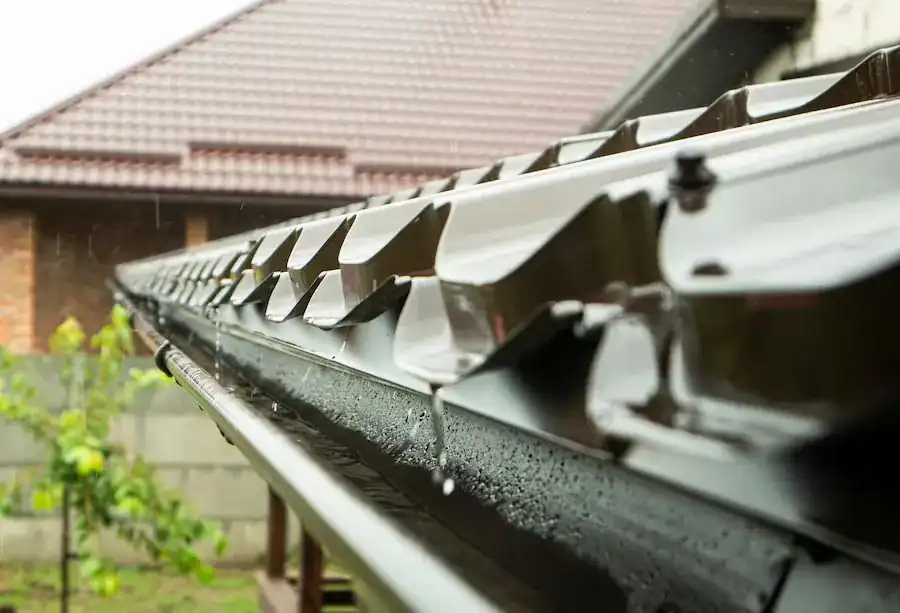
A summer storm rolls in fast, and within minutes your rain gutters are spilling over the front edge like a fountain. You cleaned them last month, so that’s not it. Afterward there’s a puddle along the foundation and a damp smell in the basement. If your rain gutters in Springfield, MO can’t keep up with a real storm, the problem is usually size and layout, not dirt.
That’s frustrating, because it feels like you did everything right. The good news is that an overflow problem can usually be measured and solved. You deserve gutters that handle the storms Springfield actually gets.
APC Roofing has been in business since 2017. We’re GAF Certified, licensed and insured, and your inspection is free.
How much water your roof sends to the gutters
Roofs collect more water than most people expect. One inch of rain falling on 1,000 square feet of roof adds up to roughly 600 gallons. A typical house has more roof than that, and it doesn’t all drain evenly. Some runs carry a small slice of roof. Others take the runoff from two big slopes and a valley.
Ozarks thunderstorms make it harder. A storm can drop heavy rain in a short burst, and the gutter has to move that water as fast as it arrives. A system that’s fine in a light shower can be overwhelmed in ten minutes of a spring downpour.
5-inch or 6-inch gutters?
Most homes use 5-inch or 6-inch K-style gutters (the shape that looks like crown molding from the side). A 6-inch gutter carries noticeably more water than a 5-inch one.
A 5-inch gutter can be plenty for a smaller, lower-pitched roof. Larger roofs, steep roofs and runs that collect water from a valley are often better served by 6-inch. Matching the size to each section of the roof, instead of using one size everywhere out of habit, is often what fixes a chronic overflow.
Downspouts are the bottleneck
A gutter can only drain as fast as its downspouts let it. Common residential downspouts are 2×3 inches and 3×4 inches, and the larger one moves a lot more water.
Two things decide whether downspouts keep up: their size and how many there are. A long run with a single small outlet at one end will back up in a heavy storm no matter how wide the gutter is. Adding a downspout, moving one closer to where water collects or stepping up to a larger size often clears up overflow without replacing anything else.
The spots that overflow first
Some parts of a roof concentrate water. Watch for overflow in these places during your next storm:
- Valleys. Where two roof slopes meet, water from both pours into one short stretch of gutter.
- Inside corners. Water from two directions meets and slows down.
- Below an upper roof. When a second-story roof drains onto a lower roof, the lower gutter catches both.
These are the places where a larger gutter, a diverter or an extra downspout does the most good.
Getting water away from the foundation
Rain gutters only finish the job if the water ends up somewhere harmless. A downspout that empties right next to the house sends all that collected water into the soil against your foundation, and in the Springfield area that can mean a wet basement or crawl space.
There are a few ways to move it further out:
- Splash blocks spread the water out but only carry it a short distance.
- Downspout extensions move water several feet from the house, though they get knocked loose and need to be put back.
- Underground drain lines carry water well away and stay out of sight, but they need a clean-out so they can be cleared if they clog.
The ground also needs to slope away from the house. Even perfect gutters can’t fix a yard that drains toward the foundation.
Hail and wind damage to rain gutters
Springfield’s spring hail often leaves dents in gutters and downspouts. Dented gutters usually still drain, but a crushed downspout or a bent section can slow water down. Dents are also a good sign the roof took hits in the same storm, so it makes sense to have both checked.
If you file an insurance claim for storm damage, you pay your deductible. We document the damage, write the estimate and work with your adjuster. Be wary of anyone who offers to waive or cover your deductible.
How it works
- Book your free inspection. Call 913-398-5020 or request a free online estimate.
- Get a clear, honest assessment and estimate. You’ll get a look at how your roof drains, where the overflow is coming from, and a recommended gutter and downspout layout with a written estimate.
- Get your rain gutters installed and the site cleaned up. The crew installs the new system and cleans up before leaving.
To see what the install involves, visit our gutter installation page.
Rain gutter questions
Why do my gutters overflow when they’re clean?
Usually the gutter or the downspouts are too small for the roof area draining into them, or the gutter isn’t pitched well toward its outlets. Valleys that dump water into one spot are another common cause.
Should I switch to 6-inch gutters?
If your roof is large or steep, or you see overflow at valleys during heavy rain, 6-inch gutters are often worth it. Smaller, simpler roofs may do fine with 5-inch.
How many downspouts does my house need?
It depends on the length of each run and how much roof drains to it. Long runs generally drain better with a downspout at each end.
Are seamless gutters better for heavy rain?
Seamless gutters have fewer joints, so there are fewer places to drip. See our seamless gutters in Springfield page.
Get rain gutters that keep up in Springfield, MO
Call 913-398-5020 or start your free estimate online. For everything else gutter-related, see our Springfield gutters page.
The goal is a storm you can watch from the window without worrying: gutters that carry every drop, downspouts that keep up and a dry basement when it’s over.


















