Roof Repair

Looking for Roof Leak Repair in Shawnee Kansas?

APC Roofing seals the gaps that let rain indoors, with the attention on flashing, boots and seams.

Call 913-398-5020 to set up a visit from a roofer.


How Leaks Get Started: Following the Trail

A continuous stretch of shingles is hard for rain to get past, because the laps all face downhill. Weak points sit wherever the surface stops against something else, at chimneys, skylights, valleys and stacks.

The wet patch indoors rarely lines up with the damage above, since the flow travels along the framing for a stretch. Measuring from inside without following the track leads a repair astray, so the trouble returns with the next heavy rain.

Where Siding Meets the Roof – What Hides Under the Trim

The stepped metal is laid in a piece at a time, alternating with the rows, and a cap strip overhead keeps rain off the top edge. If rust eats a hole through the bend, runoff slips behind the siding into the framing.

The lasting repair is new flashing, laced back in properly, so a few rows are taken up and put back. A coat of mastic on top is not the same thing, because movement in the joint splits a surface seal.

Boots on Pipes – Why the Bathroom Gets Wet

Every plumbing stack through the deck is sealed by a flexible collar on a flat base, and years of ultraviolet light leave the material hard. Eventually a crack forms right around the pipe, and the leak lands in whatever room lies beneath.

Replacement involves loosening the rows above and sliding new hardware into place, while a rusted metal plate means the entire thing comes out. A heavier boot resists cracking much better, and suits a roof with many years ahead.

The Valley Channel: Rebuilt, Not Patched

Where two slopes meet, the runoff of both gathers in one narrow strip, and in a downpour the water runs deep and fast. The material lining the trough is scoured thin years before the open roofing, and without a liner below, the wear turns into a leak.

Leaves and pine needles pile up along the channel, which holds water against the overlaps. A valley that has failed is rebuilt from the deck up, as a surface patch cannot survive a fast stream.

Popped Fasteners: Why Hammering Fails

The boards under a roof soak up damp air and dry out again season after season, and each cycle eases the shanks upward a fraction. A risen nail head tents the tab overhead, and wind-blown rain can slip in underneath.

Hammering a loose fastener back down does not hold for long, as the widened socket cannot grip the shank tight. The proper repair pulls the nail out, seals the hole and drives a new nail an inch away, plus a new shingle wherever a tab tore.

Metal on Shops and Porches – What Fails With Age

Screw-down systems pin the steel with fasteners through the weather surface, and a sealing washer beneath the head closes each opening. With age the rings shrink and stop gripping, and a crooked install never sat square at all.

Old screws come out and new screws with fresh washers go back, and a stripped opening takes a thicker shank. The trim at the ridge and the edges is inspected on the same pass, because everything installed alongside has faced the same weather.

Tabs the Wind Has Raised: Checking the Damage

A course is nailed and then glued to the row below by a heat-activated strip, and a hard squall can pry the lower edge up. Any tab flipped past upright ends up creased, which lets driven water work under the shingle.

An undamaged piece that only lost the bond is resealed with hand-applied cement, and a shingle split lengthwise gets swapped. A bare patch with no tab uncovers the heads of the nails beneath, which lets water reach the deck.

The Ridge – Fixed as a Whole

The shingles across the apex are bent over a sharp angle, so years of sun leave splits on top. The deck under a ridge vent has a strip removed on purpose, and only the housing above keeps rain from dropping into the attic.

Lost end plugs let squalls push spray under the unit, and staining appears along the uppermost board. Ridge work covers the cap shingles, the vent and the vent fastening in one job, as one neglected component undoes the rest.

Ice at the Eaves: the Overhang Problem

In the colder markets we serve, a roof in good shape can still take in water, as heat lost upward thaws the lower face of the snow. The runoff freezes again on reaching the unheated overhang, and a ridge of ice grows along the gutter line.

Upslope of the blockage, standing melt spreads out, where the water seeps upward into the nail holes. The real fix is a cold deck, which means a sealed, well-vented attic, and a self-adhering membrane along the eaves limits the harm meanwhile.

Additions and Porches: A Better Choice

Some homes have a low-pitched area off the back, and the main material is often carried onto the flat portion regardless. Overlapping shingles only stay watertight while runoff keeps going, but on a lazy grade the water hangs around and seeps sideways.

The cure is a continuous membrane sealed at every seam, carried up under the tabs above for a clean transition.

Reading the Wood Under the Roof: Following the Trail

Water running along the framing leaves a dark streak on the boards, and the tint holds long after the rain. The stain's upper limit lies right under the fault, and distances to the ridge and the gable find the same spot up top.

A nail knocked up through the deck gives the crew a visible flag, but under a cathedral ceiling there is no access, so the search moves outdoors. Flattened, damp batts reveal where the drops fall, and a layer in that state is replaced, not dried out.

When the Attic Sweats: A Seasonal Pattern

Even dampness across the whole underside of the sheathing usually has nothing to do with rain, since humid air escaping the living space turns to droplets up there. Where winters freeze, frost on the nail tips after a frigid night has the same cause, and a thaw turns the ice into drips like a leak.

Work on the outside of the roof leaves the droplets untouched, as the answer is moving the humid air out and keeping more from rising. You hear from us whether rain or household vapor wet the wood, which spares a homeowner the wrong repair.

The Chimney Detail: Water Against the Brick

A broad apron closes the lower face, and step flashing is woven up both sides, and an upper strip tucked into the joints overlaps what lies beneath. A good-sized chimney calls for a cricket upslope, so the flow is split and sent around the brick.

Without a raised wedge to shed rainwater, the uphill face holds leaves and water every storm, and the upper corners are soon soaked. Old mortar allows rain to enter the chimney above the metal, which makes some of the work a mason's job.

Skylights: Reflash or Replace

Water seldom gets through the glazing; the flashing kit at the curb lets go instead. The head of the opening takes the whole stream from overhead, and twigs trap small puddles.

New flashing goes on around the unit already there, as long as the seal between the panes has not failed. Condensation on the inside of the glazing can run down the shaft and pass for a leak, which no roof work will stop.

The Eave Line – Hangers and Outlets

A ceiling spot beside an outside wall may come from the gutter, since a blocked run spills backward toward the house. Where no drip edge was installed, rain clings to the shingle edge and curls beneath, which leaves the fascia and sheathing rotting.

Sometimes the gutter just needs clearing and rehanging at the proper angle, and a hanger screwed into solid wood stays put. Drip edge that stops short is a roofer's mistake, and the remedy is a length of metal that covers the entire overhang.

Old Dish and Antenna Holes – Sealing the Spot

A TV receiver, a floodlight or a weather station is usually attached with lag bolts through the shingles, and a smear of caulk is often all that keeps rain out. Over a few seasons the sealant shrinks and comes loose, which leaves a path for water at every attachment.

Removing old hardware does nothing about the holes underneath, and gaps that small are easy to overlook afterward. Every penetration gets sealant, and new shingles go over the area, and a light that stays is moved onto a flashed block.

Rot Under the Shingles: New Panels in Place of the Old

A trickle that goes on unnoticed waterlogs the plywood below, and the layers of veneer weaken and come apart. On top, the area feels springy under a boot, while inside the attic the sheathing bows between the framing.

The soft decking is sawn away back to firm material, and properly nailed replacements fill the gap. Felt and shingles are laid back over the patched area, and the fault that started the decay is corrected alongside.

A Cover on a Damaged Roof: Done Properly

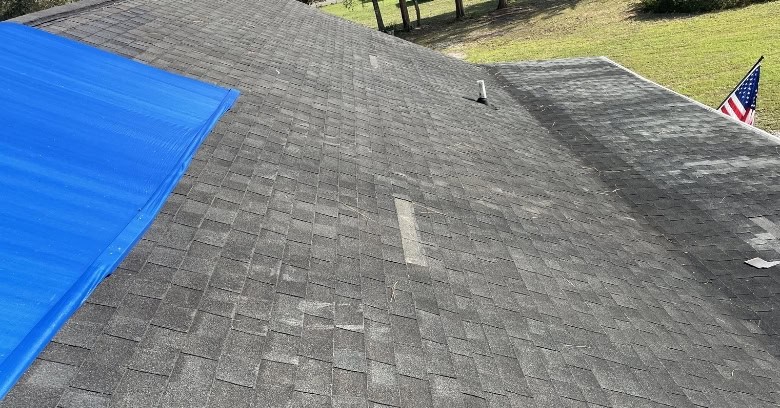
A heavy tarp keeps the interior dry, but no repair has been made. A well-anchored sheet runs over the ridge with boards fixed along the edges, and anything merely weighted gets torn away.

A row of nails is driven through the courses below, with the spacing kept no closer than needed. Weeks turning into months under plastic hold heat and damp against the covering, and the asphalt underneath deteriorates.

Documenting the Work: Seen at the Time

With fresh material installed, the broken piece disappears, though the flaw may have been only a hairline crack. We photograph the opening and the worn part before anything is changed, and the finished result is shot as well.

The images are yours to keep, and the record serves a buyer, an inspector or another roofer down the line. The report states in plain words which part gave out, with the fix described in the same terms.

Fixing or Starting Over: What Tips the Balance

A leak at one detail on an otherwise sound surface is simply mended, as caulk and gaskets give out ahead of the asphalt. Replacement comes into the conversation when the tabs are brittle and bare on every slope, or when water keeps finding different ways in.

Mending a leak on an aging roof buys time, although nothing about the remaining shingles improves. Our advice is plain, and so is the thinking, and the decision stays with you.

Color and Profile – Discontinued Lines

Replacement tabs stand out against the neighboring courses, since ultraviolet light has worn the original surface pale. We match the profile, the size and the nearest color still made, and time takes much of the edge off the contrast.

When a manufacturer retires a design, an identical replacement is gone, which means picking a comparable tab or extending the job to a hip or a ridge. The match is judged with a sample next to the existing shingles, since catalog pictures seldom print the tones true.

Signs of a Leak: What to Watch For

  • Paint that bubbles on a ceiling after a storm, however small the mark.
  • A mildew smell in a linen closet, which gets stronger in muggy months.
  • Sky visible through the deck, noticed with the attic in darkness.
  • Dark streaks running down the rafters, or nails furred with rust.
  • A cracked rubber collar at a vent pipe, plain to see with binoculars.
  • Mineral grit at the bottom of a downspout, in quantities that keep coming.
  • A bare patch where a tab used to be, anywhere on the house.
  • Rusted or gapped step flashing, where an addition joins the main structure.

How APC Roofing Takes On Roof Leak Repair in Shawnee Kansas: Plainly Explained

The search starts inside, in the attic, and any wet track there leads a roofer to the spot on the slope above. Whatever gave way is rebuilt properly, not smeared over, and the neighboring flashings get a check too.

The camera records the problem and the completed work, and a written account comes with the set. If mending no longer makes sense, we say so outright, and what happens next is your decision.

Roof Leak Repair Across Shawnee Kansas: a Roofer Who Finds the Way In

Reach us at 913-398-5020 to arrange a visit.


Working With the Weather: Heat, Cold and Adhesives

A cover goes on even with moisture around, though shingles and flashing go on only once the wood has dried. Adhesive strips on new tabs bond once the sun warms the shingles, so a job in the cold includes sealing by hand.

Tall or steep houses get safety lines and brackets, as a slide down a sharp incline is hard to stop. A roof baking in the afternoon sun bruises under traffic, and every scuff wears away some of the mineral surface.

Worn-Out Roofs: Where Mending Still Makes Sense

Asphalt that has baked for decades turns brittle, which means raising a course to reach the fasteners splits the shingle. Pieces harmed while getting to the fault become part of the job, so the effort may widen once underway.

You hear from us beforehand when the tabs are too brittle to raise, with pictures that make the case. Patching an old roof still makes sense to stop the water, while everyone knows the roof is near the end.

For Roof Leak Repair in Shawnee Kansas, phone APC Roofing at 913-398-5020. We find the opening and mend the failed part with the right material, and the images of each stage come to you.

steve persaud

Verified

★★★★★
APC roofing provided the best price and the best service. Ivan was courteous and professional,he kept me informed thru out the process The installers were professionals and did excellent work. They made sure the yard was spotless when the job was completed.. Highly recommended.

R

Verified

★★★★★
Nicholas Rodriguez was so helpful and knowledgeable, I would highly recommend this company to my friends and family.

Tammy Baker

Verified

★★★★★
Love our new roof! Brian Derminer was our roof specialist. He explained the process and was there to answer any questions. APC worked with us and our insurance/mortgage company to get the job done. Kayla at the office was a great help too. When the roofers came it took then no time to replace the roof. It's beautiful 😍 Tammy & Owen Mount Dora

Danielle Aigner

Verified

★★★★★
I had a great time working with Kylan. He answered all my questions and handled the whole process with great care.

Angelina Salcedo

Verified

★★★★★
I highly recommend working with APC especially Nelson he did an exceptional job making sure everything worked out smoothly thank you !