Water is dripping onto the sales floor again, or a ceiling tile in the back office has a brown ring that grows after every storm. Maybe the tenant called, or the bucket under the rooftop unit’s duct is filling faster than it used to. You need commercial roof repair in Shawnee, KS that finds where the water is actually getting in, so you’re not paying for the same leak twice.
The roof is only part of what’s on your mind. There’s the cost, the disruption to your staff and customers, and the nagging question of whether someone is about to tell you the whole roof has to go. You deserve a straight read on the roof before you make that call.
APC Roofing works on commercial roofs across the Kansas City area from our office here in Shawnee. We’re GAF Certified, licensed and insured, and we’ve been in business since 2017. Your inspection is free. Call 913-398-5020 to have someone look at the building.
Why commercial leaks are hard to pin down
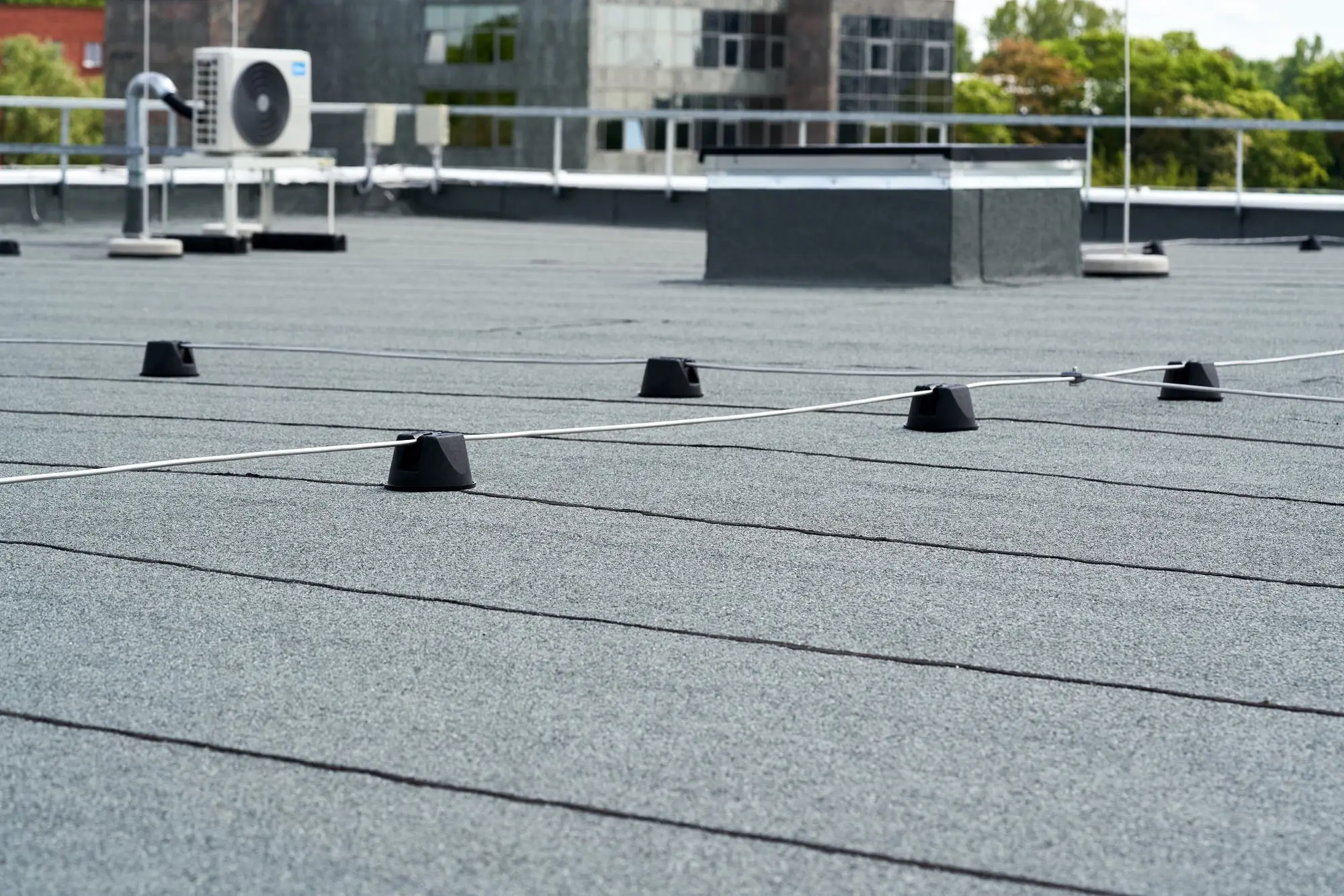
On a low-slope roof, water rarely drips straight down from the hole. It gets under the membrane, soaks into the insulation and travels along the deck, sometimes for many feet, before it finds a seam in the deck or a fastener to follow down. The stained ceiling tile tells you where the water came out. It doesn’t tell you where it went in.
That’s why patching the spot directly above the stain so often fails. A real commercial roof repair starts on the roof with a slow walk of every seam and flashing near the leak, then works uphill.
Where commercial roofs in Shawnee usually leak
Most leaks we trace come from a short list of places.
Rooftop units and curbs. The flashing around HVAC curbs, exhaust fans and pipe penetrations takes a beating from service crews, vibration and heat. A cracked corner or a loose counterflashing is one of the most common leak sources on any commercial building.
Seams. On TPO the seams are heat-welded, and on EPDM they’re bonded with primer and tape. A seam that wasn’t welded or bonded fully can hold for years and then open up after a hard freeze or a summer of expansion and contraction.
Drains and scuppers. A drain clogged with leaves or a strainer knocked loose lets water pond. Ponded water finds the weakest seam nearby, and in winter it freezes and works that seam open.
Parapet walls and coping. Gaps between coping caps let water run down inside the wall, and it can show up well below the roof line.
Edge metal. Wind pulls hardest at the corners and edges of a low roof. Loose edge metal lets the wind get under the membrane, and a small lift can peel back into a large one in the next storm.
Punctures. A dropped screw, a technician’s tool or hail can puncture a single-ply membrane. These are often tiny and only show up on a close walk.
What Kansas weather does to a commercial roof
The Kansas City area hands a commercial roof a mix of hazards over a single year. Spring storms bring hail that can bruise or fracture membranes and crack the board underneath, and straight-line winds that test every edge. Summer sun heats a dark roof surface well past the air temperature and makes the membrane expand and shrink every day. Winter adds snow load, ice in the drains and freeze-thaw cycles at every spot where water sits.
None of this means your roof is failing. It means repairs and inspections are worth timing around the seasons, especially after a major hailstorm.
What commercial roof repair in Shawnee usually looks like
Most repairs are smaller than owners expect once the source is found.
A puncture or open seam on TPO gets cleaned and a patch is heat-welded over it. On EPDM, the patch is primed and bonded with seam tape. Flashing at a curb or wall gets replaced with new membrane flashing and fresh counterflashing, not another layer of mastic.
Ponding gets fixed at the cause. That can mean clearing and resetting a drain, adding a cricket to push water toward it, or building up low spots with tapered insulation.
Wet insulation is the part people don’t see. If water has been getting in for a while, the insulation under the membrane may be soaked. A moisture meter or a small test cut shows how far it has spread. Wet sections get cut out and replaced, because a dry membrane over wet insulation keeps rotting the deck and loses its insulating value.
When repairs stop making sense
A repair is the right call when the problem is local and the rest of the membrane is sound. When leaks keep coming back in new places, seams are failing across the roof, the membrane has turned brittle or a large share of the insulation is wet, you’re usually better off planning a re-roof than paying for patch after patch.
You’ll get photos and a written summary either way, and the decision stays yours. If replacement is on the table, our commercial roofing in Shawnee page explains the systems and options. For a building with TPO, our TPO roofing in Shawnee page goes deeper on that membrane.
Keeping your business open
Most commercial roof repairs happen on the roof, not inside the building, and can be planned around your operating schedule. If work affects an area below, you’ll know ahead of time so you can move stock, equipment or people. Ask any roofer how they’ll protect the interior and handle access before work starts.
Storm damage and insurance
If hail or wind damaged the roof, you or your property manager files the claim with your insurance company, and you’re responsible for your deductible. We document the damage with photos, provide a written estimate and work with your adjuster. Be wary of anyone who offers to waive or cover your deductible. Our storm damage in Shawnee page has more on what to check after a storm.
How it works
- Book your free inspection. Call 913-398-5020 or request a free estimate online. Tell us where the leak shows inside.
- Get a clear, honest assessment and estimate. We walk the roof, check drains, seams, curbs and edges, test for wet insulation where needed and give you photos with a written estimate.
- The repair gets done and the site gets cleaned up. Scraps, fasteners and old material come off the roof with the crew.
A slow roof leak on a commercial building costs more than the patch. Wet insulation, ceiling tiles, inventory and equipment all sit under it, and the longer it runs, the bigger the repair.
Commercial roof repair questions
Can you repair just the leaking section?
Usually, yes. If the membrane around the leak is sound, a local repair is the right fix. If testing shows wet insulation spreading beyond that area, you’ll see the readings before deciding.
Do you repair both TPO and EPDM roofs?
Yes. TPO and EPDM are repaired differently, since one is heat-welded and the other is bonded, and the repair has to match the membrane.
What should I do until the roof is looked at?
Move inventory and equipment out from under the drip, catch the water and note when it leaks: during every rain, only in wind from one direction or only when snow melts. Those details, plus a few photos of the ceiling, help narrow down the source fast.
Do you work outside Shawnee?
Yes. We work on commercial buildings across the Kansas City area, including nearby Lenexa and Overland Park.
A dry building and a roof you can plan around
Call 913-398-5020 or book your free inspection online. You’ll know where the water is getting in, what the fix is and how much life the roof has left, so you can budget for it instead of reacting to it.