Every afternoon storm sends a wall of water off your roof edge. It splashes mud up the walls, carves a trench in the flower bed and puddles at the front door. Or the gutters you already have overflow at the corners every time it really rains. Gutter installation in Palm Coast means building a system that can keep up with Florida rain.
It’s easy to feel unsure here. Gutters look simple, quotes vary a lot, and it’s hard to tell what you’re paying for. You deserve an estimate that’s based on your roof and explained in plain terms.
APC Roofing installs rain gutters along with the roofing work we do across Flagler and Volusia counties. We’re licensed in Florida (CCC1337030), insured and GAF Certified, and the estimate is free.
What sets the size of your gutters
Good gutter installation starts with measurements, not a catalog. Two numbers matter most: how much roof area drains to each run, and how steep the roof is. A steeper roof sends water down faster, so it can push more water into a gutter than its footprint suggests.
Summer storms along the coast can drop a lot of rain in a short window. A gutter that handles an ordinary shower can still overflow in that kind of downpour. Many Palm Coast homes do fine with standard 5-inch K-style gutters, while larger roofs or long runs often need 6-inch gutters to keep up. The math on your roof decides it, and your estimate should show you why.
Downspouts do more of the work than you’d think
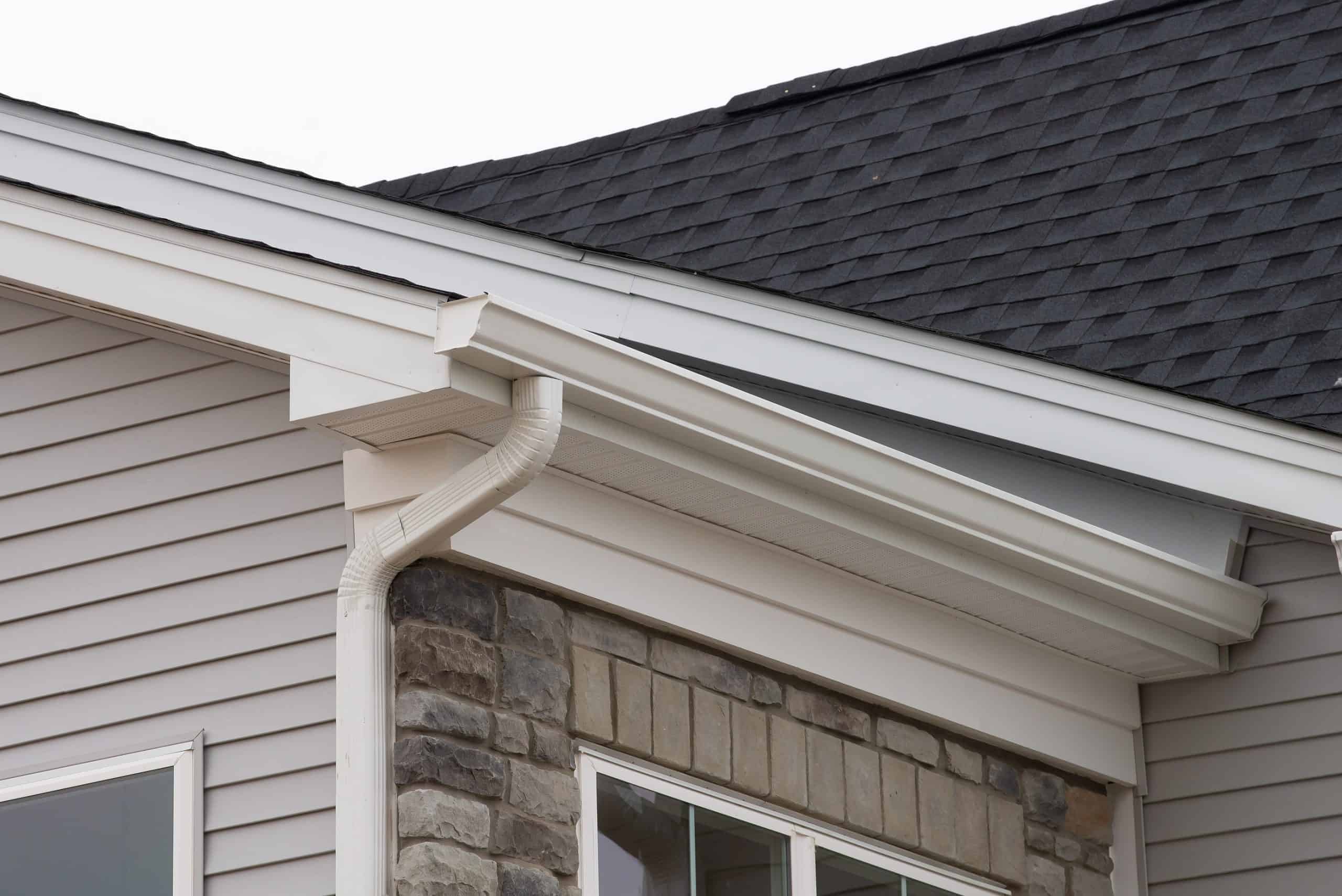
A gutter can only drain as fast as its downspouts allow. Too few, or downspouts that are too small, and water backs up and spills over the front edge. Placement matters too. Spreading downspouts so no single run carries too much water keeps the system from overflowing at the far end.
Where two roof planes meet in a valley, water concentrates at one spot on the gutter below. That spot may need a larger downspout or a diverter so the flow doesn’t shoot past the gutter edge.
Gutter installation in Palm Coast, step by step
Checking the fascia. Gutters hang on the fascia board along the roof edge. If that wood is soft or rotted, it has to be fixed first, because new gutters on rotten wood will pull loose. APC also works on fascia and soffits, so that repair doesn’t need a second contractor.
Setting the slope. Gutters need a slight fall toward each downspout so water doesn’t sit. A common guideline is about a quarter inch of drop for every 10 feet. Too little and water pools; too much and the gutter looks crooked from the street.
Hanging it securely. Hidden hangers spaced along the run hold the gutter to the fascia. Along the coast, wind is the test, so the spacing and fastening need to hold through hurricane-season gusts.
Protecting the roof edge. Drip edge or a gutter apron at the roof edge steers water into the gutter instead of letting it run behind and soak the fascia.
Sending water away from the house. Downspouts get extensions or splash blocks that carry water out away from the foundation. Much of coastal Florida sits on sandy soil that washes out quickly, so where the water lands matters as much as the gutter itself.
Material choices for Palm Coast homes
Aluminum is the most common choice here. It doesn’t rust, which matters in salt air, it’s light, and it comes in colors to match your trim. Runs can be formed on site in one long piece from coil, so there are fewer joints along the front of the house to leak.
Your estimate should spell out the gutter size, the material, how many downspouts and where they go. If two quotes differ a lot, those details are usually why.
Pairing gutters with a roof project
If you’re planning a roof replacement in Palm Coast, it often makes sense to look at the gutters at the same time. The roof edge, drip edge and fascia are already being worked on, and everything can be sized and fitted together. Gutters can be added to an existing roof too, as long as the fascia is sound.
To learn more about why gutters matter on a Florida home and what to choose, see our rain gutters in Palm Coast page, or browse all our Palm Coast gutter services.
How it works
- Book your free estimate. Call 386-259-8425 or request a free online estimate.
- Get a clear, honest assessment and estimate. We measure the roof, check the fascia and look at where water lands now, then give you a written estimate with the size, layout and material spelled out. Financing is available through Aqua Finance, Fortifi, Hearth and Home Run Finance.
- Your gutters go up and the site gets cleaned up. The crew hangs, seals and tests the system and leaves the yard clean.
Every heavy rain without working gutters washes a little more soil from around your foundation and soaks the fascia a little more. Those problems are slow, and they cost less to stop now than to repair later.
Gutter installation questions from Palm Coast homeowners
What size gutters do I need in Florida?
Many homes use 5-inch gutters, but larger roofs, steep roofs and long runs often need 6-inch gutters with bigger downspouts to handle heavy Florida rain. Measuring your roof is the only way to know for sure.
Should I install gutters before or after a new roof?
After, or at the same time. Installing gutters with the new roof lets the drip edge, fascia and gutter fit together properly.
Can you replace rotted fascia when you install gutters?
Yes. Fascia and soffit work is part of what we do, and soft fascia gets fixed before new gutters go up.
Will new gutters hold up in a hurricane?
Well-fastened gutters stand up to strong wind far better than loose ones, but no gutter is storm-proof in a direct hit. After a big storm, check for sagging runs or pulled hangers and call us to take a look.
Get your Palm Coast gutters installed right
Call 386-259-8425 for your free estimate, or start online. You’ll end up with gutters that keep up with the next downpour, a dry front step and soil that stays where it belongs.