
The hail lasted maybe five minutes. Now the yard is covered in shredded leaves, the gutters have new dents, and you can’t tell from the driveway whether the roof is fine or quietly ruined. You don’t want to file a claim over nothing, and you don’t want to find out next spring that you should have.
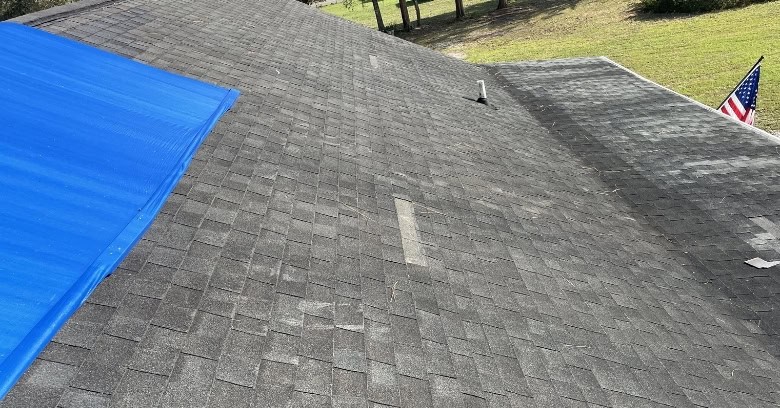
That’s a fair spot to be in. Hail damage is hard to read from the ground, and it often doesn’t leak right away. Hail damage roof repair in the Ozarks starts with someone getting on the roof and telling you plainly what’s there.
APC Roofing is a GAF Certified roofing contractor with an office in Springfield, licensed and insured. Your inspection is free, and you’ll see photos of everything we find.
What hail damage on a roof looks like
On asphalt shingles, hail usually leaves a bruise: a dark spot where the granules have been knocked off and the asphalt underneath is exposed. Press on a fresh bruise and it can feel soft, a bit like the spot on an apple. Harder hits crack the shingle mat or break the corners off tabs.
Not every mark is hail. Blistering, scuffs from foot traffic and normal granule wear can look similar to an untrained eye. That’s one reason a careful inspection matters: the damage has to be real, and it has to be from the storm.
Other roof types show it differently. Tile can crack or chip outright. Metal roofs dent, and whether a dent is cosmetic or lets water in depends on where it is and how deep it goes.
Signs of hail damage you can check from the ground
You don’t need a ladder to gather some useful clues. Walk around the house and look for:
- Fresh dents in gutters, downspouts and metal roof vents
- A pile of granules at the bottom of a downspout or in the gutters
- Dings on the fins of your outdoor AC unit
- Torn window screens, chipped paint or cracked siding on the side the storm came from
- Damage to cars, fences or a mailbox from the same storm
If the soft metals around your house took hits, the shingles almost certainly did too. How badly is what the inspection answers.
Why hail damage doesn’t always leak right away
A bruised shingle can keep water out for a while. Over the next few seasons, though, the exposed asphalt dries out in the sun, more granules wash away, and a crack forms where the hail hit. Freeze-thaw cycles in an Ozarks winter speed that along by working water into anything already split.
So the leak may show up a year or two after the storm, when it’s much harder to prove which storm caused it. That’s the strongest reason to get a roof looked at soon after a hailstorm, even when the ceilings are dry.
Hail damage roof repair in the Ozarks, or a full replacement?
If the damage is limited to a few spots, a repair may be all you need. Damaged shingles are cut out and replaced, cracked flashing or vents are swapped, and the rest of the roof is left alone. Our shingle roof repair page for the Ozarks covers that work.
When bruises are spread across every slope, patching starts to make less sense. Matching is the other catch. Older shingles may not be made anymore in your color, and a quilt of new and old shingles can look worse than the damage did. Then a roof replacement in the Ozarks may be the better long-term call. You’ll get photos and a plain explanation, and you make the decision.
Choosing shingles for the next storm
Hail comes back around here. If you’re replacing the roof, ask about impact-rated shingles, the ones tested to the UL 2218 Class 4 standard. They’re built to take hail better than standard shingles, though no shingle is hail-proof. Some insurance companies treat them differently on a policy, so it’s worth a call to your agent before you choose.
Hail damage and your insurance claim
If you decide to file, you open the claim with your insurance company and you pay your deductible. We inspect the roof, photograph and measure the damage, give you a written estimate and work with your adjuster so the hail damage is clearly documented. Our insurance roof claims page for the Ozarks explains the process step by step.
Be wary of anyone who offers to waive or cover your deductible, or who pushes for a signature before the roof’s been inspected.
How it works
- Book your free inspection. Call 913-398-5020 or request a free estimate online.
- Get a clear, honest assessment and estimate. You’ll see photos of each hit we find, hear whether it’s a repair, a replacement or nothing worth worrying about, and get a written estimate.
- Your roof gets done and the site gets cleaned up. Many residential shingle roofs are finished in a single day, and the crew cleans up before leaving.
Hail damage questions from Ozarks homeowners
How big does hail have to be to damage a roof?
As a rough guide, hail around an inch across is often where shingle damage starts, and older or brittle shingles can be hurt by smaller stones. Wind matters too, since hail driven sideways hits harder.
How soon after a hailstorm should I get an inspection?
Sooner is better, while the marks are fresh and clearly tied to one storm. Your policy also sets a deadline for reporting damage, so check it.
My roof isn’t leaking. Can it still be hail damaged?
Yes. Bruised shingles often hold for a season or two before they crack and leak.
Do you repair hail damage on metal and tile roofs too?
Yes. We work on shingle, metal and tile roofs, and the inspection covers whichever one you have.
Know what you’re dealing with
Hail damage left alone tends to turn into a leak at an inconvenient time, often long after the storm is forgotten. A quick inspection now costs you nothing and settles the question.
Call 913-398-5020 to book your free inspection, or read more about storm damage roofing in the Ozarks. Either way, you’ll end up with a sound roof, a dry house and no surprises the next time it rains.


















