Researching Tile Roof Repair for a Property in Deltona Florida?
APC Roofing builds, patches and relays coverings of every common shape, including the valleys, ridges and wall flashings.
Phone 386-259-8425 and the answers you get will be in everyday language.
What Sits Over the Attic: A Plain Guide
Rows of clay or concrete pieces carry the bulk of the rain down to the gutters, and the real waterproofing is an underlayment laid across the boards. Gusts can push a little moisture up under the courses during a downpour, and the layer beneath leads that seepage down and off the slope.
A cracked piece of tile does not by itself put a stain on a ceiling, because the waterproofing underneath is still sound. Once past the underlayment, water often follows the decking downhill before it falls, so the mark it leaves can sit well away from the opening.
Picking a Material: Sun and Moisture
A clay piece is formed from wet earth and fired at high heat, and the pigment goes clear through rather than sitting on the face. The sun can beat on a slope like this for decades with barely a visible change, while quality material turns away nearly all the rain that lands.
Concrete tile is formed from a wet sand and cement blend and hardened by curing, and on a lot of lines the pigment sits in a slurry near the face. Years of strong light wash out the sunniest slopes, while a broken corner shows the gray inside. Swapping in one unit leaves an obvious bright patch, and blending in takes many seasons outdoors.
Concrete absorbs noticeably more rain than good clay does, and at the colder end of our territory, soaked-up moisture turns to ice within the body. Repeated cycles like that can flake the face away, so products carry a grade for how they stand up to that exposure.
Choosing a Profile – Style Meets Function
Traditional barrel work alternates a trough turned up with a cap turned down, and the look echoes centuries-old Mediterranean houses. Modern S tile rolls the dip and the hump together, and a lot of newer houses carry it.
A plank-like flat piece looks like slate or wood shake from the curb, and rain moves over the exposed faces rather than along a trough. The hollows of a barrel or S roof trap tree litter, while a smoother surface lets much less settle.
Structural Limits: Before Switching Materials
Clay or concrete at full thickness is several times heavier than asphalt shingles, and rafters under a roof tiled when new were sized with that in mind. Trading a light covering for a heavy one puts new demands on an older house, and an undersized frame can sag under it over the years.
An engineer’s assessment of the rafters and supports comes before any such conversion, and strengthening is sometimes part of the answer. Reduced-weight concrete exists as well, and a house that would struggle under the standard version may take the reduced version.
Securing the Covering – Code and Exposure
A piece can be nailed or screwed through a hole near its head, and on many jobs each course hangs from a wood batten run across the slope. A foam adhesive laid under the tiles is another common method, and a mortar bed under every unit is used on others. Metal clips at the lower edge add grip in certain systems, and what a given job gets is set by the maker’s literature and the code.
Wind pulls hardest at the eaves, rakes, hips and ridges, and the fastening schedule tightens at the perimeter. The coastal end of our territory is held to hurricane standards that ask more of every tile, and the amount of foam and the number of screws are spelled out in advance. Mending a roof means matching the method that keeps its neighbors in place, since careless prying at a glued unit breaks more than it frees.
The Underlayment – Heat and Sunlight
Doubled asphalt felt was the norm for a very long time, and newer options include synthetic rolls and peel-and-stick bitumen. Summer heat builds up below the covering and bakes the underlayment, and anything not intended for such exposure turns brittle early.
The tile also shades what lies under it from direct sun, and an opening up top lets the rays wreck the exposed strip in short order. Even with the rooms dry, a missing piece deserves prompt action, because rot starts in the wood as soon as the membrane lets rain through.
New Waterproofing – Matching Replacements
The existing pieces on a major project are frequently hand-removed and set aside, and sagging boards get repaired. A new underlayment is laid across the whole area next, and the same tile goes back where it came from. The finished result looks just like the original, and the layer that stops leaks is at the start of a long life.
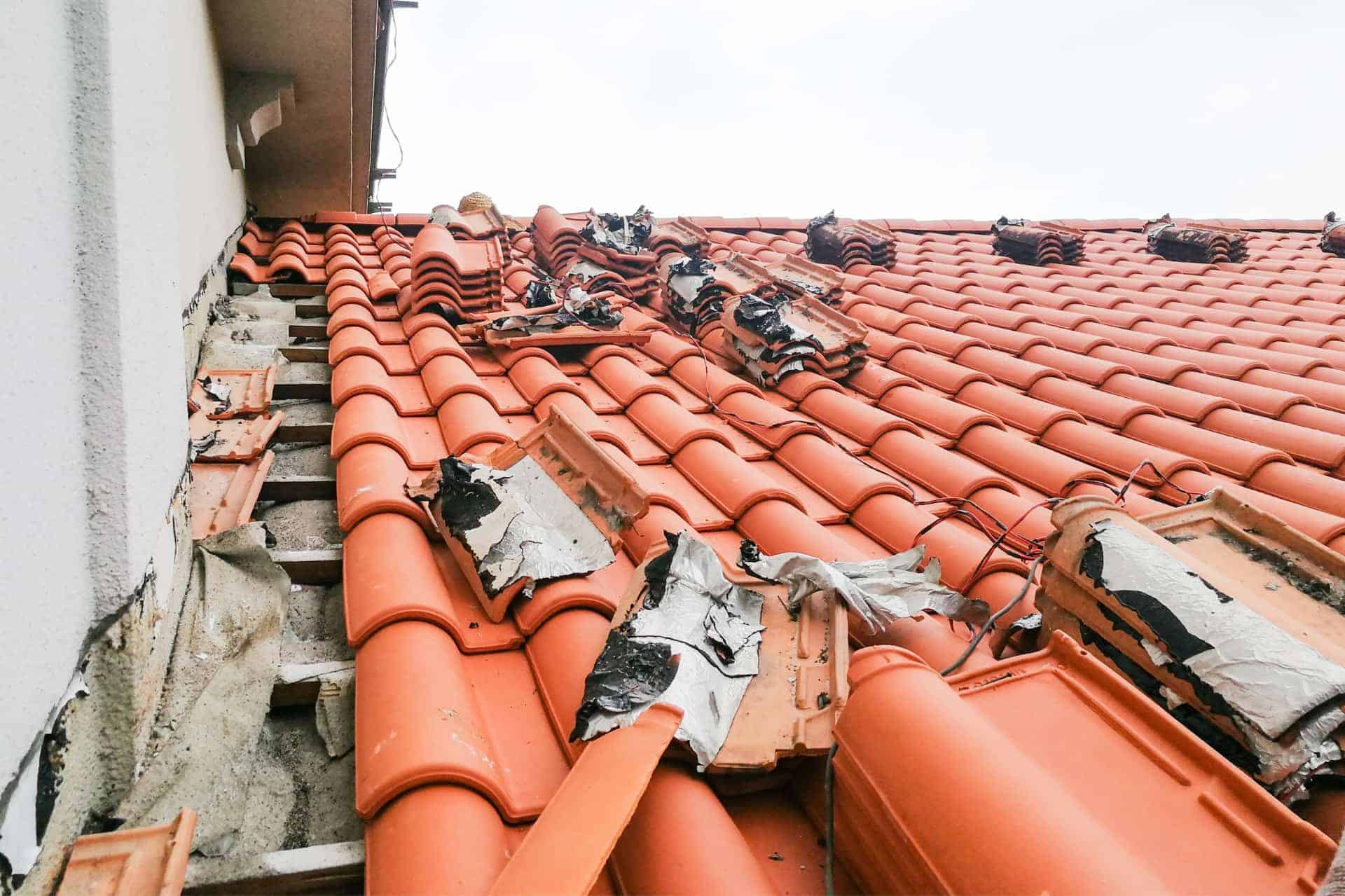
Not every piece survives being moved twice, and the rate climbs with the age of the roof. Any new tile has to interlock with the courses around it, and where the original profile is still in production, an exact match is possible. Discontinued tile is replaced with salvage or the nearest alternative, and even the best option can differ slightly in shade.
Damage to Single Units: Trees and Hail
Somebody’s shoe accounts for a large number of the fractures, and the walker is often a contractor there for a dish, a chimney or a gutter. The top of a ladder set against the edge cracks the lowest units, while a standoff keeps the pressure elsewhere.
A heavy bough dropping onto the slope ruins many tiles at once, and cutting back overhanging growth heads off most of that harm. Large hailstones at the colder end of our territory can split a unit clean through, though pea-sized pellets usually do nothing.
Stepping Safely – Boards and Routes
The lapped end of each piece bears weight well, while the center has no backing and fractures under a shoe. On barrel and S profiles, a step belongs low in the pan, never on the crown, and a path used over and over gets boards so the load is shared.
From above, a unit trodden on in the wrong spot can look intact, so a roof can collect breaks nobody knew about. Anyone putting equipment on tile should arrange the approach with a roofer beforehand, and tile beneath every bracket gets removed and put back properly.
Valley Lines: Width and Upkeep
Where adjoining slopes meet, a single fold gathers rain from both, and on tile a sheet-metal channel runs down it. Where the pieces are cut back decides how wide the open strip is, and too tight a space spills water sideways in a cloudburst.
Small leftover pieces along the metal have nothing to nail through, and foam, clips or tie wire keep them from sliding. Litter that piles up in the valley dams the flow, and the water then works sideways beneath the pieces.
At the Ridge – Air and Closures
Along the peak and the sloping outside corners, a run of curved trim closes the joint, and many older roofs hold it in mortar. Old bedding splits as the roof warms and cools, and chunks drop out while the pieces loosen.
A raised nailer along the joint gives the trim something solid to screw into on newer work, with foam or a flexible strip sealing beneath. Vented products let attic air move out at the peak, while baffles inside turn back rain and insects.
Chimney and Wall Junctions – Sealant Shortcuts
Anywhere tile stops against brick or siding, bent sheet metal lines the corner, with a counterflashing set above it to cover its upper edge. With tile, that flashing is broad at the base and ends in a raised lip, while shortened tile sits clear so runoff drains freely.
Sealant smeared along the joint cracks within a few seasons, and water comes back through the same place. A proper repair means lifting the pieces and redoing the flashing under them, with fresh underlayment laid at that edge before the pieces go back.
Pipes and Vents – Mounts and Skylights
Each plumbing stack has a base flashing attached to the underlayment below, with a soft lead or aluminum skirt molded to the tile above. A boot designed for asphalt cannot close the gaps a curved piece leaves, and rain gets under its flange.
Every skylight, vent and panel mount requires flashing suited to the tile, and anything drilled through a piece without it becomes a leak.
At the Bottom Edge – Keeping the Line Straight
A rolled profile leaves an open arch under the end of each piece at the gutter, and birds and wasps move in and blown rain enters unless the space is blocked. A closure made for the purpose is installed along the fascia, and weep holes in it still let water drain out.
Eave pieces have nothing below them to angle them up, and a riser strip gives them the rise they need. Low-set pieces at the gutter tend to pond water, and a dip along the lower edge shows from the yard.
Built-In Cooling – Trouble Spots
Rolled shapes and batten systems keep the pieces lifted above the boards, and air can move through the cavity below. Much of the sun’s heat leaves with that draft instead of sinking inward, so the underlayment stays cooler.
Across a long summer, air conditioning tends to run less, while the weight of the material delays warmth reaching the living areas. A packed eave or a fully mortared ridge blocks the draft, so the benefit disappears.
What Collects Up There – Washing Without Damage
Newer concrete sometimes shows a powdery white film called efflorescence, and it fades on its own with rain. Moss and lichen hold moisture in the laps and hollows, and at the colder end of our territory freezing then flakes the face.
Pressure washing strips the color coat from concrete, and it drives water in beneath the courses. A suitable cleaner applied with a garden-hose rinse loosens growth, while clearing litter from the valleys and gutters by hand prevents damming.
Things to Watch For: Before Damage Spreads
- Part of a course has shifted out of line, and the hold under it has given way.
- One opening in a course shows bare underlayment, and the exposed sheet begins to degrade in sunlight.
- Chunks of tile collect along the driveway or walk, and the break they came from may be out of sight.
- Mortar pieces sit in the grass below a ridge, so the trim along the peak may be losing its hold.
- A water stain appears on an upstairs ceiling, while the opening that feeds it may lie higher up the slope.
- An inside wall near where the roof meets it turns blotchy, which suggests trouble with the flashing there.
- Mats of green or black growth choke the laps, which keeps the pieces damp between storms.
- A low spot shows along the front edge of the covering, which may point to rotted wood behind the gutter.
APC Roofing and Tile Roof Repair in Deltona Florida: What to Expect
The opening step is walking every slope, and the material, the shape and the way the pieces are set are identified. The valleys, ridges, flashings and eave closures are read one at a time, and a handful of pieces are raised where the sheet below is in doubt. Up in the attic, stains and softened sheathing are looked for, as discolored wood traces where water traveled.
What turns up is photographed, and the extent is measured. Everything seen goes down in writing, with each recommendation explained. If the sheet beneath holds and the damage is only on top, a repair is the answer, while an underlayment at the end of its life is named for what it is. The owner picks what to do, and holding off remains possible.
Tile Roof Repair for Deltona Florida Homeowners – Looked at Closely
Phone 386-259-8425 and describe the problem.
Patch or Relay – Slope by Slope
A split unit, loose trim or a tired flashing at a chimney tends to be a problem of one place, so the effort is confined to that area. Choosing a small job or a relay comes down to the underlayment, and a worn-looking surface proves nothing either way.
A slope with a failed sheet from top to bottom is relaid, and slopes still in good shape stay as they are. Underlayment put down in one job usually ages evenly, so the rest can be close behind.
Looking Ahead: Staying Sound
Quality fired clay can keep going for a century or more, while concrete serves for decades, if somewhat fewer. Underlayment gives out well before the pieces do, and it is usually what calls for the next large job.
Regular looks and clear gutters keep the covering in good order, whereas neglect lets a single gap ruin the sheet early. Every service figure is an approximation, not a commitment, since grade, attachment and flashing quality push it up or down.
Getting the Basics Right – Code and Maker Rules
Each course of tile overlaps the next instead of being sealed to it, so the roof must tilt enough to keep rain moving. Shallower pitches get a sturdier underlayment, and under the permitted limit another covering does the job better.
The decking must be solid before anything is laid on top, so spongy areas come out and new wood goes in. Gutters belong to the drainage of the house, and when they back up, water rises beneath the lowest course.
When you are sizing up Tile Roof Repair in Deltona Florida, reach out to APC Roofing at 386-259-8425. The slopes are walked and the findings are put in writing, and what happens next is up to you.
« All Services in Deltona Florida