Considering Corrugated Metal Roofing Here in Deltona Florida?
APC Roofing works on ribbed sheet and concealed-clip panels alike, across homes as well as sheds and barns.
Phone 386-356-2111 and you will hear in plain words what condition the roof is in.
Telling Systems Apart – Surface Clues
Corrugated and ribbed sheet is held down by screws driven straight through the metal, while standing seam is attached with clips tucked inside raised joints. Nearly every residential job uses coated steel, though aluminum and copper have a place too.
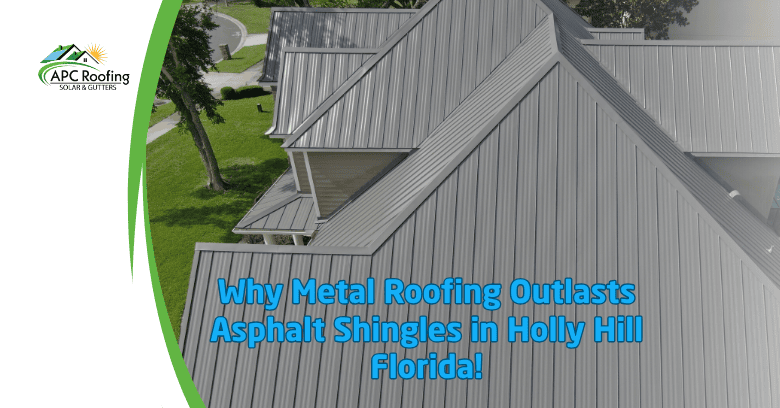
A glance from a lawn at lines of screw heads points to a through-fastened roof, while plain pans and tall ribs with nothing in sight are standing seam. Outbuildings and porches lean toward ribbed or corrugated sheet, and houses carry both styles.
The Cross-Section – Span and Style
Corrugated sheet ripples in smooth, repeating curves, and ribbed panels pair tall square ribs with broad flat areas. Adjacent lengths share a narrow side lap, and screw locations follow a published diagram.
Ribs make a stiffer panel that crosses longer spans, while corrugated fits a period barn or a farmhouse style. On a big roof plane, taller ribs keep a downpour from spilling over side laps, while a low pattern handles short runs like a porch or lean-to.
Hardware in the Weather – Driven Right or Wrong
Each screw draws a panel snug against a rafter or purlin, and a washer under each head keeps rain out. Years of sun and heat stiffen synthetic rubber until cracks form, though the coated metal nearby stays sound far longer.
An overdriven screw squashes a washer flat, and a slack or crooked fastener leaks on one side.
Fastener Replacement – Where Help Stops
Rubber rings across a ribbed or corrugated field wear out together, so a complete re-screw comes due at some point. Worn hardware is taken out in turn, and a bigger diameter is driven in to grip where an old thread stripped.
Re-fastening stops water at every head and holds down sheets that lift, but corrosion, parted laps and bad flashing are left as found. Screw length and thread are chosen for what sits below, wood or a steel purlin, and color-matched tops blend in with a painted finish.
A Covering in Motion – Built to Allow Travel
A steel sheet grows in afternoon heat and shrinks back by dawn, and forty feet of panel shifts roughly a quarter inch or more, while aluminum goes about twice as far. Where nothing lets a panel slide, the metal elongates screw holes, and washers begin to leak.
Ticking heard as morning sun lands on steel is ordinary expansion, and a well-built roof takes no harm from some noise.
Anchoring Standing Seam – Out of Sight
Each long pan is fixed solid in one short zone, and floating clips farther along give the metal freedom to shift. Trim at an unanchored end leaves a gap for travel, while a pan fastened hard along every foot pulls loose or ripples.
Clips are screwed to the deck along one edge of every pan as work proceeds, so no fastener head is left out in the weather.
Joint Styles – Suited to Pitch
Snap-together panels latch by hand, and mechanical versions are finished by a rolling tool. Double-lock construction resists uplift and ponding, so maker ratings reach lower pitches.
Manufacturers offer a range of pan widths and rib heights, and a home's design and a buyer's taste guide selection. Parts made for one system rarely suit a rival brand, so parts are not mixed between makers.
Heavier and Lighter Stock – Worth Confirming
A steel panel is rated by gauge, and a low figure signals thick metal. Pole buildings frequently carry twenty-nine, and homes typically get twenty-six or twenty-four.
For aluminum, sheet is sized in thousandths, and in both cases a heftier panel stays straighter and tougher. A light grade and a heavy grade are indistinguishable from a driveway, so only a maker's label or data sheet can confirm what was bought.
Factory Protection – Finishes That Hold Up
At a steel mill, coil gets a metallic layer of zinc or zinc and aluminum, and baked-on primer and color follow. A scratch that stays within paint does no harm, but a sheared edge exposes steel that will corrode.
PVDF finishes hold color for decades, and polyester types chalk white sooner. Wet masonry corrodes aluminum-zinc coated sheet, so panels are kept away from a new chimney or stone wall.
Which Metal Suits – Trade-Offs
Aluminum has less mass than steel and cannot turn red with rust, but softness means a heavier grade for equal toughness. At the coastal end of our territory, salt spray breaks down galvanized coatings faster, and manufacturers set limits on how near a shoreline a product may go.
Copper turns up chiefly on bay windows, dormers and entry roofs, and the metal is left bare to weather.
Metals That React – Matching or Separating
Rain rinsing off a copper detail wears through coated steel downhill, and staining shows up well ahead of pinholes. Treated wood touching aluminum pits the metal at each contact, and a mismatched fastener rusts quickly.
A new piece of flashing belongs in a metal that matches existing work, or tape and membrane keep dissimilar metals from meeting.
Looks, Not Leaks: What Can Be Done
In trade terms, oil canning describes soft ripples across a broad flat between seams, and faint hollows show at sunrise and fade by noon. A panel that looks uneven sheds rain as well as a perfect sheet, and useful life is unchanged.
Striations, heavier stock and narrower pans keep rippling in check, and an installer who does not overdrive clips helps as well. Photographs of finished houses show how noticeable oil canning can be, and the decision on profile rests with you.
Comfort Below – Sound and Temperature
Panels laid straight over bare purlins ring out in a downpour, since a single skin is the only barrier. A home has sheathing, a membrane and an insulated ceiling under steel panels, and loudness indoors is close to what asphalt gives.
A white, tan or light gray panel turns back much glare, so upstairs spaces bake less. A charcoal or black panel gets hot, and ventilation and insulation underneath matter as much as finish. After sunset, metal sheds stored warmth quickly, so evenings indoors feel better sooner.
Guards and Placement – Only Where Needed
At the colder end of our territory, snow slides readily off smooth coated steel, and a whole mass may come down at once on anything under an eave. Retention bars keep a load up top to melt off gradually, with placement over doorways, decks and equipment.
A standing seam roof gets brackets that squeeze an upright joint rather than pierce a pan, whereas corrugated panels get mounts anchored through to purlins, and in our warmer markets a house goes without.
Storm Marks: When Paint Cracks
Hail is a fact of life at the colder end of our service area, and a heavier gauge or striated pans resist dents better. Paint knocked off at a crease leaves base metal exposed to corrosion, while a seam or trim edge pushed out of line may open.
Once a storm has moved on, affected spots get photographed and measured, so the size and position of each dent are known.
Storm-Ready Attachment – A Denser Pattern
Gusts tug harder at corners and along a perimeter, and an unfastened edge lets pressure build beneath. Trim hooks over a continuous strip fastened to the deck, leaving nothing for a storm to seize.
Clips and screws are packed closer in high-load zones near corners, set by a maker's tested layout for each exposure. At the coastal end of our range, where hurricanes come ashore, rows of screws draw in further, and only systems with a high wind rating qualify.
Breaking Through the Metal: Keeping Water Out
A pliable-based collar is shaped to fit a panel and clamped onto a pipe, and a flat location lets a flange bed down evenly. A bigger penetration is framed with a curb and a small cricket upslope, and water cannot pool at an upper edge.
Sealant finishes a joint already made watertight by folded metal, since weather hardens and splits any compound long before the panels are done.
Meeting Planes – Joining Long Runs
A valley pan goes down ahead of any panel, and panels are sheared to a matching slant. Each raw end is hemmed back and hooked onto a cleat, and nothing pierces a channel that carries rain.
Where a long run needs more than one length, a lap is sealed between layers, and uphill metal always goes on top, screwed through.
How Low Metal Can Go: Where Locked Seams Help
Screw-down panels typically call for roughly three in twelve, and on a gentler slope, overlaps start to let water through. Machine-folded seams go much lower, with certain lines suited to decks that are nearly flat.
Nearly level spots over sunrooms and porches turn up on plenty of houses, and a measured angle decides what goes on, and below every panel limit, a membrane goes on.
Substrate: Checked on a Tear-Off
Metal on a dwelling is installed over full sheathing, and a heat-rated synthetic membrane goes in between, because traditional felt degrades quickly up there. Pole buildings commonly have metal spanning between purlins with air below, so wider gaps call for thicker steel.
With an old roof gone, damaged sheathing is cut away and rebuilt, as fasteners driven into mush pull straight out.
When the Old Roof Stays: Condition Decides
Local codes commonly accept metal set over a lone shingle layer, so waste is kept out of a landfill. A steel covering adds only slight dead load, so reinforcement is rarely needed. A synthetic underlayment and rows of battens come next, and clips or screws go down into solid structure.
A roof that was recovered once before, or a deck with decay underneath, comes off entirely, since dampness sealed beneath panels goes on rotting structural lumber.
Finishing Off: Done Properly
Closure strips shaped to a panel profile plug hollows under every rib where a run starts and stops, and driving rain and wasps are blocked. A ridge cover can include a vent or be solid, and attic ventilation is what decides.
Trim at every rake plus a drip edge over a gutter finish a roof's border, and fascia boards are kept out of runoff.
Care With the Metal – Sheet by Sheet
Standing seam is produced to fit each run from bottom to top, and nothing overlaps partway up. A long panel calls for several people spaced along the metal, and a crimped or creased pan is no longer usable.
Each step should land in a flat with support right underneath, because ribs and seams crush under a boot. Dew or rain makes coated steel as slick as glass, so the safest place for the household is indoors.
Signs Worth a Call – No Ladder Needed
- Rust rings around screw heads, near the top of a run.
- A row of lifted screws, on a south exposure.
- Flashing flapping in a breeze, following a gusty night.
- A pipe collar tipped to one side, over a kitchen.
- Rust creeping from a trimmed end, along a rake.
- Peeling paint, on a south exposure.
- Spots on a ceiling in a row, in a garage.
- A gap along a rib, near a valley.
How APC Roofing Approaches Corrugated Metal Roofing in Deltona Florida: Our Routine
We start by identifying which panel type is installed and how the panels are held, followed by every screw or clip, edge, boot, valley and lap. Notes cover gauge, finish and every kind of hardware, while the underside of the deck is inspected from the attic.
Every finding goes into a report with images, and every item comes with the why. When a small fix works, nobody pushes a bigger job, and a roof at the end of service life is named as such.
Corrugated Metal Roofing for Property Owners in Deltona Florida: Plain Findings
Call us at 386-356-2111 and a visit gets put on the calendar.
Keeping the Roof – When a Tear-Off Makes Sense
An individual rusted sheet can be unscrewed and exchanged, but brand-new paint stands out against faded neighbors. Resealing a lap or replacing a boot stops a local leak, and new screws restore a roof full of aged seals.
Rust through sheet after sheet calls for a new covering, and a covering with every joint and collar given out is no different. Redoing one face of the house is a middle path, when damage stays in one place.
The Long View – Exposed Screws Versus Hidden Clips
A carefully installed panel system can pass forty years, though climate, care and material all make a difference. A seamed pan roof has fewer parts that age, while ribbed sheet gets new fasteners once washers tire.
Dissimilar metals, raw edges and sealant used instead of proper flashing wear out a covering ahead of schedule, and regular inspection turns up faults while minor. Leaves and twigs that collect against a curb or in a valley hold moisture against coated steel, so clearing debris away helps paint last.
If Corrugated Metal Roofing in Deltona Florida is on the table, call APC Roofing at 386-356-2111. Every detail, including how the panels are fastened, is read in person, and findings come to you written up, with any choice left to you.
Verified

Verified
Verified
Verified