Every summer afternoon the same thing happens. The storm rolls in off the ocean, water sheets off the edge of your roof, splashes dirt onto the siding and pools against the foundation by the front door. Maybe you have no gutters at all. Maybe the old ones are sagging, leaking at the corners or dumping everything in one spot. Either way, you’re looking at gutter installation in Daytona Beach and wondering how to tell a good job from a quick one.
Most homeowners never think about gutters until they fail, so it’s hard to know what to ask for. You shouldn’t have to become an expert to get a system that works.
APC Roofing installs rain gutters along with the roofs we work on across Volusia County. We’re licensed in Florida (CCC1337030), insured and GAF Certified, and your estimate is free. Call 386-259-8425 to have your roofline measured.
What a gutter installation in Daytona Beach has to handle
Florida rain doesn’t drizzle. A summer storm can drop an inch or more in under an hour, and a tropical system can keep that up for a day. A gutter that would be fine in a milder climate overflows here, and when it overflows, the water lands right where you don’t want it: against the foundation, in your flower beds, on the walkway and back against the fascia board.
The coast adds salt air, which is hard on low-grade fasteners and mixed metals. And hurricane-season wind puts real load on a long gutter run, especially on a two-story wall.
So a good install starts with the rain, not the catalog.
It starts with a measurement
Before anyone talks about color or style, the roof gets measured. Two numbers matter most: how much roof area drains to each gutter run, and how steep that roof is. A steep roof sends water into the gutter faster than a low one, and a big slope that drains to one short gutter needs more capacity than the same slope spread across two.
From there, the installer works out gutter size, how many downspouts each run needs and where they go. On many Florida homes that means a larger gutter or more downspouts than the house had before. Our gutters in Daytona Beach page goes into sizing in more detail.
Where the downspouts go matters more than people think
A gutter only moves water sideways. The downspouts decide where it ends up.
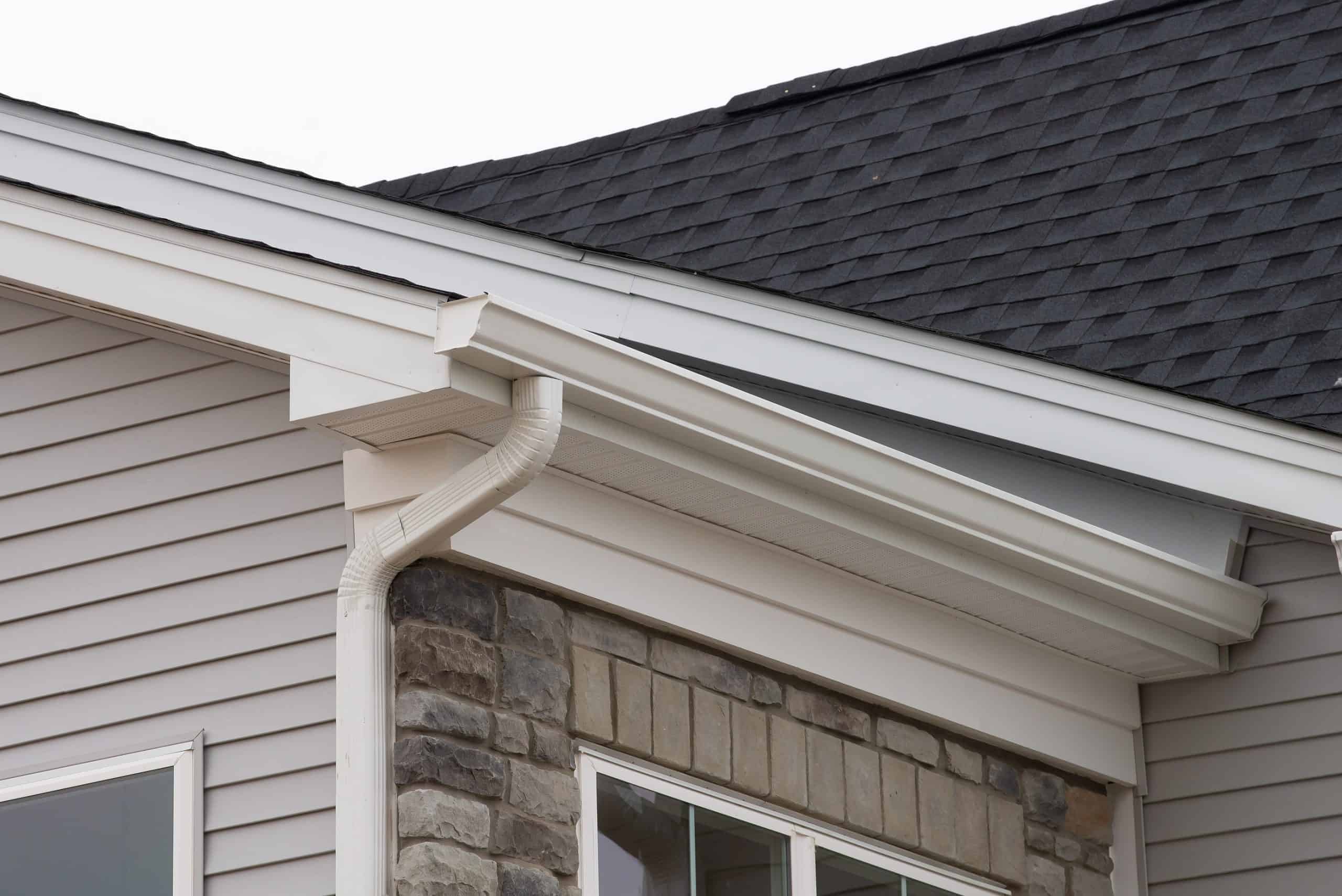
Good placement puts downspouts at the ends of runs and near the spots that collect the most water, like the bottom of a roof valley. They should discharge onto a splash block, an extension or a drain line that carries the water well away from the house, not straight down next to the slab. On a sandy Florida lot, water that keeps hitting the same spot will wash out soil, undermine walkways and find its way toward the foundation.
It also helps to think about where you walk. Nobody wants a downspout dumping onto the front steps or the driveway where it’ll leave a stain and a slick spot.
The installation itself
Here’s what a careful gutter installation includes, in roughly the order it happens:
- Checking the fascia. The board behind the gutter carries all its weight. If it’s soft or rotted from an old leak, it gets replaced first, because new gutters on rotten wood will pull loose.
- Setting the pitch. The gutter needs a slight slope toward each downspout so water doesn’t sit in it. Too little and it holds standing water. Too much and it looks crooked from the street.
- Hangers at the right spacing. Hidden hangers screwed into the fascia hold the gutter in place. In a place with heavy rain and hurricane wind, they shouldn’t be spread too far apart.
- Tying into the roof edge. Drip edge or gutter apron at the bottom of the roof should lead water into the gutter, not behind it. A gap there lets water run down the fascia and rot it.
- Sealing the outlets and corners. Corners and downspout outlets are where leaks start, so they get sealed carefully.
Gutter installation during a roof replacement
If your roof is close to the end of its life, it’s worth installing gutters at the same time as the new roof, or right after. The roof edge, drip edge and fascia are all exposed during a roof replacement in Daytona Beach, which makes it the easiest time to fix rotted boards and set the edge details correctly. Doing them separately can mean taking the gutters down again later.
How it works with APC Roofing
- Book your free estimate. Call 386-259-8425 or request a free online estimate.
- Get a clear, honest assessment and estimate. We measure the roof, look at how water leaves it now, check the fascia and show you where gutters and downspouts should go. Your written estimate lists the gutter size, downspout count and any wood that needs replacing.
- Get your gutters installed and the site cleaned up. The crew hangs, pitches and seals the system and cleans up before leaving.
Financing is available through Aqua Finance, Fortifi, Hearth and Home Run Finance.
Gutter installation questions
Do I really need gutters on a Florida house?
Plenty of Florida homes were built without them, but gutters protect the foundation, landscaping, walkways and fascia from the heavy rain this area gets. If water is splashing dirt onto your walls or pooling near the house, gutters will help.
What kind of gutters do you install?
Most homes do best with seamless aluminum gutters, formed to length so there are no joints along the run. Our seamless gutters page explains why.
Can new gutters go on old fascia?
Only if the fascia is solid. If the wood is soft or rotted, it gets replaced first, and you’ll see that on the estimate before work starts.
Should gutters go on before or after a new roof?
After, or at the same time. Installing gutters before a roof replacement often means removing them again so the roof edge can be finished properly.
Rain that ends up where it should
Water that runs down the walls every afternoon can rot fascia, stain siding and wash out the soil by your foundation over a few seasons. A properly placed set of gutters stops that.
Call 386-259-8425 or start your free estimate online. Then the next storm can come and go, and you won’t have to go outside to see where the water went.