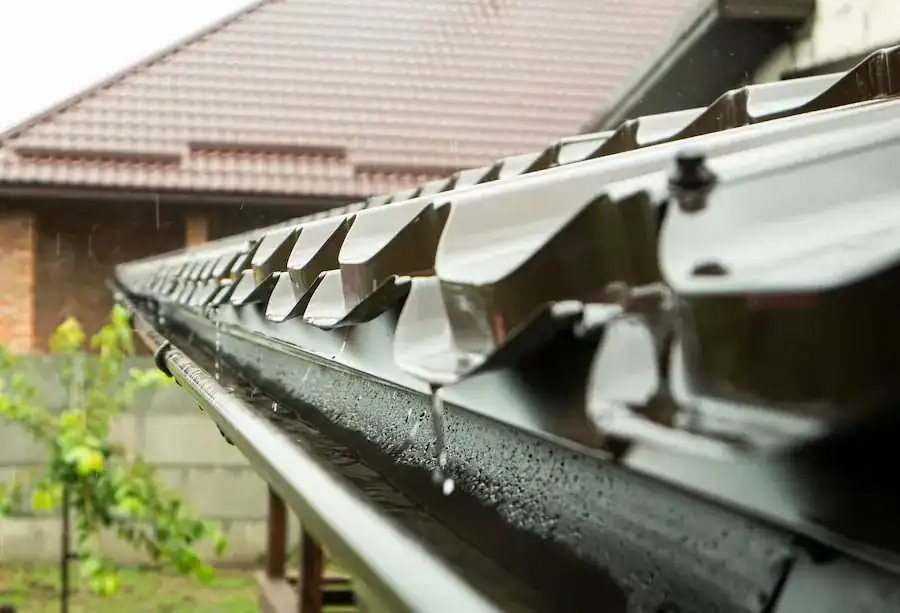
In need of Rain Gutters in Altamonte Springs Florida?
APC Roofing sizes, hangs, and services roof drainage on Altamonte Springs Florida properties.
Phone 407-270-1129 to talk it through.
Every Rain Gutters Estimate Starts With a Tape Measure – Not a Catalog
Most every undersized rainwater system that has to be replaced in Altamonte Springs Florida came up short the same way: it was priced by the foot rather than sized for the roof above it. A rainwater system is a conveyor carrying a load, and that load is governed by two things: the area of roof it serves, and how hard it can rain.
The rainfall figure surprises people. Nobody sizes a downspout using how much rain a place gets in a year. The engineering tables – the ones the sheet-metal trade has used for generations – are keyed to peak short-duration intensity. A downspout does not fail during a wet year. It overflows through the ten minutes a downpour sits over the block.
That point counts for a great deal in our service area. One of the markets we work in catches north of fifty inches in a typical year; the drier end of our map records under twenty inches over the same year. Common sense says the drier parts of the map need less capacity. They do not. The worst five minutes differs far less than the annual totals would suggest.
The Only Two Numbers That Decide What You Pay for Rain Gutters in Altamonte Springs Florida
The first of them is the size of the trough. The two choices you will see on a quote on a house are the five-inch K-style and the six-inch. Moving up a size is not a trim decision: the bigger section moves roughly fifty percent more water than the smaller one. On a small, low-slope roof that margin is comfort. On a large steep roof feeding one long run, it decides between working and overflowing.
Next comes the outlet. This is the figure people skip, and it is where the system gives up first. The 2×3 downspout – the one on most older houses – handles somewhere around six hundred square feet of roof. Change up to the larger rectangular downspout and the capacity roughly doubles, to nearer 1,200 square feet. A four-inch round lands in the same range. That is real capacity, and it adds very little to the price.
Put those together and the math is easy. Add up the area of roof feeding each length of gutter, and next check how many downspouts there are. If the arithmetic says three downspouts are called for and the house has one, no amount of maintenance will put it right. That is a capacity problem, not a maintenance one.
How the Water Actually Leaves the Roofline
A run of gutter does not sit level, though nobody should be able to see the fall. The usual rule of thumb sits near a quarter of an inch across every ten feet. Trades vary from an eighth of an inch up to a half inch in ten feet, but the aim is the same: enough to carry the flow to the outlet, slight enough that the run still looks level.
Too little slope and the trough never drains fully. Standing water is the start of the failure: it collects grit, it stays against the seals, and it weighs on the hangers in the worst possible place. Excessive pitch and the roofline looks off while the flow skips the drop during a heavy burst.
The length of the run matters as much as pitch. Somewhere beyond forty feet, the answer is another outlet, not a larger trough. Water moving down a long length reaches the outlet quicker than a single opening can swallow it, and it overflows at the low end of the run – often above a doorway, which is how most people find out.
What Holds It Up, and Why It Moves
Spacing between brackets is one of the few things you can look at yourself from the ground. Hangers should be no further apart than two to three feet. Where snow sits on the roof, closer spacing is the right call – to eighteen inches or so – because ice and packed snow build up above the rim and sit there for weeks, and rainwater is gone in minutes.
The other detail that rarely comes up is expansion and contraction. A run of aluminum moves as the weather turns. Over a hundred feet of run and a full seasonal swing, that comes to over an inch. That has to be allowed for. A run pinned rigidly at both ends will ripple, split a seam, or work a screw free after a handful of seasons. It is not a fault in the material. This is an install detail that was missed.
Where the Roof Edge Meets the Gutter
Here is a problem that everybody blames on a leaking gutter and is nothing of the kind. A stain appears on the trim board, or runs down the wall in behind the trough, and the trough itself is not leaking. The reason is the detail where the roof stops.
A standard drip edge is an L-profile strip that carries runoff past the deck edge. Where no apron backs it up, water can still creep back into the gap behind the trough by surface tension. The gutter apron is the longer version that runs past the deck and turns down inside the gutter. It closes the gap the water was finding. On a sharp slope shedding water fast, the difference is plain.
The covering above the run alters how the joint is made. Composition shingle is the easy one. Clay or concrete tile stands proud of the deck, and the edge flashing has to be worked in before the tile is set. Standing seam drops its whole snow load at once rather than losing it a little at a time, which is why putting snow guards above the eave belongs in the gutter discussion every bit as much as a roofing one. Flat and low-slope sections shift the geometry once more. APC Roofing covers all of those, which is why we mention it.
Ice at the Eave
In the parts of our territory that freeze, this is the seasonal question. And it is the one most regularly gotten wrong.
A dam of ice at the eave is not caused by the gutter. It is caused by heat leaking out through the roof from the rooms below. That heat melts snow where the deck is warm; the melt flows down to the cold edge, which sits over open air, and sets as ice. Do that through a string of cold nights and the ice builds a wall, holding water back above it.
The gutter is not the cause, though a blocked run does not help. A gutter full of ice leaves the melt no way out, and the backup gets worse. What we tell people, when we are asked whether new gutters will end the ice problem, is no. The real fix is sealing the air leaks and insulating. What drainage can do is give the meltwater somewhere to go before it does a further round of damage when the thaw arrives. A contractor who sells a gutter job as the fix for ice dams is selling you the wrong repair.
Where the Water Goes After It Leaves the Downspout
A run sized exactly right discharging right at the foundation has just moved the damage rather than dealt with it. It has collected water from a wide roof area, focused it to a single outlet point, and dropped it at the worst spot on the property.
This is one of the few areas where the residential building code is specific. Where the soil swells or gives way, discharge from the roof is required to go five feet or more away from the foundation, or to a proper drainage arrangement. Notice what sets that rule off: the ground, not the rain.
That detail is why the driest place we work is the place where discharge distance matters most. Soil that expands when it gets wet and contracts as it dries out will raise and settle a foundation through the wet and dry cycles. The moisture behind it need not be plentiful. It merely has to be dumped over and over at a single spot. An outlet that ends at the wall does it in every storm.
A second number in the code applies to every property, not only the awkward ones: the finished grade must drop six inches across the first ten feet out from the foundation. That is the surface your downspout empties onto. A faultless gutter emptying onto ground that falls the wrong way is beaten before it starts. The grade gets checked while we are measuring the roof – they are the same job.
Three Kinds of Debris
What ends up in a trough is not all the same, and that is why a single fixed schedule is a rough guide at best. Roughly speaking, three things fill a gutter.
- Leaf litter – leaves and woody bits. It comes in a seasonal burst, mostly sits on top, and clears easily. It is generally what everybody pictures when gutter cleaning is mentioned.
- Fine debris – needle drop, catkins, and flower litter. That is the difficult one. It runs straight through the usual mesh, settles into the low points, and packs into a sludge that will not flush out.
- Shingle granules – the mineral granules washing off an asphalt roof over the whole of the roof’s life. A little of it is nothing to worry about. A noticeable jump in grit at the downspout is worth a call to us, because that is a roofing signal and not a gutter one.
Guards and screens are part of the answer, not a cure. They bring down the cleaning frequency, which is worth something. Against that they restrict the opening that water must get through, and in a hard downpour a portion sheets past. Fine debris still works its way in. Whether that trade is worth taking depends on what overhangs the roof, which is something we look at rather than guess.
Getting the Water Clear of the House
There are three workable ways to move discharge out to where it does no harm, and they differ a good deal. A splash block at the base costs the least and moves water the shortest distance. It blunts the impact of what comes out of the pipe and scatters it, but it carries it barely a foot or two. Where the grade leans toward the wall the discharge comes straight back to the foundation.
A roll-out extension is the sensible middle ground. The outlay is small, it moves aside when the lawn is cut, and it really does move water several feet out. The downside is that you can see it, and anything on the surface gets knocked aside and stays that way. We find more loose extensions than we ever do failed troughs.
An underground line is the lasting answer where conditions call for it: a sealed pipe carried out to a discharge point a long way from the house. None of it shows, nothing can knock it loose, and it will still be there when the gutters are not. The cost is that it can clog and nothing on the surface says so, and that is why a cleanout belongs in the design instead of being regretted later.
Fascia, Rafter Tails, and Soft Wood
A length of gutter has to be carried by something, and that something is generally the fascia or the rafter tails it is nailed to. Where water has been getting behind the run or soaking the board for years, that board is frequently soft by the time the old gutter comes down.
We would sooner say so up front than run into it once the crew is on site. A fastener set into a soft board holds for a while and then pulls out, usually when the gutter is full – and that is when you are counting on it. Where we find soft board, we say so, take you to it, and price that work openly so you can see what you are paying for.
Low-Slope Work and Larger Drainage
Not every building sheds at an eave. Low-pitch and flat sections drain differently: the water leaves through scuppers, internal drains, or tapered falls instead of spilling off the edge. The questions to answer are identical, but the way it fails is better hidden and much harder to spot early.
On a pitched roof a blocked run overflows and you see it. On a low-slope roof a blocked scupper backs water up on the membrane, and that pond puts real weight on the structure before anyone sees it. APC Roofing covers both, meaning a building with a mix of the two is treated as one system instead of two separate outfits disagreeing at the junction.
Storm Damage and the Drainage Below It
Weather damage to a roof gets noticed. The gutters underneath get attention last, if anyone looks at all. The order should be reversed for a couple of reasons.
One thing worth knowing – drainage is regularly the clearest record of what actually hit the property. Impact marks in the metal are sized and directional. They are a record that stands up in a claim when the shingle surface is harder to assess.
Another point worth making – a run shifted out of line says nothing. It looks right from below, and it copes in the weather it usually sees. It comes to light in the next real storm, and that may be a few months later – often past the deadline for a claim. A look after the storm costs a small part of the repair that follows.
Signs It Is Time to Call About Rain Gutters
No climbing is required to notice the usual signs. Take a slow lap of the building in the middle of a downpour, which is when the system shows its hand.
- Water pouring over the front lip in a storm – undersized, blocked, or badly hung.
- A gap opening behind the run – hangers that have let go, usually after a heavy load.
- Staining on the fascia board with the run itself in good order – a missing apron, nothing to do with capacity.
- Splash marks and eroded ground under one downspout – the discharge stops short.
- Water pooling at the foot of the foundation hours after the rain has gone – grading and discharge together.
- A length that dips in the middle – standing water plus weight, and it gets worse by itself.
The Places That Overload a Correctly Sized Gutter
Area alone takes you only so far, given that roofs do not shed water evenly. Every valley collects the water off two planes and puts the entire flow into a few feet of run. That short stretch is often taking several times the volume of the rest of the run, though it looks the same.
That is the reason a run can overflow at a single point in storm after storm while the remainder behaves perfectly. The cure is seldom a larger gutter. It is another outlet sited close to where the water arrives, so the water leaves the moment it arrives rather than traveling along a trough never intended to carry it.
Higher roofs create the same problem in another shape. A drop from a higher roof dumping onto the roof below is seen everywhere, and it is often the wrong way to do it. It concentrates the whole upper roof on one spot of the covering below, which strips the surface and floods the trough that lower roof drains into. Running the upper discharge to ground level directly removes both faults together.
Reading a Gutter Quote
Where you have two competing estimates and one comes in lower, the gap is usually not somebody being greedy. It is almost always a different specification that neither piece of paper actually states.
An estimate worth reading names the profile and what it is made of, the outlet count and profile, what the run is hung on and at what spacing, what happens at the roof edge and whether it is priced in, and where the runoff is carried at ground level. Those five items. Where a quote leaves any of them blank, that is what the price difference is.
All five appear on the estimate because that is the job. A figure per foot with none of it specified is a bare number, not a quote.
What the Day of the Job Looks Like
A typical install is done in a day, sometimes two. The run is rolled on site off a coil of stock, cut to the length needed, and that is why there are no joints anywhere in between. Corners, outlets, and caps are still joints, and they are the places where the work has to be done properly.
Weather drives the schedule more than anybody would choose. The work calls for dry weather – sealant needs time to cure and nobody should be up a wet ladder. We would rather move the date than rush it in poor weather and watch it fail early.
Access shapes the day. Restricted room at the side, beds and shrubs below the run, lower additions, and boundary lines all affect the sequence. We look at that on the measuring visit, not when the truck pulls up.
The Way APC Roofing Tackles Rain Gutters in Altamonte Springs Florida
The roof gets measured before anything is quoted. Roof area per run, the pitch, run lengths, and where outlets can actually land – those four figures make the specification. The rest – the choices you can see – is yours to settle with the numbers in front of you.
Because roofs are part of what we do, the place where roof and gutter meet gets designed rather than inherited. Asphalt, tile, standing seam, low-slope – every one of them changes the way the edge is built. It is not tacked on at the end. It happens to be where we begin.
Repair or replace is a judgment, and we will say which one applies. A properly sized run with a damaged section or a hanging fault is a repair job. A run that was never big enough for the area it drains is not a repair job. Cleaning it more frequently does not change the numbers.
Book Rain Gutters in Altamonte Springs Florida Priced From the Numbers
Dial APC Roofing now at 407-270-1129 and we will start with a measurement.
What Is Under the House Changes the Damage
The same shortfall in drainage carries a very different bill on every house, and the deciding factor is what the house sits on.
A house built on a slab has no basement to flood. The damage is slower: runoff finding its way beneath the edge, soil washing out from underneath, and water wicking up through the floor slab far from where it came in.
A crawl space hands the water a destination, and it finds its way there. Moisture coming through the wall, a chalky bloom on the masonry, the sump cycling constantly, and wet air moving up into the rest of the house – every one of those begins outside, at a downspout putting water too near the wall.
In both cases the answer is outside, and it is far cheaper than anything done after the water is already in.
Gutter Materials, Briefly
Aluminum gutter is what goes on most houses, and with good reason: it will not rust, it is light on the supports, and it is formed on site in one unbroken length. Cutting out the seams means fewer places where a run can fail. The trade-off is that it dents easily and it moves with temperature, which is the installer’s problem to solve.
Steel keeps its shape better, which matters in hail country, but the finish is the one thing holding corrosion off, so it repays attention. Copper gutter is the durable end of the range and it looks the part. Vinyl goes up cheaply and hardens and cracks as it ages in sun and frost. We will walk you through what fits your roof and your weather with no sales pressure.
Maintenance Without the Guesswork
Twice a year is what gets repeated, and it is a reasonable default rather than a hard rule. How often it really needs doing turns on the trees around the house. A house under pines takes a steady needle drop for most of the year and needs more attention. A house with no trees close by can go a long time between visits.
The spring-and-fall habit was inherited from colder climates, and it does not travel well. The semi-evergreen oaks across the southern end of our service area keep their leaves through the cold and let them go in early spring, not in the fall. Anyone with one of those over the house who books a fall cleaning and stops there is doing the work at the wrong point in the year and leaving it to fill for the drop that actually matters.
What matters on a visit is not only whether it is clear. How the drops are running, joint and end-cap seals, hanger tightness, whether the slope has held, how the drip edge is holding, and where the discharge ends up. The last of those is the part most often skipped and it is the one most likely to be costing you.
If you would rather it was handled, that is what we do. A run that gets looked over on a sensible interval generally lasts the life of the material. A run that is only looked at after the damage is done seldom does.
To get started on Rain Gutters across Altamonte Springs Florida, contact APC Roofing now at 407-270-1129. We measure the roof before anything else and price it from what the tape says.
« All Services in Altamonte Springs Florida