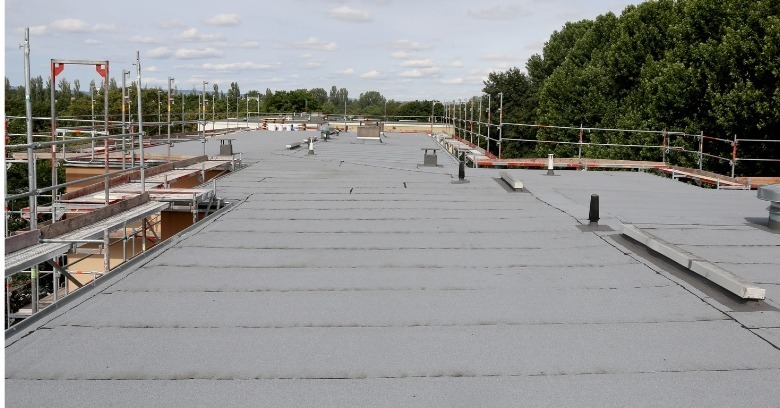
Hoping to find Commercial Roof Repair in Denver Colorado?
APC Roofing replaces and patches membranes on warehouses, shops and offices, taking in the edges, the outlets and every curb.
Call 720-902-6940 and a roofer will inspect the whole surface and report back.
Above a Shop or Office – an Overview
Employees, inventory and equipment are what the membrane protects, so a drip can shut down a shift instead of staining a tile. Wide commercial buildings carry a top surface that is nearly flat, so outlet sizes and wind design come from engineering figures.
Condensing units, exhaust stacks and antennas are spread across the top, and each duct, line or support passes through the waterproofing. The purpose of the building drives the design, since a cold store and a law office have different needs.
The Principal Membranes: Options on the Market
One flexible layer of TPO, PVC or EPDM is what single-ply describes, modified bitumen is asphalt with polymers added, supplied in rolls, and built-up roofing stacks felt and hot tar in plies. A walk-behind welder fuses the overlaps on thermoplastic material, but rubber is spliced with tape over a primed surface.
Restaurant hoods blow grease out beside the fans, and oily residue softens asphalt and EPDM, so the stretch nearby is often PVC. Built-up plies under a gravel layer make a heavy, durable assembly, since the aggregate protects the felts from ultraviolet light.
Steel Over a Warehouse: Where Trouble Shows
On an exposed-fastener system, screws pass straight through the face of each sheet, and each shank is set into a purlin or joist. The neoprene washer at each head dries out under years of sunlight, and thermal movement works the fasteners loose over time.
Standing-seam panels attach with clips tucked under the raised seams, and the pans shift slightly through the day. Corrosion sets in at side laps and sawn ends, and a retrofit coating can give sound metal more years of service.
Deck Types: Age and Condition
Attachment methods are limited by what the original builders put in, and a new covering goes over the same framing. Formed steel grips a screw well, concrete is glued or drilled for anchors, and wood or gypsum plank takes nails or purpose-made fasteners.
Old, slow leaks corrode patches of a metal deck, and the failed section is removed and rebuilt. The underside can be viewed from below where no ceiling blocks the view, and exploratory openings from above reveal the remainder.
Anchoring the Membrane: Choosing an Approach
Mechanically fastened sheets carry rows of plates and screws in the laps, fully adhered systems are glued across the whole underside, and ballasted sheets lie loose under stone or pavers. Deck type, building height and wind exposure point to the right method, and a frame with no spare capacity rules out a heavy layout.
Screw-down systems flutter between plates when gusts hit, but adhered work stays motionless and needs a dry surface to grip. A ballasted layout turns inspection into a slow job, because gravel or pavers must come off before anyone sees a joint.
Wind Across a Wide Roof: What Codes Expect
Suction peaks at the corners, since air accelerates on rolling over the perimeter. A band along each side takes somewhat less, and the interior bears a light load.
The fastening pattern gets denser toward corners and edges, as set out in engineering tables for height and wind speed. An outer angle with too few anchors allows the sheet to lift, and pressure underneath can strip a wide section.
Rigid Foam: Doing Double Duty
Polyiso is set on the deck in one or more courses, and a thin, hard cover board is often added last. Insulation keeps conditioned temperatures indoors, and tapered units can slope a dead-flat deck to the outlets.
Soaked foam gives up most of the thermal resistance, and the heavy mass adds weight and rusts a steel deck. Nondestructive meters and cored samples show how far the problem reaches, and any spoiled patch is replaced, never roofed over.
Drainage Hardware – Laying Out the Route
Every interior sump is guarded by a strainer dome, and the slots hold back gravel and plastic bags. Silt plastered over the grate cuts the flow to a dribble, and a wide pool gathers in the surrounding field.
A raised overflow waits above each primary drain, and a stream from the upper spout shows the ordinary route has stopped. Ponded water adds load that the framing may not be sized for, and a puddle still there two days after a storm indicates a sag or a matted strainer.
Leak Hunting on a Large Building – Patience Pays
A soggy tile shows the spot where moisture emerged below, but the fault on the surface can lie a long way off. Steel decking guides runoff down the corrugations, and joints between boards lead a trickle further still.
On the membrane, every lap, curb and outlet on the high side gets examined, and a low-voltage test can trace an elusive leak. Repairs aimed at the spot directly over the drip tend to miss, and the next downpour sends water through again.
Package Units Overhead: Keeping Water Out
Every heavy machine rests on a curb built up from the deck, and the covering turns up the sides beneath metal counterflashing. The corners are the fussiest detail up there, and a poorly sealed crease admits rain.
Swapping a machine for a newer model tends to add an adapter curb without flashing, and drips show up indoors within weeks. Condensate discharged straight onto the covering discolors and softens the surface, and the fix is carrying the flow to a drain.
Pipes, Vents and Conduit – Detail by Detail
A preformed boot, cinched with a band, covers each round stack, while odd shapes go into a pitch pocket filled with sealant. The compound hardens, shrinks and separates at the edges, and a top-up is standard upkeep.
Electrical conduit and gas lines ride on blocks simply set in place, since a bracket screwed through the covering becomes a leak. A rubber pad beneath every foot distributes the weight, so daily movement rubs the buffer rather than the covering.
Hinged Covers Up Top: What Wears
Plastic bubbles on older units go cloudy and brittle under sunlight, and hairline breaks radiate from each fastener. Water gets in through a hardened gasket or a loose frame joint, and the stain below often gets blamed on the membrane.
The access hatch is lifted on every service visit, which wears out the springs, latch and weatherstrip. Smoke vents release automatically when a fusible link melts, and nothing stacked or sealed nearby is allowed to jam the lid.
The Low Wall Around the Edge – Getting the Details Right
The field sheet continues upward as base flashing, a termination bar pins the upper margin, and counterflashing tucked into a reglet covers the fastened line. A coping cap spans the crest to push rain aside, though a cracked seam beneath lets runoff in.
Weathered brick and block take on water through the faces, and the ceiling stain that follows mimics a membrane problem. A proper look takes in the coping, the flashings and the wall along with the sheet, and a gap in the mortar is repointed, never just caulked.
Gravel Stops and Fascia – Parts and Purpose
The folded hem of the flange hooks over a cleat on the nailer, and a cover strip of membrane is laid over the upper face. Perimeter pieces must carry a wind rating for the building's height, and an undersized section flexes until the metal pulls away.
Gutters on a large building must swallow drainage from an enormous area, and the hangers, joints and leaders must be sized generously. Crumpled or raised trim is a clear repair item, since early work protects the covering behind the edge.
Foot Traffic From Technicians: Setting Some Ground Rules
Equipment mechanics may be up top every few weeks on a busy building, so a scuffed trail builds along the usual line. An abandoned screw gets forced through the sheet by a passing boot, and an access panel set down on a corner slices a gash.
Walkway pads set out a marked route to the equipment, and grinding hits dense material instead of the field. Contracts with service firms can spell out where crews may walk, and loose screws and scraps should leave in a bucket.
Upkeep Through the Year – the Routine
A commercial covering should get a professional walk-through twice annually, plus an extra check after a severe storm. Upkeep includes emptying every strainer, the seams are traced with a probe, and brittle sealant gets marked for replacement.
The trip ahead of the stormy months focuses on outlets and perimeter metal, and a follow-up hunts for whatever a harsh stretch of weather pulled apart. Each small defect found is logged with the location on a plan, so repairs can be arranged before a leak starts.
Roof Records – a Long Memory
A clear drawing pins down the position of each unit, drain and hatch, and a section view names each material from deck to membrane. Each fix is logged with a date and photographs, and moisture readings are added as taken.
Older properties frequently hold no notes on the covering, which leaves every new contractor guessing. Documentation stays with the building, and a copy passes to the next manager or buyer.
Repair, Restore or Replace – Letting Condition Rule
A membrane that is mostly intact needs only spot patching, while an elderly but dry surface can accept a new liquid system. Waterlogged insulation across large areas points toward a new covering, and so do seams that crack wherever flexed, while a date on the calendar decides little.
A liquid coating needs a scrubbed surface and sound mending beneath, and material below that holds water never dries out. Taking out just the spoiled areas occasionally works as a halfway measure, as long as the remaining membrane has plenty of service ahead.
Reroofing Options: Code and Condition
With a recover, the old sheet stays and a new membrane goes over the top, and a board is placed between old and new. Code permits a second covering, never a third, as long as the insulation below is dry.
A tear-off removes every component down to the structure, and damaged sections of deck are mended while exposed. A tapered system can be designed to empty the low spots, and a saddle between drains turns the flow toward each outlet.
Warning Signs – Reasons to Call
- A spout of runoff from the secondary scupper, which suggests a plugged strainer.
- Discolored ceiling panels that darken after wet weather, which confirms a path through the assembly.
- Peeling paint high on the exterior wall, which can trace to a leaking downspout joint.
- A gravel stop that moves when a gust hits, which can give wind a place to pry.
- Ponding visible from a higher window days after rain, which can indicate a settled structure or a fouled drain.
- A skylight whose plastic has turned chalky, which is ready to fail at the frame or under a load.
- Rust spots spreading on the underside of a steel deck, which suggests an opening some distance uphill.
- Downspouts that gush at the joints, which can mean a clog or an undersized run.
How APC Roofing Plans Commercial Roof Repair in Denver Colorado: the Order of Work
We look first at the drains, scuppers and overflows, and after the outlets we move to the laps, curbs and edge metal. Where there is a leak, the insulation is metered for moisture, because saturation below changes the answer.
A written report, photos and a sketch record what we found, and every trouble spot is pinned to a location. The recommendation names repair, restoration or replacement, and each reason is spelled out for the owner.
Commercial Roof Repair Around Denver Colorado: What Needs Doing Up Top
Call us at 720-902-6940 and we will fix a time to see the building.
Business as Usual Downstairs – Planning Together
Every screw driven into steel decking is heard indoors, and the smell of primers can reach the fresh-air intakes. The loud part of the job is planned with whoever runs the building, and vents close to the work can be blocked until curing ends.
Debris leaves by chute into a dumpster, and shelving or machinery directly below can be tarped. Low-odor adhesives cut down the smell considerably, and the gentler choice suits a building full of people.
Sequencing a Big Replacement – Protecting the Interior
Old layers come off only in amounts that can be closed up by evening, and new insulation and membrane go onto the opened area in the same pass. A temporary closure protects the joint between finished and unfinished portions, and the patch comes out once progress picks up.
How much is stripped depends on the weather outlook, and a chance of showers keeps the opening small. Water that lands on uncovered foam saturates the panels, and drips can fall on whatever sits underneath.
Our Service Area's Range: Timing and Materials
Toward the colder end of our territory, hail and heavy snow both figure in, so a hard cover board and an engineer's review of the framing are sensible. Sunlight and heat wear down a membrane in all of our markets, and white TPO or PVC keeps the top cooler.
Hurricane wind at the coastal end demands tighter anchoring, and tropical storms require ample secondary drainage. Adhesives come with a cold limit printed on the label, but a welder copes with cool air far better than with a shower.
Staying Safe Aloft: Practical Precautions
A knee-high parapet or a bare perimeter leaves a sheer drop, so a warning line keeps crews back from the edge. Skylight lenses cannot take a body falling onto the plastic, and fixed screens rule out a plunge into the space below.
Permanent anchors make later visits by other trades less risky, and a self-closing gate at the hatch adds a barrier. A missing screen or warning line is flagged in our findings, as a single-story drop can still cause grave harm.
When you need Commercial Roof Repair in Denver Colorado, contact APC Roofing at 720-902-6940. We will cover the surface on foot, from the outlets to the parapets, and everything goes down on paper while the decision stays yours.
Verified

Verified
Verified
Verified