In Need of Storm Damage on a Family Home in Denver Colorado?
APC Roofing walks a slope after a hard night outdoors, checking every edge and photographing what is there.
Call 720-902-6940 and a roofer will come out for a closer look.
How Air Travels Over Shingles – an Uneven Push
Along the eaves, the rakes and the ridge the force runs highest, while an open middle section stays comparatively calm. Air slipping beneath a raised lip pushes upward on the shingle set over the lip, and one fastener beneath a course answers for the whole pull from there on.
At a house corner, wind rounding two exterior faces collides, and hardware spacing shrinks at that point on a well-built roof. A row nearest a projecting edge takes on more force than a row set well off to the side, and a crew’s added fastening there answers exactly that need.
What the Crew Leaves to the Sun – Made by Warm Weather
Every shingle carries a strip of sealant that fastens down to the course beneath, and nothing else secures a shingle’s lower edge. A sharp gust can tear a bond apart across a length of roof, though nothing shifts out of place in the first hour after.
A broken seal stays hidden until the wind picks up again, and rain then reaches nail heads left bare for the first time. A single shingle adrift on a wide slope is a small matter alone, though several shingles parted together make a doorway rather than a blemish.
The Number on a Package – What Gets Left Out
Technicians secure factory-fresh material to a sample and close every seal, after which a fan runs air over the surface at a set rate. Years of sun and cold change how a shingle performs compared with the shingle’s very first months in place, which is why that rating fits day one and nothing after.
Fastening outside the marked zone leaves a shingle with a weaker hold, so a slope lets go sooner than a printed number suggests. A shingle ages from the moment installation finishes, and stiffness follows, and a laboratory rating fits new construction, never an older roof.
Hail Against a Shingle: Under the Surface
Stones grow largest in storms that cross the colder end of our territory, and the size eases as a storm tracks eastward. A strike drives surface granules down into the asphalt underneath, and the struck area no longer feels as firm as the surrounding shingle.
A saturated inner core actually keeps rain out of a roof, so a bruise reaching that depth is a fault, not a blemish. A struck area of a shingle runs down faster than a sound area beside a struck spot, so a covering with widespread hail damage develops trouble in scattered places.
The Rest of a Roof’s Hardware: Quiet Evidence After the Fact
A hit the asphalt handles fine dents soft metal beside a struck slope, so a mark from a storm remains long after the weather clears. A cracked collar no longer grips a pipe a collar once surrounded, and a ceiling below takes drips within a day or two. A gutter knocked about at the front still moves water as designed, while a crimped downspout carries water over the leading lip without help.
A pitted vent cap sits alongside a dimpled fascia and a scuffed drip edge on one visit, so nothing made of trim is left out of a written record. A split collar, a warped flange and a battered gutter face rarely turn up without a shingle nearby in equally rough shape, so hardware that looks off is hardly ever paired with shingles that look fine.
Loose Grit After a Storm: Worth a Second Glance
A mineral coat baked onto a shingle screens the asphalt from direct sun, and a bare patch left exposed hardens and splits within a season. A hard rain washes displaced grains all the way to a gutter, so a drift of sand at that point tells a roofer something worth knowing.
A shingle stripped of a protective coat starts to curl at the edges, so a minor fault becomes a reason for replacement later on. A heap at an outlet is a rough measure of what washed down, and tracing grains back to that slope is straightforward for a roofer.
A Leak That Only Happens in a Blow – Up, Under and In
A shingle lap is engineered to carry whatever comes directly from overhead, but pressure coming from the side changes the entire calculation. Off-ridge vents let spray past open baffles once wind picks up, which reads indoors like a fault in the shingles that is not really there.
A Heavy Bough on a Roof – Weighing the Impact
Sudden momentum drives an entire mass through one narrow point of contact, and the framing takes the full brunt of that force. Sheathing under a strike can split while the shingle above shows only a graze, and the underside tells a roofer what a glance from above cannot.
Limbs raking a roof leave sweeping lines of exposed asphalt along the way, and the outline stands out clearly once the pattern is known. Getting to a split panel calls for removing the covering above the crack first, and the finished patch ends up wider than the mark visible above.
Signs Inside the Attic: Seen From Below
Open sky glimpsed from within means a piece of the covering is gone, and the location is clear well before anyone climbs onto the roof. Wet plywood darkens, and the tips of nearby nails often show rust, and the darkest mark generally sits closest to the actual opening.
Insulation flattened in one place shows where runoff has settled again and again, and the fibers rarely spring back once squeezed that way. A driven shower through a vent can wet framing at the gable end, and the answer in that case is a baffle behind the slats, not a repair to the surface.
What Shows Up Indoors: Reading the Stain
A discolored area forms where a drop of rain finally let go, because water can travel the length of a rafter before any hint develops. Bubbling up above means the finish has separated from the board beneath, and the size of a stain has little to do with the size of the opening above.
Water reaching a ceiling fan is reason enough to cut power to that circuit, and live wiring beside water is left to an electrician. A dark patch next to a chimney chase often shows moisture running down against the masonry, so counterflashing set into the mortar gets a close look in a case like that.
Where Surfaces Come Together – What Pulls Free
Segments set against a sidewall rely on both a proper lap and a secure fastener, and one weak point undermines the protection for the entire span. Air sliding under a gable edge can roll that length of metal upward, and the covering can begin to unzip from that corner inward.
Ridge caps sit in the roughest airflow on a roof and can still come away as a unit, and slack fastening opens the seal on the seam sitting beneath. A vent lifted at one end leaves a slot running the length of the piece, so insulation across a wide stretch can end up wet, not just underneath.
Glass Placed Into the Roof – Where Leaks Start
A curb under a skylight is built above deck level for a reason, and every face of that structure gets a flashing cut just for that face. The outside glass of a unit can break while the inside layer holds, and nothing laminated gets mended in place.
Debris striking a plastic dome can leave a pattern that spreads with heat, and a small fracture can widen with every hot afternoon that follows. Condensation locked inside a sealed unit cannot simply be wiped away, so the affected section is exchanged for a sound one.
More Than a System Can Take: What Overflows and Why
A sudden downpour can pass along more volume at once than a trough can handle, and whatever misses the channel runs down the siding underneath. A wad of debris at an outlet can leave an entire drain line backed up behind that point, and a blocked length can sag out of line over time.
An Interim Measure – Out There Overnight
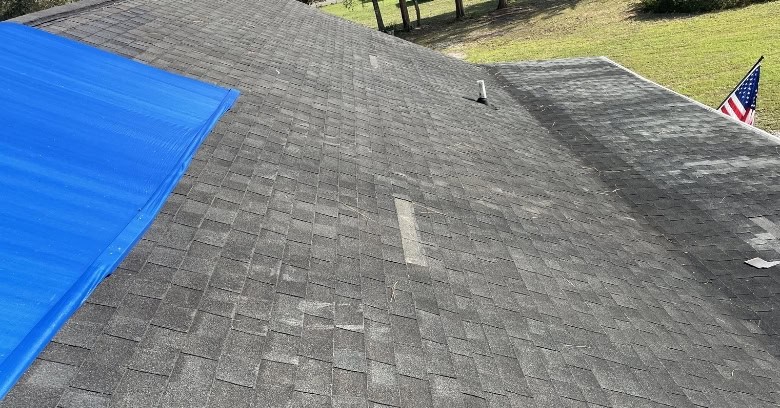
A tarp over an opening can hold the line for a few days at most, though nothing about that covering is built to last for long. A covering battened along every edge stays firm without further help, and screws for that step land in framing, not merely in the covering.
Anything simply sitting on top can leave with the next hard blow, and a gap in the covering can scatter granules in the same blast. Every penetration made in haste becomes one more spot to seal properly, which keeps the rest of a slope free of new punctures.
A Plain-Language Summary of the Damage: What a Roofer Writes Down
A camera goes over the roof while the marks a storm left are still fresh, and every face of the house gets included in that record. Each damaged spot gets a number attached in ordinary figures, because a mark’s true size is hard to judge without a reference point.
Conditions keep changing what a later look would actually find, so a fresh look afterward can turn up something different entirely. A request for documentation gets the same file kept on hand, and nothing in that record gets dressed up to suit the occasion.
A Sudden Rush of Visitors – Why the Hurry
Unfamiliar trucks can move street by street once skies have cleared, and a share of that traffic does solid, honest work. A form signed at a front door binds a homeowner like any other contract, and reading every line before agreeing is always worth the extra minute.
A firm listed at a local address remains easy to reach later on, which is no small consideration when picking who does the work. A deal that cannot survive a single night of thought is not worth taking, so there is no harm in declining to agree to anything on the spot.
How Weakness Builds Up: Picking Up Where Things Left Off
A covering with parted bonds has less holding capacity in reserve, and less force is required with each fresh round of damage. A shingle folded once in a strong wind carries a crease from that event onward, and water can find that same flaw on a future occasion.
A second wave of runoff can travel past a roof deck and straight indoors, and interior finishes end up part of the repair once that happens. Delamination can begin wherever dampness settles between the layers underneath, which turns what should be a simple job into a larger, structural one.
What to Watch For After a Storm: Notes Worth Keeping
- Bare patches where a shingle used to sit, plain enough from a driveway.
- A pitted cover on a stack or a vent, still evident long after weather has passed.
- Grit banked up at a drain outlet, in amounts that keep returning.
- Sky seen through the boards overhead, best looked for at midday.
- A spreading mark on drywall upstairs, however small a mark looks at first.
- Staining on both sides of a chimney chase, strongest on the side wind blew from.
- Glass in a skylight chipped or broken, whether or not the covering nearby is torn.
- A gutter hanging away from a fascia board, on the side that took the wind.
How APC Roofing Takes On Storm Damage in Denver Colorado: Plainly Explained
Our roofer opens with a slow circuit of the house from ground level, and stray pieces scattered nearby offer the first clue about what gave way overhead. Every roof plane gets covered wherever the pitch allows safe footing, while the underside of the deck gets a separate look from below.
The pictures and dimensions go into a plain account kept on file, and the phrasing stays everyday rather than technical trade terms. The advice gets explained, not simply stated as a conclusion, and the decision on what happens next stays with the homeowner.
Storm Damage in Denver Colorado: Getting a House Sound Again
Call us at 720-902-6940 and say what you noticed outside.
Snow on a Roof – A Sturdier Kind of Build
The colder end of our territory sees falls deep enough to press down on the framing, and freezing and thawing in cycles makes the load denser over time. A frozen edge at the gutter line can trap runoff on the slope higher up, and water held back that way can find a path up under the lowest courses.
At the colder end of our territory, drifts pile up in valleys and beside dormers, which is often where sagging first becomes visible. A slab breaking loose can take a gutter down in one motion, and hangers can bend under strain from a sudden release like that.
The Toll Taken Near the Water – More Upkeep for Fixtures
At the coastal end of our territory, a tropical system can settle over a house for most of a day, and gutters and flashing there can corrode faster given the salt in the air. Repeated flexing over many hours can loosen what a quick gust would not touch, and failures can multiply the more that sort of weather lingers.
Wet blown against an elevation can work into window heads and trim, so leaks during that kind of storm can show up in spots that never see water otherwise. Codes at the coastal end of our territory call for more fasteners per shingle, and new work in that area follows the pattern already set locally.
New Work Beside Old: Close, Not Exact
Material from a current production run differs in tone from shingles baked by years of sun, and the surrounding roof ends up setting the visual standard. Replacement shingles near a driveway can catch the eye of anyone passing, which some homeowners accept and others would rather avoid.
When a specific line has been dropped, a similar design takes over that spot, so a gap in tone or texture remains even with careful selection. A slope covered in individual patches tends to read as pieced-together rather than one continuous surface, and an even surface is often the whole point of a full redo.
A Proper Result: Nothing Left Loose
A mended section sits down without any visible ridges, and the exposure lines up with the older courses nearby. Metal at a wall gets tucked into place rather than glued to the surface, and caulk never ends up as the thing actually keeping water out.
Every nail head on a mended spot sits beneath the next course up, which is what a wind rating assumes will happen. A dated photograph of a finished repair is worth a homeowner keeping on file, because that record marks where a fresh section of roof began.
If you searched for Storm Damage after bad weather in Denver Colorado, phone APC Roofing at 720-902-6940 to arrange for a roofer to come out. What is up there gets inspected, measured and photographed in full, and what happens next gets explained in plain language.
« All Services in Denver Colorado