A tenant on the top floor mentions a stain that keeps growing along the outside wall. Or you finally get up on the roof and find a pond of water sitting around a drain three days after the last storm. You know something’s wrong, but you don’t know if it’s the membrane, the drain or the wall itself. You need commercial roofing in Country Club, Denver that tracks the problem to its source before anyone starts selling you a new roof.
That uncertainty is the hard part. A flat roof is out of sight, the bids you get can be miles apart, and it’s tough to tell who’s being straight with you. You deserve to see the evidence and understand the reasoning.
APC Roofing is a GAF Certified contractor, licensed and insured, and the inspection is free. Call 720-902-6940 to have a roofer walk the roof with you.
Commercial roofing in Country Club starts at the drains
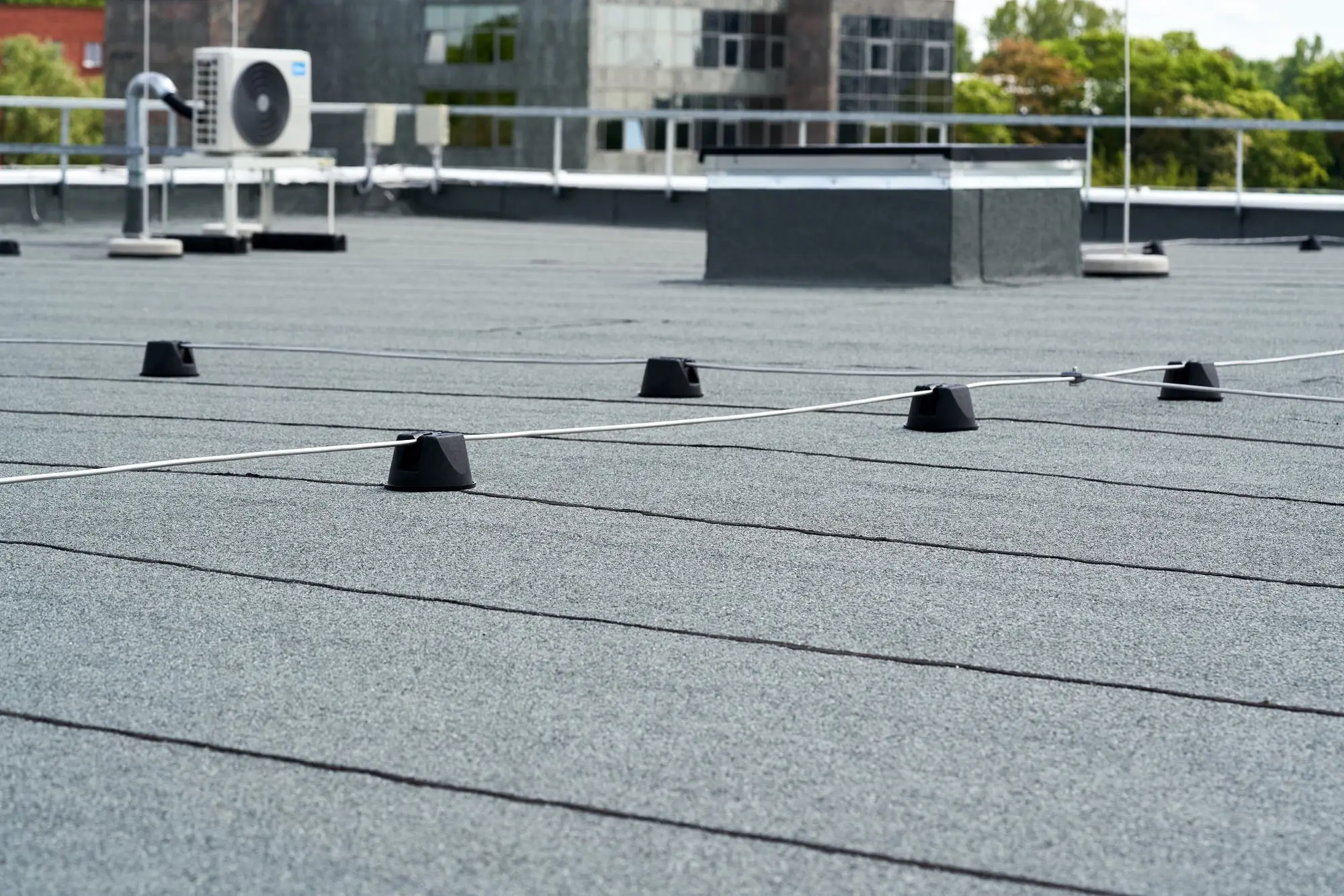
A low-slope roof isn’t truly flat. It’s built to tip water toward drains, scuppers or gutters, and when any of those can’t keep up, everything else on the roof suffers.
Interior drains have strainer domes that keep debris out of the pipe. Leaves, grit and roofing debris pack against the strainer and slow the flow to a trickle. Most roofs also have overflow scuppers set a little higher than the main drains. If you see water pouring out of an overflow during a storm, the main drain below it is probably blocked.
Denver winters add a twist. Snow on a flat roof melts in the afternoon sun, and if a drain or scupper is frozen, that water has nowhere to go and refreezes overnight. Ponding water that’s still there 48 hours after a storm usually points to a clogged outlet or a sagging deck, and it adds weight the structure wasn’t designed to carry for long.
Parapet walls, coping and masonry
Many low-rise buildings have parapet walls, the short walls that rise above the roof at the edges. The membrane turns up the inside face of the wall, a metal bar fastens the top edge, and a counterflashing laps over it. A metal or stone cap, called coping, covers the top of the wall.
When the coping seams open up or the mortar under the cap cracks, water gets into the wall and runs down inside it. Brick and block are porous too, so water can soak straight through. To the person downstairs, that wet wall looks exactly like a roof leak. A good inspection checks the coping, the wall and the flashing together, and if the wall is the problem, you’ll hear that, so the right trade can fix it.
Roof edges and Front Range wind
Wind doesn’t load a roof evenly. Suction is strongest at the corners, then along the edges, and weakest in the middle. That’s why a well-built commercial roof has more fasteners at the corners and perimeter than out in the field, and why the edge metal has to be heavy enough for the building’s height and exposure.
Strong gusts coming down off the foothills test those details. If the edge metal is loose or bent, wind can get under the membrane and peel it back. A loose edge is a repair item worth handling early, because it protects everything behind it.
Membrane options for a Country Club building
Most low-slope buildings in Denver use TPO (a white, heat-welded single-ply sheet), EPDM (a black rubber sheet with taped seams), modified bitumen (asphalt rolls reinforced with polymers) or built-up roofing (layers of felt and asphalt, often with gravel on top). Some smaller buildings have low-slope metal panels. The right choice depends on your deck, what’s on the roof and how the building is used, and we’ll explain the trade-offs in plain terms. For more detail, see our Denver commercial roofing page.
Repair, recover or replace: let the condition decide
The age of the roof matters less than what’s going on underneath it.
A membrane that’s mostly sound with a few bad seams or a punctured spot needs a repair. A worn roof with dry insulation beneath it may be a candidate for a recover, where a new membrane goes over the existing one. Codes generally allow one recover, not a second. If the insulation is soaked across large areas, it has to come out. Wet insulation stops insulating, adds weight and can rust a steel deck from the top down.
Moisture readings, confirmed with small core samples where needed, show how far water has spread. That’s how you know the difference between a few repairs and a full commercial roofing installation.
Keep a file on your roof
Many buildings change hands with no roof history at all, so every new roofer starts from scratch. A simple file helps: a roof plan showing drains, units and hatches; what the roof is made of; when it was installed; and dated photos of every repair. It saves time on every visit and gives the next owner or manager a head start. Ask for a copy of the photos and findings from any inspection, ours included.
How it works
- Book your free inspection. Call 720-902-6940 or request a free estimate online.
- Get a clear, honest assessment and estimate. We check the drains and overflows first, then the seams, curbs, parapets and edges. You get photos with each trouble spot marked and a written estimate.
- The work gets done and the site gets cleaned up. You get a realistic schedule up front, planned around your tenants and the weather.
A clogged drain or an open coping joint is a small fix. Left through a winter of freeze and thaw, either one can turn into wet insulation and damaged walls.
Commercial roofing questions from Country Club property owners
Is it a roof leak or a wall leak?
It can be either, and they look the same from inside. Water staining along an outside wall often traces back to the parapet coping or the masonry rather than the membrane. An inspection checks both.
Why does water sit on my flat roof after it rains?
Usually a partly clogged drain, a sagging spot in the deck or insulation that’s been crushed. Water that’s still there two days later is worth having checked.
Can the roof be replaced while tenants are in the building?
Usually, yes. Work is planned around access, noise and timing, and larger roofs can often be done in sections.
What happens if hail damages my building’s roof?
You file the claim with your insurance company and pay your deductible. We inspect the roof, document the damage with photos, give you a written estimate and work with your adjuster.
Book a commercial roof inspection in Country Club
Call 720-902-6940 or schedule online. You can also see everything we do in Country Club, Denver.
The goal is a roof that drains, walls that stay dry and tenants who stop calling about the ceiling. Trust matters.