There’s a bucket under a ceiling tile in the back office, and it’s been there since the last storm. Someone already came out and smeared sealant around a vent, and it still leaks. Now you’re wondering whether the roof is failing or whether nobody has found the real problem yet. Good commercial roof repair in Denver starts with finding exactly where the water gets in.
Repeat leaks wear on you. They damage inventory and equipment, frustrate tenants and make it hard to trust the next person who climbs the ladder. You should get a repair that holds and a clear explanation of what was wrong.
APC Roofing is a GAF Certified contractor, licensed and insured. The inspection is free, and you get photos of what we find. Call 720-902-6940 to set it up.
Why commercial roof leaks are hard to find
On a low-slope building, the drip inside is rarely right below the hole outside. Water that gets through the membrane can run along the ribs of a metal deck, travel between insulation boards or follow a beam before it finds a way down. The stain can be 20 or 30 feet from the actual source.
That’s why the “find the stain, seal what’s above it” approach fails so often. A real search starts uphill of the leak and works through every likely entry point in that area. When the source still isn’t obvious, moisture testing under the membrane shows where the insulation is wet, which points back toward where the water came in.
Where commercial roof repair is usually needed
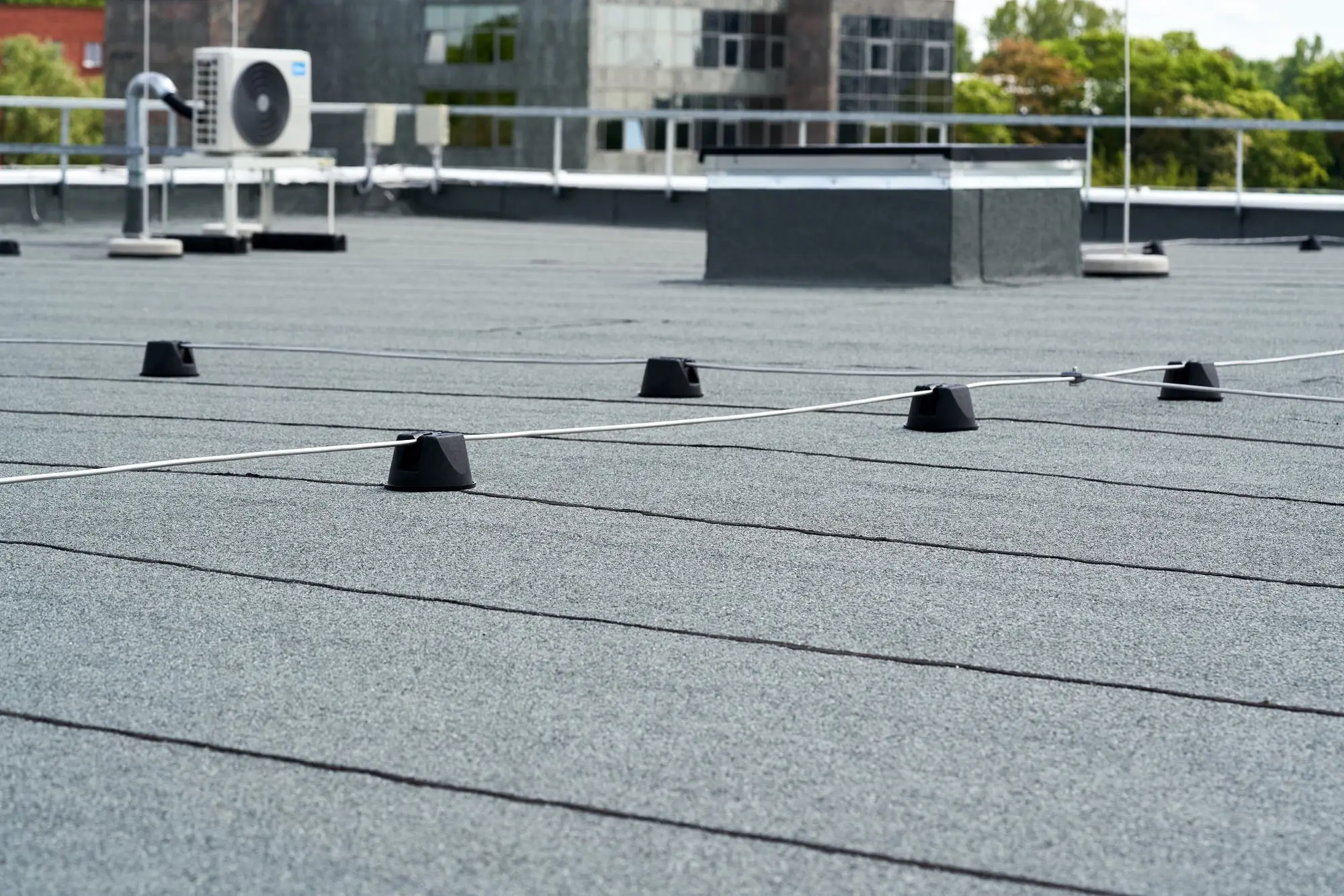
The open field of a membrane rarely fails first. Leaks almost always start at a detail:
- Seams. Welded seams on TPO can have gaps, and taped seams on EPDM can lift at the edges, especially if they were installed dirty or damp.
- Rooftop units. HVAC units sit on curbs, and the flashing at the curb corners is hard to get right. A unit swapped for a newer model sometimes ends up on an adapter curb that was never flashed properly.
- Pipes and penetrations. Vent pipes get rubber boots, and odd-shaped penetrations get sealant-filled pockets. Both dry out and pull away over time.
- Drains and scuppers. A clogged drain lets water pond and push against every seam nearby.
- Parapet walls and edges. Flashing at the base of a wall, the metal cap on top and the edge metal on roofs without parapets can all loosen, crack or lift.
- Condensate lines. AC condensate that drains onto the roof keeps one spot wet all summer.
Hail and wind damage on Denver commercial roofs
Denver’s hail hits flat roofs straight on. On a newer membrane, the damage may be cosmetic. On one that’s aged and lost its flexibility, hail can leave small punctures and fractures, and it can crush the insulation board underneath. Those small holes are easy to miss unless the whole roof is walked after a storm.
Wind does its damage at the edges and corners. Loose edge metal lets gusts get under the membrane, and once a section lifts, it can peel back quickly.
If storm damage leads to an insurance claim, you file it with your insurance company and pay your deductible. We inspect the roof, document the damage with photos, give you a written estimate and work with your adjuster. For more on what hail does to a roof, see our Denver hail damage roof repair page.
A repair, a section or a new roof
Most commercial roofs that leak don’t need to be replaced. A patch welded or bonded over a puncture, a resealed seam, a new pipe boot or reflashed curb corners can stop a leak for a lot less than a new roof. That’s the right answer when the rest of the roof is in good condition.
Sometimes the damage is bigger than a patch but smaller than the whole roof. If one area has wet insulation, that section can often be cut out and rebuilt while the rest of the roof stays in place.
When seams are failing everywhere, the membrane has gone brittle or wet insulation runs across large parts of the roof, more repairs are just delaying the inevitable. At that point, our page on commercial roofing installation in Denver explains what replacement involves. Either way, you’ll see the photos and moisture readings behind the recommendation.
Repairs while your business stays open
Most repairs happen on the roof without anyone below noticing much. When work does affect the space underneath, like replacing a wet section, it’s planned with you ahead of time so you can protect equipment, move stock or schedule around customers.
How it works
- Book your free inspection. Call 720-902-6940 or request a free estimate online. If water is coming in right now, tell us when you call.
- Get a clear, honest assessment and estimate. We trace the leak, check the rest of the roof while we’re up there and give you marked-up photos and a written estimate.
- The repair gets done and the site gets cleaned up. You’ll know the scope, the schedule and what was fixed.
A leak that drips for one season can soak the insulation around it, and wet insulation spreads. Fixing it early keeps a repair from turning into a section replacement.
Commercial roof repair questions
Can you repair just one area of my roof?
Yes, if the rest of the roof is sound. Localized repairs are often the right call, and you’ll get the reasoning with photos.
Why does my roof keep leaking in the same spot after it’s been repaired?
Usually because the repair was made above the stain instead of at the actual entry point, or because a seam or flashing detail nearby is the real source. Tracing the water path fixes that.
Do you repair metal commercial roofs?
Yes. On metal panel roofs, leaks often come from loose fasteners, worn washers, open side laps or flashing at penetrations, and those can usually be fixed without replacing panels.
How do I know if hail damaged my commercial roof?
Look for dented rooftop units, vents and gutters, and for granules washed out of downspouts on asphalt-based roofs. Damage to a membrane can be hard to see, so a roofer should walk the whole roof.
Get commercial roof repair in Denver
Call 720-902-6940 or book a free inspection online. For everything else we do on business buildings, see our Denver commercial roofing page.
The goal is simple: the bucket goes away, the ceiling stays dry and you know exactly what was fixed. Your satisfaction is our reputation.