In need of Gutter Installation in Overland Park Kansas?
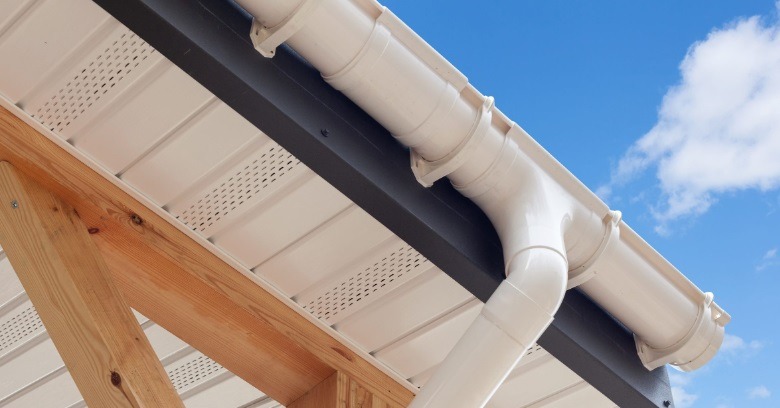
APC Roofing sizes, hangs, and services gutter systems for Overland Park Kansas residences.
Call us at 913-398-5020 for a measured quote rather than a guess.
Every Gutter Installation Job Starts With a Tape Measure – Not a Product List
Practically every undersized roof-drainage setup that has to come down in and around Overland Park Kansas ran out of capacity for one reason: it was priced by the foot rather than sized for the roof above it. A gutter run is a channel with a duty, and the volume it carries is set by two figures: how much roof sheds into it, and how hard the sky can open.
That second figure is the one people get wrong. No one sizes a gutter from the total that falls in a year. The design tables – the same figures commercial buildings are drained by – are based on peak short-duration intensity. A gutter run does not give up because of a wet year. It overflows through the ten minutes a downpour parks over the house.
That point shows up plainly across the map we cover. One market on our list catches over fifty inches of rainfall annually; somewhere else on the list logs under twenty inches over the same year. You would think the low-rainfall markets need smaller gutters. That is not how it works. The intensity of a single hard cell is a great deal closer than the rainfall maps would have you believe.
The Only Two Numbers That Determine What You Pay for Gutter Installation in Overland Park Kansas
The first is the width of the gutter itself. The two profiles worth arguing about on a residence are five inch and six inch K-style. Moving up a size is not cosmetic: the six-inch trough carries about fifty percent more water than the smaller one. On a modest roof with a gentle pitch the extra capacity is simply margin. On a wide, steeply pitched roof feeding one long run, the extra size is what stands between a dry wall and a soaked one.
The second of them is the size of the downspout. This is the one that most quotes leave out, and it is where the failures start. A two-by-three downspout – the size on most houses built a while back – will take about six hundred square feet of roof area. Use a three-by-four instead and the capacity roughly doubles, to about twelve hundred square feet. The four-inch round profile is in the same territory. That is a real doubling, and the price difference is small.
Combine them and the arithmetic is simple. Measure the square footage that empties into each run, then check how many downspouts there are. If the math says the run wants three outlets and only one is there, no cleaning routine will make that run behave. That is a design fault, not a maintenance one.
Where the Fall Goes and Why It Matters
A gutter run is never hung level, and a good one never looks sloped. The common working figure is close to a quarter of an inch per ten feet of length. Shops vary anywhere from an eighth to a half inch in ten feet, but the intent does not change: enough slope to keep the water moving, slight enough that the run still looks level.
Too little slope and the run holds standing water. A run that holds water is the beginning of the end: it traps grit and leaf litter, it works at the seams, and it loads the hangers at the one place it cannot take it. Excessive pitch and the roofline looks off while water shoots past the drop when the rain comes hard.
The length of the run is as important as the pitch. Somewhere beyond forty feet, the run needs another downspout, not a wider section. Water moving down a long length arrives at the bottom quicker than a single opening can swallow it, and the water goes over wherever the edge has dropped – commonly above an entry, which is how it gets noticed.
What Holds It Up, and Why It Moves
The distance between hangers is one of a handful of things anyone can inspect from the ground. The supports belong no further than roughly three feet apart. Where snow sits on the roof, closer is correct – eighteen inches – because snow and ice heap over the lip and stay put for weeks, when rainwater is gone in minutes.
A second detail no quote mentions is expansion and contraction. Aluminum moves as the weather turns. Across a hundred-foot length between a winter morning and a summer afternoon, you are looking at over an inch of movement. Every bit of it has to be allowed for. A run held tight at both ends distorts, splits at the joints, or pulls its brackets loose over a few seasons. It is not a fault in the material. That is an install detail that was missed.
Where the Gutter Meets the Roof
There is a failure mode that presents as a leaking gutter but is not one. Moisture shows on the board behind the run, or marks the wall below at the back of the gutter line, and the gutter is not the source. The cause is the flashing at the edge.
A standard drip edge is a simple L-section that throws water clear of the deck. Where that is all there is, water can still creep back onto the fascia by surface tension. The gutter apron is the longer version that carries over the edge and into the trough. It seals the gap that was letting water behind. On a steep pitch moving water in a hurry, the difference is plain.
Whatever is on the roof matters here too. Composition shingle is the simple case. Tile sits well above the deck, and the apron profile has to be in place before the tile is laid. Standing-seam metal turns loose a full slope of snow in one movement rather than melting it away gradually, which is why adding snow retention is a drainage question as much as a roofing one. Shallow and flat sections change the geometry again. APC Roofing works on all of them, which is why we mention it.
Why Ice Builds at the Cold Edge
In the colder markets we serve, this is the conversation. It is also the one most regularly turned on its head.
The ice at the roof edge starts nowhere near the gutter. It is caused by heat getting into the roof structure from inside the home. That heat melts snow where the deck is warm; that water makes its way down as far as the cold overhang, which has no heat under it, and refreezes. Go around that cycle for a few days and a wall of ice forms, holding water back on the roof.
The gutter is not to blame, though the trough is part of the story. A trough already packed with ice takes away the last route out, and the dam builds quicker. What we say, when someone asks whether new gutters fix it, is that they will not. The actual fix is sealing the air leaks and insulating. What a properly built system does is carry the melt away before it does more harm when the thaw arrives. Anybody quoting a new run as an ice dam solution has the diagnosis wrong.
What the Last Few Feet Decide
A perfectly sized system that empties hard against the foundation has moved the problem and not solved it. It has gathered water off a big span of roof, narrowed it into one discharge, and dropped it at the worst place available.
This is one of the few areas where the residential code sets an actual figure. Where the soil swells or gives way, the roof water has to be taken five feet or more clear of the foundation, or into an approved drainage system. Note what triggers that: soil type, not annual rain.
That distinction accounts for why one of the driest markets on our map is exactly the market where how far the water is taken counts for most. Ground that expands when it takes on water and shrinks once it dries out works a foundation loose year after year. The water that drives it need not amount to much. It simply needs to be repeatedly concentrated beside one wall. An outlet with no extension does it every single storm.
A second code figure applies to every house, not only the difficult ones: the finished grade has to drop six inches within the first ten feet out from the wall. That is the slope the downspout hands its water to. A faultless gutter putting water onto a slope that returns it to the wall cannot win. We look at the ground when we measure – the two belong together.
The Three Loads a Gutter Has to Take
What ends up in a trough is not all the same, and so a single fixed schedule is a rough guide at best. In general, three things gather in the run.
- The heavy stuff – big leaves and small branches. It comes all at once, largely stays on the surface, and lifts away cleanly. That is the debris everyone imagines when a clogged gutter is mentioned.
- The fine load – pine needles, oak catkins, maple seeds, and blossoms. That is the difficult one. It drops through the usual mesh, works into the standing water, and packs down into a mat that water will not shift.
- Roof granules – the colored granules that come off an asphalt shingle roof throughout the roof's life. A small amount is normal. A clear jump in what gathers at the downspout is worth a call to us, because that is a roofing signal and not a drainage one.
Covers and screens give with one hand and take with the other. They significantly reduce the number of times you go up, which has real value. In trade they restrict the opening the water has to pass through, and in a heavy driving rain some of it runs clean over the top. The fine load still works its way in. Whether they make sense on your house depends entirely on your trees, which is why we look before recommending rather than sell from a brochure.
Extensions, Splash Blocks, and Buried Lines
You are left with three real options to move the water away from a wall, and they are not the same. The concrete or plastic splash block is the low-cost option and achieves the least. It breaks the force of the water coming down and disperses it, though it moves it only a foot or two. Where grading is poor the runoff ends up right where it started to where it started.
A surface extension is the middle choice. The cost is small, it lifts out of the way for mowing, and it takes the discharge well away from the wall. The weakness is that it lies across the ground, and anything sitting out in the open gets knocked aside and is never put back. We find more disconnected extensions than we ever do failed troughs.
A buried discharge line is the lasting answer when the ground demands it: a solid, sealed pipe taken out to an open outlet a long way from the house. It is out of sight, it cannot be pulled off, and it will still be there when the gutters are not. The trade-off is that it can block and nothing on the surface says so, and that is the reason a clean-out at the top of the line is put in at the outset instead of being regretted later.
The Board Behind the Gutter
A rainwater run hangs from something, and that point of support is generally the fascia or the ends of the rafters. Where water has been getting behind the run for a long stretch, the wood behind has usually gone soft by the time the old run comes off.
We would sooner say so before the work starts than discover it part way through the job. A bracket going into decayed board holds for a while and then lets go, typically under load – which is precisely when you need it to hold. Where rot has taken hold, we tell you, show it to you, and quote it as its own item so you know what you are paying for.
Flat Roofs and the Drainage They Need
Not every roof out there drains at a gutter. Low-slope and flat sections work another way: the water is carried away by parapet openings, internal drains, or a built-in fall rather than off an open edge. The engineering questions stay the same, but the failures are less obvious and much harder to spot early.
On a roof with pitch a run that has filled dumps over the edge and it is obvious. On a flat or low-slope roof a plugged outlet leaves the roof ponding, and water standing on a roof runs to tons in weight well before it is spotted. APC Roofing does both, so that a building with a mix of the two is treated as one system rather than two trades disagreeing at the junction.
What Severe Weather Does to a Gutter Run
Weather damage to a roof gets noticed. The gutters lower down are checked last, if at all. The order should be reversed for two good reasons.
Worth knowing – drainage is regularly the plainest evidence of what the weather did. Impact marks in the metal show how big the hailstones were and which way they came. They are a record that supports a claim when the covering above is harder to assess.
Another point worth making – a gutter moved by the wind gives no sign. It reads as normal from below, and it works in normal rain. It comes to light during the next big storm, which may be a few months later – by then possibly past the window for a claim. A look after the storm is a fraction of the cost of finding out later.
Signs the Roofline Needs Attention
You do not need to climb anything to spot most of these. Take your time and walk around during or just after heavy rain, since that is the only time a gutter shows what it can do.
- Runoff pouring over the front when it rains hard – undersized, blocked, or badly sloped.
- Daylight between the run and the board behind it – bracket failure, frequently after a season of heavy loads.
- Paint blistering behind the trough while the run itself is sound – the flashing at the edge, not the gutter.
- Splash marks and eroded ground beneath an outlet – extension needed.
- Water lying against the foundation long after the storm passed – drainage and grading.
- A dip in the middle of a length – load the hangers were never meant to carry, and it will get worse on its own.
The Places That Overload a Correctly Sized Gutter
Square footage alone is not the whole story, and roofs do not spread the load evenly. A roof valley collects the water off two planes and puts the entire flow into a short length of trough. That section may be handling many times the load of the run on either side of it, though nothing about it looks different.
This is why a run can spill at exactly one point every single storm while everything else behaves perfectly. The answer is rarely a bigger gutter. It is a second drop positioned at or close to the point of concentration, so the water gets out right where it lands instead of running down a length that was not built for that load.
Roofs above create the same problem in a different shape. An upper-level downspout discharging onto a lower roof is very common, and it is regularly a bad arrangement. It drops an entire upper roof on one spot of the covering below, which scours the shingles and then overwhelms the trough that serves the roof below. Piping the upper discharge past the lower roof entirely settles both at once.
What a Good Estimate Tells You
Where you have two quotes and the numbers differ, the gap between them is usually not margin. It is almost always a different scope of work that neither document sets out clearly.
A quote you can trust names the size of the trough and the metal, the outlet count and profile, the hanger type and spacing, the edge detail and whether it is in the price, and where the runoff is carried once it leaves the downspout. That is the whole list. If a piece of paper leaves one out, that is where the gap is.
We write those down because that is what you are buying. A per-foot figure with none of it specified is just a number, not a real estimate.
Timing, Access, and How Long the Work Takes
Most house gutter work is done in a day, two now and then. The gutter is rolled at the house out of coil stock, cut to fit each run exactly, which is why no joints appear part way along. The corners, the outlets, and the ends remain joints, and they are the spots where the work has to be done properly.
Weather sets the schedule more than anyone would like. The work needs a dry spell – sealants need to cure and no one should be on a wet ladder. We would sooner push a date than hurry it in bad weather and have you calling us back.
Getting to the work changes the day. A narrow gap at the side, shrubs and beds under the eave line, porches and lean-tos, and neighbors' boundaries all change the way the work is staged. We take account of that when we measure, not when the truck pulls up.
What Happens When APC Roofing Quotes Gutter Installation in Overland Park Kansas
The first thing we do is measure the roof. Area per run, the slope, how long each run has to be, and where the downspouts can actually go – those four figures give us a specification. Everything after that – the choices you can see – is a choice you get to make with the figures in front of you.
Because the roof above is our work too, the seam between roof and gutter is drawn, not guessed. Shingle, tile, standing seam, flat – every one changes the way the edge detail is made. It is not an afterthought. It is where the job begins.
Fixing or replacing is a real judgment call, and we will tell you which. A properly sized run with a failed section or a pitch problem is a repair. A run that was never big enough for the roof above it is not a repair. Cleaning it twice as often does not add capacity.
Get Gutter Installation in Overland Park Kansas Priced From the Numbers
Phone APC Roofing now at 913-398-5020 and we will start with a measurement.
Slab, Basement, or Crawl Space
One and the same fault has very different consequences on two different houses, and the difference is what the house sits on.
A home on a slab has no basement to fill. The trouble shows up slowly: water getting in under the slab edge, the ground beneath being carried off, and wet spots on the floor at the wall-floor junction a long way from where the water got in.
A basement offers the water somewhere to sit, and it will find it. Water through the wall, white staining on the concrete, a pump that runs much more than it should, and humid air pushed up into the rest of the house – each of those starts at an outlet that ends at the foundation.
Whichever it is the work is outside, and it is cheaper than anything tried once the water is already inside.
What a Gutter Is Made Of
Roll-formed aluminum goes on the large majority of houses, and it earns that: it does not rust, it is light enough for the hangers, and it comes off a roll-former at the house as a single continuous run. Cutting out the seams means fewer places for a leak to start. What you give up is that it scratches and it moves with temperature, which is the installer's problem to solve.
Galvanized or coated steel is stiffer and stands up to impact, which matters in hail country, though the coating is all that stands between it and corrosion, so it pays to keep an eye on it. A copper system is the long-life choice and it looks the part. PVC is inexpensive to install and turns brittle in sun and cold. We are happy to go through what suits your roof and your market with no sales pressure.
Cleaning, Timing, and What Actually Needs Doing
The twice-a-year figure is what gets repeated, and it is a reasonable starting point rather than a fixed rule. How often it really needs doing is set by what grows above the roof. A house with conifers over it takes a steady needle drop the year round and wants more frequent attention. A roof with nothing above it can go much longer.
The two-visit habit was inherited from colder climates, and it fits some markets poorly. The oaks that stay green across the southern end of our service area keep their old leaves all winter and shed them as the new growth comes. Somebody living under one who books an October visit and no more is clearing the run at exactly the wrong point in the cycle and letting it fill again for the real leaf fall.
What we look at is more than the leaves. Whether the outlets are moving water, sealant at the joints and end caps, hanger tightness, the fall along the length, how the drip edge is holding, and where the discharge ends up. The last of those is the one that gets overlooked and the one most likely to be doing damage.
If you would rather it was handled, that is what the maintenance visit covers. A gutter looked over regularly generally lasts the life of the material. A run that is only looked at after the damage shows rarely does.
To arrange Gutter Installation in Overland Park Kansas, dial APC Roofing right now at 913-398-5020. We do the measuring first and the quote comes from the numbers.
Verified

Verified
Verified
Verified
Verified