Considering Metal Roof Installation in Denver Colorado?
APC Roofing installs panel coverings and mends worn sheet, for houses as well as workshops and barns.
Call 720-902-6940 and someone who knows the trade will come out to take a look.
Which System Is Up There – Surface Clues
Corrugated and ribbed sheet is held down by screws driven straight through the metal, while standing seam is attached with clips tucked inside raised joints. On homes the metal is usually coated steel, while aluminum and copper account for a minority.
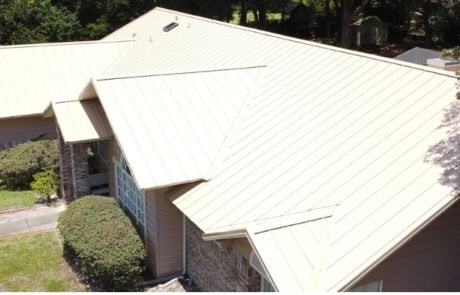
Screw heads marching in rows, easy to spot from below, point to exposed fasteners, and clean flats between raised joints, bare of hardware, belong to standing seam. Barns, workshops and porches often wear corrugated or ribbed sheet, while residences take either style.
Shapes Rolled Into Steel: Old Look, New Look
Corrugated sheet rises and falls in rounded, evenly spaced waves, and ribbed panels pair tall square ribs with broad flat areas. One length rides over a neighbor at a side lap, and fastener placement follows a published pattern.
A squared profile resists bending and reaches further between purlins, and corrugated suits older buildings and a farmhouse look. Rib height governs how much water a long slope can move, and a lean-to or porch manages fine with a gentle pattern.
Hardware in the Weather – Why Installation Matters
A screw pulls the metal tight against a purlin or the deck, and a washer under each head stops water getting in. Ultraviolet light slowly bakes neoprene brittle, long before the painted metal gives out.
A screw set too tight crushes a washer out sideways, while too little pressure or a crooked angle leaves an opening.
Swapping Out Hardware – Benefits and Gaps
Washers dotted across a ribbed field grow old together, so a complete re-screw comes due at some point. Tired fasteners are pulled one by one, and a wider replacement goes back in where threads can still find purchase.
A re-screw stops drips around screw heads and draws lifting sheets back down, yet rusted panels, opened laps and poor flashing still need separate repairs. Screw length and thread are chosen for what sits below, wood or a steel purlin, and tops come painted to suit a colored finish.
Growth and Shrinkage – Stress at Screw Holes
A steel panel stretches in sunshine and draws in after dark, and forty feet of panel shifts roughly a quarter inch or more, while aluminum goes about twice as far. Metal held too rigidly wears fastener holes into slots, and washers begin to leak.
Ticking heard as morning sun lands on steel is ordinary expansion, and a careful installation suffers no damage.
Beneath Raised Seams: Hidden Hardware
A long pan gets one fixed point, often near a ridge or an eave, while clips on every other section permit movement. Trim at an end that travels is bent with clearance underneath, and a pan held rigid throughout tears loose or buckles.
Each pan is set in place, and clips are driven through into the deck along one side, and an adjacent pan then covers every anchor point.
Seam Styles: A Choice With Consequences
One kind of rib clicks shut under a firm push, and heavier-duty versions are folded over by a motorized tool. A double-lock seam holds far better against strong gusts and standing water, and a gentler pitch is allowed.
Manufacturers offer a range of pan widths and rib heights, so the house and a preferred look guide a decision. Parts made for one system rarely suit a rival brand, and a mismatch shows up as gaps and loose joints.
Heavier and Lighter Stock – Worth Confirming
A steel panel is rated by gauge, and numbers fall as sheet gets thicker. A shop or barn frequently has twenty-nine, while a dwelling generally takes twenty-six or twenty-four.
For aluminum, sheet is sized in thousandths, and in either metal thicker stock dents less and lies flatter. Different grades look identical once installed, so printed product data gives a firm answer.
Factory Protection – Finishes That Hold Up
At a steel mill, coil gets a metallic layer of zinc or zinc and aluminum, and a baked primer goes on before a color coat. Paint scuffed but not broken through is fine, whereas a gouge through to bare metal soon shows red.
PVDF finishes hold color for decades, while polyester versions chalk and fade sooner. Wet mortar and fresh concrete attack an aluminum-zinc coating, and a barrier belongs wherever panels meet new stonework.
Base Material: Salt Air
An aluminum panel is light and immune to red rust, though a thicker grade is needed to resist dents. Close to salt water, at the coastal end of our range, metallic coatings break down faster, and manufacturers set limits on how near a shoreline a product may go.
Copper usually goes on small accent roofs over bays and entries, and left unpainted, the metal darkens with age.
Incompatible Neighbors – Matching or Separating
A copper pipe or flashing above steel sends corrosive drainage down over the panels, and discoloration arrives well before a panel gives way. Treated wood touching aluminum pits the metal at each contact, and fasteners of an unsuited metal leave a ring of damage.
A new piece of flashing belongs in a metal that matches existing work, or a plastic barrier divides unmatched metals.
A Matter of Taste: What Can Be Done
What the trade calls oil canning is a mild wave in a flat pan, and faint hollows show at sunrise and fade by noon. Metal with a visible warp stays just as watertight, and useful life is unchanged.
Striations, heavier stock and narrower pans keep rippling in check, and an installer who does not overdrive clips helps as well. Photos of finished roofs give a fair idea of how much oil canning shows, and the final pick is yours.
For People Inside: Noise and Heat
A racket many recall comes from sheet over open framing, as no material absorbs vibration. Metal on a home rests on a deck and underlayment, over an insulated ceiling, and indoors most people hear little more than on shingles.
A light-colored panel sheds much of the sun's warmth, so the space under the roof runs cooler. Dark metal heats up like any black roof on a clear day, and venting and insulation under the deck do as much for comfort as color. Metal loses daytime warmth shortly after the sun sets, and the attic below catches up before long.
Guards and Placement: Position Matters
Across the colder end of our territory, snow does not cling to painted steel, and a slab arriving all at once can injure someone or rip a gutter off. Guards break a load into small harmless chunks, and hardware sits over entries, paths and meters.
A standing seam roof gets brackets that squeeze an upright joint rather than pierce a pan, whereas on corrugated sheet, mounts go into solid wood with gasketed fasteners, and in milder markets roofs do without.
Pounding From the Sky – A Record of What Happened
At the colder end of our range, hail arrives most years, and panels with an impact rating are an option. A crease that cracks paint exposes bare metal to rust, and a flattened rib or a shifted cap can leak.
Once a storm has passed, a roofer photographs and measures every mark, and each dent and damaged panel is located.
Holding On in a Gale – Rated Assemblies
Suction gathers along rakes and eaves, and air that gets under a loose edge can peel a sheet back. Trim along every outer line is hemmed and hooked onto a continuous cleat, and nothing is left free to flap.
Spacing shrinks where loads climb, at corners and a rim, as manufacturer tables call for at each site. Where hurricanes reach, at the coastal end of our territory, the number of fasteners goes up again, and panels carry an uplift rating to suit.
Breaking Through the Metal: Detail Work
A flexible boot is formed around every rib and banded tight to a pipe, and a level stretch, not a peak, is chosen for a hole. Larger units get a raised curb plus a cricket on an uphill side, and water from higher up is divided and sent past.
Sealant backs up flashing and never stands in for folded metal, because sunlight dries and cracks sealing compounds within a few years.
Changes of Direction: Made to Shed
A valley pan goes down ahead of any panel, and sheets are cut on a diagonal to suit. Raw ends are folded under and locked to a cleat, and nothing pierces a channel that carries rain.
Where a long run needs more than one length, a lap is sealed between layers, and fasteners through both thicknesses keep water from backing up.
Additions and Wings – Measured, Not Guessed
Makers of exposed-fastener sheet commonly list three in twelve, and on a gentler slope, overlaps start to let water through. Standing seam with double-locked joints goes much lower, with some lines cleared almost down to flat.
Many homes have a gentle stretch over a porch or a later addition, and pitch is measured rather than judged by eye, and anything under a panel's limit is finished in a membrane.
A Base Layer: Wood or Open Framing
Metal on a dwelling is installed over full sheathing, and a synthetic sheet rated for heat is sandwiched between, because traditional felt degrades quickly up there. Sheds and barns often fasten directly to purlins, and support distance dictates grade.
Once an old covering comes off, spongy sheathing is found and swapped, because crumbling plywood cannot anchor a clip.
Leaving the Old Roof in Place: Light Enough to Add
Many building codes allow metal over a single layer of asphalt shingles, so waste is kept out of a landfill. New steel adds well under two pounds per square foot, so rafters rarely need reinforcing. Battens over a fresh membrane go across existing shingles, and every fastener is sized to reach solid wood.
Soft spots, old leak stains in the attic or a second layer rule out an overlay, since dampness sealed beneath panels goes on rotting structural lumber.
Finishing Off: Done Properly
Profile-cut closures fill openings beneath each rib at the upper and lower lines of a run, and wind-driven rain, wasps and birds stay out. A ridge cap may be vented or sealed, and attic ventilation is what decides.
A drip edge along an eave and trim on each rake complete a border, and fascia boards stay dry.
Care on Site: Handling and Footing
Standing seam is produced to fit each run from bottom to top, so a single piece covers eave to ridge without an endlap. A long panel calls for several people spaced along the metal, and a damaged pan is replaced, not flattened out.
On panels, a step belongs in a flat above a purlin or deck, since pressure on a rib bends the metal out of shape. Dew or rain makes coated steel as slick as glass, so owners do better keeping off the roof.
What to Watch For: Easy to Notice
- Brown rings at fastener heads, just above a gutter line.
- Screws backed out of holes, on long panels.
- Flashing flapping in a breeze, over a front door.
- A vent cap knocked askew, on a back slope.
- A sheared end streaked orange, next to a skylight.
- Blotchy color, where afternoon light hits.
- Spots on a ceiling in a row, in an upstairs bedroom.
- A joint gaping open, beside a hip.
How APC Roofing Tackles Metal Roof Installation in Denver Colorado: Order of Work
The first thing we do is identify which panel system is on the house and what holds the panels down, before each fastener, edge, boot, valley and lap is read in sequence. Gauge, finish and hardware are noted as we go, while the underside of the deck is inspected from the attic.
What we find goes into a report with photographs, and each recommendation carries reasons. Where a reseal will do, a reseal is what we propose, and a finished roof is described without softening.
Metal Roof Installation Around Denver Colorado – Careful Assessments
Reach us at 720-902-6940 and we will pick a time together for a visit.
Deciding on Scope: Piece by Piece
An individual rusted sheet can be unscrewed and exchanged, and a difference in shade stays visible. New sealant at a lap ends trouble at an overlap, while new fasteners seal screw holes again.
Widespread perforation puts replacement on the table, and a covering riddled with failed seams is no better off. Sometimes one weathered side is re-covered alone, when harm is local.
The Long View – Upkeep Matters
Good metal work frequently reaches forty years, though any figure is an estimate, not a promise. Standing seam, with no holes through a pan, gets by on less maintenance, whereas exposed-fastener sheet needs a re-screw partway through.
Mixed metals, raw cut edges and caulk doing the job of flashing all shorten a roof's service, and an occasional walk-over catches problems promptly. Wet leaves left sitting on panels stain and dull a colored finish, so clearing debris away helps paint last.
For a roofer's view on Metal Roof Installation in Denver Colorado, call APC Roofing at 720-902-6940. Someone will climb up and read how the panels are attached, along with every edge and opening, and a written summary lays out what we saw so you can choose.
Verified

Verified
Verified
Verified