Searching for Gutter Installation in Denver Metro Area?
APC Roofing sizes, hangs, and services roof drainage at Denver Metro Area buildings.
Dial 720-902-6940 to talk it through.
Every Gutter Installation Estimate Starts With Arithmetic – Not a Sales Pitch
Just about every struggling rainwater system that ends up being replaced in and around Denver Metro Area came up short for one reason: nobody sized it against the roof feeding it. A gutter is a drain with a workload, and the size of that job is decided by a pair of figures: the area of roof it serves, and how hard the sky can open.
The second of those catches most homeowners off guard. No one sizes a gutter from the annual rainfall total. The sizing tables – the same tables commercial roof drainage is designed on – start from short-burst rainfall intensity. A gutter run does not fail because the year was wet. It fails inside the few minutes a cloudburst sits over the block.
That point carries real weight across the areas we cover. One corner of the map we cover gets north of fifty inches in a typical year; another market is left with under twenty. Common sense says the markets that see less rain need smaller gutters. The arithmetic disagrees. The peak burst differs far less than the annual totals would suggest.
The Two Measurements That Drive What You Pay for Gutter Installation in Denver Metro Area
First comes the size of the trough. The two profiles you will see on a quote on a house are a five-inch section and a six-inch one. Moving up a size is not cosmetic: the six-inch trough carries on the order of fifty percent more water than the narrower profile. On a small roof with little pitch the extra capacity is simply margin. On a wide, steeply pitched roof served by a single length, it is the line between a dry wall and a soaked one.
Number two is outlet size. This is the figure that gets skipped, and it is where the system gives up first. A two-by-three downspout – the one on the majority of older homes – drains roughly six hundred square feet of roof. Move up to a 3x4 downspout and you roughly double that, to about twelve hundred square feet. A four-inch round section sits in similar territory. That is arithmetic, not sales talk, and the price difference is small.
Set them against each other and the math is straightforward. Measure the area of roof that ends up in each run, and next count the downspouts. If the answer says three downspouts are required and the house has one, no cleaning schedule in the world will stop the overflow. That is an engineering shortfall, not a cleaning problem.
Fall, Outlets, and Run Length
A gutter run is never hung level, though a good one looks like it is. The figure most installers use is roughly a quarter inch for each ten feet of gutter. Crews differ from an eighth of an inch up to a half inch in ten feet, but the principle holds: enough to move the water, slight enough that the run still looks level.
Hang it flat and water lies in the bottom. A trough that never fully empties is what finishes a gutter off: it holds silt and leaf litter, it stays against the seals, and it adds weight at the weakest point. Overdo the slope and it reads as crooked from the street while water shoots past the drop when the rain comes hard.
Run length matters as much as slope does. Past about thirty-five or forty feet, a second outlet is the answer, not a wider section. Water in a long run with one drop gets to the downspout quicker than it can be carried away, and it tips over the side at whatever point the lip is lowest – typically over the front step, which is how most people find out.
What Carries the Load and Why It Shifts
The distance between hangers is one of a small number of things anyone can inspect without getting on a ladder. Hangers belong no further than roughly three feet apart. In the northern half of our service area, we bring that in – eighteen inches or thereabouts – because snow and ice heap over the lip and stay put for weeks, while rainwater drains away in minutes.
The other detail nobody mentions is movement. A long aluminum run lengthens and pulls back with the temperature. Over a hundred feet of run between a winter morning and a summer afternoon, the metal moves more than an inch. It must be designed for. A length fixed hard at each end distorts, splits at the joints, or pulls its brackets loose in a couple of years. It is not a flaw in the aluminum. It is a decision nobody made at install.
Where the Gutter Meets the Roof
There is a failure mode that gets misdiagnosed as a leaking gutter and is nothing of the kind. Moisture turns up on the fascia board, or marks the wall below at the back of the gutter line, while the trough itself is sound. What is causing it is the detail where the roof stops.
Standard drip edge is a folded metal strip that throws water clear of the deck. Where that is all there is, it can still let water wick back into the space behind the run on surface tension alone. The gutter apron is a deeper piece that reaches out and drops into the trough. It seals the gap that the water had found. On a steeply pitched roof throwing water hard, that detail decides the outcome.
The roof above the gutter changes the detail too. A shingle roof is the simple case. A tile roof is thicker and heavier, and the apron has to be worked in before the tile is set. Standing-seam metal drops its whole snow load at once rather than melting it away gradually, which is why putting snow guards above the eave is a drainage question and not a roofing one alone. Low-pitch runs of roof ask for a different answer again. APC Roofing covers all of those, which is why the detail is drawn rather than guessed.
Freezing Weather and the Cold End of the Roof
In the markets that see hard winters, this is the seasonal question. And it happens to be the subject most commonly turned on its head.
Ice at the eave has nothing to do with the gutter itself. It comes from heat getting into the roof structure from inside the home. That heat melts snow where the deck is warm; the meltwater flows down to the cold edge, which sits over open air, and turns back to ice. Let that repeat over a few days and a wall of ice forms, damming meltwater on the roof.
The gutter is not to blame, but the run is not blameless. A run packed solid with ice gives that meltwater nowhere to go, and makes the backup worse. The straight answer, when someone asks whether new gutters will cure the ice, is that they cannot. The cure is in the attic, not at the eave. What drainage can do is clear the water away before it does a further round of damage when the thaw arrives. A contractor who sells a gutter job as a cure for ice at the eave is pointing you at the wrong repair.
The Ground the Downspout Empties Onto
A run sized exactly right that empties hard against the foundation has moved the problem rather than dealt with it. It has collected water off a big span of roof, funneled it into one discharge, and set it down at the one place it can do most harm.
This is a rare case where the residential building code says something specific. Where the ground is known to swell or collapse, the roof water must be carried at least five feet away from the foundation, or to an approved drain. Note what triggers that: it is the ground, not the weather.
That difference is the reason the market with the least rainfall of any we serve happens to be the place where discharge distance counts for more than anywhere. Soil that expands when saturated and shrinks back as it dries pushes a foundation around through the wet and dry cycles. The rain that causes it does not have to be heavy. It just has to be delivered time after time at a single spot. A downspout that stops at the wall does exactly that.
One more code number applies to all of it, whatever the ground is like: the finished grade must drop six inches as a minimum inside the first ten feet measured away from the foundation. That is the ground level the discharge lands on. The best-built run putting water onto a slope that returns it to the wall has already lost. We look at the ground when we measure – the two belong together.
What Actually Fills a Gutter
The material that lands up there is not all one thing, and that is why a single fixed schedule fits few houses exactly. Roughly speaking, three different loads gather in the run.
- The coarse load – full leaves, small twigs, pods and cases. It comes all at once, mostly sits on top, and lifts out easily. That is largely what most people picture when a gutter is described as blocked.
- The fine load – needle drop, catkins, and flower litter. This second one is the difficult one. It runs straight through coarse mesh, works into the standing water, and turns to a dense mat that no amount of rain will clear.
- Roof granules – the granules that come off an asphalt shingle roof all through the roof's life. A little of it is nothing to worry about. A noticeable jump in what collects at the outlet is worth reporting, because that is a roofing signal rather than a drainage one.
Screens and covers are part of the answer, not a cure. They significantly reduce the number of times you go up, which matters. In trade they shrink the opening water has to get through, and in a heavy driving rain part of the flow goes straight past. The fine load still ends up underneath. Whether that trade is worth taking depends entirely on your trees, which is something to look at together instead of guessing.
The Options Below the Downspout
You have three sensible ways to move the water out to where it does no harm, and they are not the same. The concrete or plastic splash block is the low-cost option and takes water the shortest way. It kills the force of the discharge and disperses it, but it takes it no more than a foot or two. Where the ground tilts toward the house that water works its way back to the wall.
An extension on the downspout sits in the middle. It costs little, it can be lifted for mowing, and it really does move water several feet out. The downside is that it sits on the lawn, and anything on the surface ends up detached and is then forgotten. We come across more loose extensions than we do gutters that have actually failed.
An underground line is the right answer when the ground demands it: a solid, sealed pipe led out to somewhere the water can safely go a long way from the house. It is out of sight, it cannot be pulled off, and it lasts a great deal longer than the run above. The trade-off is that it can clog and nobody notices when it does, which is why a cleanout is part of the design and not left as an afterthought.
The Wood the Gutter Hangs From
A gutter is fixed to something, and what it hangs from is the fascia board most of the time or the rafter tails behind it. Where water has been getting behind the run or running down the back for years, the wood behind is often soft once the old run is off.
We would rather tell you that before the work starts than uncover it part way through the job. A fastener driven into rotten wood holds for a season and then pulls out, usually under load – and that is precisely when the gutter is doing its job. Where rot has taken hold, we say it plainly, show you, and price it as separate work so nothing is hidden in one number.
Drainage on Low-Slope and Commercial Work
Not every roof we are asked about uses a gutter. Low-slope and flat sections work differently: the water leaves by parapet openings, internal drains, or a built-in fall instead of running off an edge. The design problems do not change, but what goes wrong is less visible and much harder to spot early.
With an ordinary pitch a blocked gutter dumps over the edge where you can see it. On a flat roof a blocked scupper holds water, and that standing water weighs tons long before it is noticed. APC Roofing handles both kinds of work, and that means a mixed roof is treated as one system rather than two trades disagreeing at the junction.
After a Storm
Impact damage to a roof gets looked at. The gutters below are dealt with last, if they are checked at all. That is the wrong way around for two reasons.
One thing worth knowing – drainage is regularly the clearest record of what actually struck the house. Impact marks in the metal are sized and directional. That amounts to a record a claim can be built on when the roof itself cannot be judged from below.
Something else worth knowing – a run knocked out of true does not announce itself. It reads as normal from the street, and it works in average rain. You learn of it in the next heavy rain, which may be a few months later – which can be past the deadline for a claim. An inspection straight after costs nothing like the cost of finding out the hard way.
Signs It Is Time to Call About Gutter Installation
You can stay on the ground to notice the usual signs. Take a slow lap of the building just after heavy rain, since that is the only time a run shows you what it is doing.
- Curtains of water spilling over the lip in heavy rain – undersized, blocked, or badly hung.
- A gap opening behind the run – bracket failure, frequently after a season of heavy loads.
- Staining or peeling on the fascia with nothing wrong inside the gutter – a missing apron, nothing to do with capacity.
- Splash marks and eroded ground below a drop – the water is not being taken far enough.
- Puddles standing against the foundation long after the storm passed – grading and discharge together.
- A visible sag in a run – water standing where it should not be, and it will get worse on its own.
Valleys, Upper Roofs, and Where Flow Concentrates
The area figure by itself is not the whole story, given that roofs do not spread the load evenly. Any valley gathers two planes of roof and puts the entire flow at one short stretch of run. That short run of trough may be handling several times the volume of the lengths on either side, while looking no different.
This explains why a gutter can spill at exactly one point storm after storm while the remainder behaves perfectly. The cure is hardly ever a bigger gutter. It is another outlet positioned at or close to where the water arrives, so the water gets out right where it lands rather than running down the length of a gutter never intended to carry it.
Higher roofs make the same problem in a different form. An upper-level downspout emptying onto the roof below is seen everywhere, and it is more often than not the wrong way to do it. It concentrates a whole upper roof on one spot of the lower covering, which strips the surface and then overloads the run that lower roof drains into. Taking the upper downspout past the lower roof entirely removes both faults together.
What a Real Quote Should Tell You
If you are holding two competing estimates and one is lower, the price gap is not usually one company charging more for the same thing. Time and again it is a specification difference that neither piece of paper puts in writing.
A quote you can measure against another should state the gutter size and the material, the outlet count and profile, which hangers and how often, how the roof edge is handled and whether that is in the price, and where the discharge from each drop ends up after it leaves the pipe. That is the whole list. If a piece of paper omits one of them, that is what the price difference is.
All five go on our quotes because they are what you are paying for. A linear-foot rate and nothing spelled out is a bare number, not a real estimate.
Timing, Access, and How Long the Work Takes
A typical house job runs to a single day, occasionally two. The run is rolled on site from a coil of metal, cut to the length needed, and that is the reason the length carries no joints part way along. The corners, the outlets, and the ends are still joints, and those are where the sealing has to be right.
Weather sets the schedule more than anybody would choose. The work calls for a reasonably dry spell – sealant has to cure and nobody belongs up a wet ladder. We would rather move the date than work through rain and have it leaking by spring.
Getting to the work affects the day too. A narrow gap at the side, shrubs and beds under the eave line, sunrooms and lean-tos, and a neighbor's fence all change how the work is staged. That gets checked when we measure, not when the truck pulls up.
What It Means When APC Roofing Quotes Gutter Installation in Denver Metro Area
We measure the roof before quoting the gutter. Area per run, the pitch, run lengths, and where the outlets can realistically go – those numbers set what the house needs. The rest – profile, material, color, guards – is yours to decide knowing what the numbers require.
Because the roof and the drainage are both ours, the seam between roof and gutter is worked out rather than inherited. Shingle, tile, metal, flat, commercial – every one changes how the apron and flashing are worked. That is not something we bolt on later. That is where the work starts.
Repair against replacement is a decision we make on the evidence, and we will tell you which. A sound run with a failed section or a sag is a repair job. A system short of capacity from the start for the roof it serves cannot be repaired into a working system. Cleaning it more often does not add capacity.
Book Gutter Installation in Denver Metro Area From People Who Measure First
Contact APC Roofing right now at 720-902-6940 and start with the roof.
Why the Same Fault Costs More on Some Houses
The same drainage fault plays out differently on every house, and what makes the difference is what is under the slab or floor.
A house built on a slab leaves water nowhere obvious to gather. The trouble is less dramatic: moisture working beneath the edge of the slab, soil being carried out from below, and dampness rising through the floor a long way from where the water got in.
A house with a basement or crawl space gives the water a place to collect, and that is where it ends up. Moisture coming through the wall, salt staining on the block, the sump pump cycling almost without stopping, and humidity pushed up into the living space – every one of those begins outside, at an outlet discharging too close.
Either way the work is outside, and it is cheaper than anything done after the water is already in.
What the Trough Is Made Of
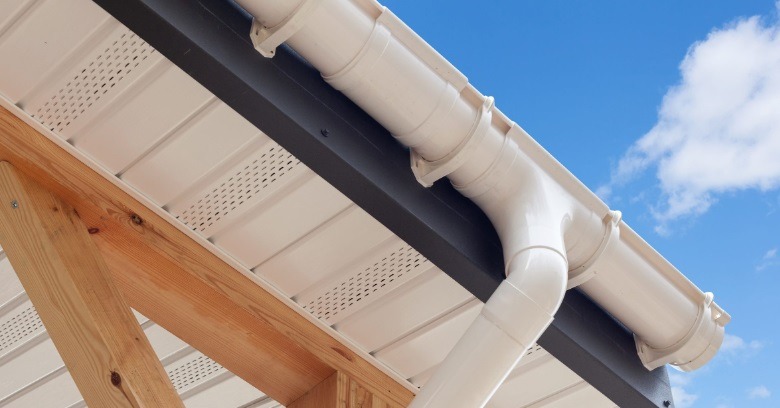
Aluminum gutter is the usual choice, and it earns that: it does not rust, it puts little load on the brackets, and it is formed on site with no joints along the run. Every joint removed means fewer places for a leak to start. The trade is that it dents and it expands and contracts noticeably, which is the installer's problem to solve.
A steel gutter is stiffer and takes a hit better, which counts in hail country, but the protective layer is the only thing keeping rust off, so it is worth checking now and then. A copper system is the durable end of the range and is priced accordingly. Plastic is cheap to put up and turns brittle as it ages in sun and frost. We will go through what makes sense for your roof with no sales pressure.
Cleaning, Timing, and What Actually Needs Doing
The twice-yearly figure is the advice everyone gives, and it is a reasonable starting point rather than a fixed schedule. What is actually right depends on the trees around the house. A house with conifers over it takes needle drop nearly year-round and needs clearing more often. A house with no trees close by will go a good deal longer.
The two-visit habit was borrowed from colder places, and it fits some markets poorly. The semi-evergreen oaks in the warmer part of our map keep their leaves through the cold and shed them as the new growth comes. A homeowner there who books a fall cleaning and stops there is clearing the gutter at exactly the wrong point in the cycle and letting it pack solid through the heaviest drop of the year.
What matters on a visit is more than whether it is clear. Whether the outlets are moving water, seals at the joints and the ends, how tight the hangers are, whether the slope has held, the edge detail, and where the discharge ends up. The last of those is the point nobody checks and also the one quietly doing the expensive damage.
If you would rather not think about it at all, that is what a maintenance visit is. A run that gets looked over regularly usually reaches the end of the material's life. A run that is only checked after the damage is done rarely does.
To arrange Gutter Installation in and around Denver Metro Area, dial APC Roofing now at 720-902-6940. We measure the roof before anything else and the quote comes from the numbers.