Your old gutters are dented, leaking at the corners and pulling loose in spots, and you’ve decided it’s time for new ones. Then the questions start. Aluminum or steel? Five-inch or six? Does the style matter? Shopping for rain gutters in Denver can feel like a lot of decisions for something you’d rather not think about at all.
It doesn’t have to be. A good gutter system comes down to a handful of choices made for your roof and your yard, and none of them are hard once someone explains them plainly.
APC Roofing installs custom rain gutters, and since we’re roofers, we plan them around the roof edge they hang from. We’re GAF Certified, licensed and insured, and your estimate is free. Call 720-902-6940 to have your home measured.
What your gutters have to handle in Denver
Denver is dry most of the year, so it’s easy to think gutters don’t matter much here. They do, for two reasons.
The first is summer thunderstorms. They can drop a lot of rain in a few minutes, and a gutter has to keep up with that burst, not the yearly average.
The second is snow. Snowmelt runs off the roof for days after a storm, and it refreezes at night. Gutters here carry ice weight and repeated freeze-thaw that gutters in warmer places never see, so how they’re hung matters as much as what they’re made of.
There’s also what happens at ground level. Much of the Denver area has clay soil that swells when it gets wet. Water dumped at the corner of the house soaks into the soil right against the foundation, so getting it away from the house is part of the job.
Gutter materials
Aluminum. The most common choice for homes. It’s light, doesn’t rust and comes in many colors. It dents more easily in hail than steel, and a heavier gauge helps.
Galvanized steel. Stronger and more dent-resistant than aluminum, and it handles ice weight well. It can rust over time where the coating gets scratched or worn.
Copper. A premium option, usually chosen for looks on homes where the gutters are a design feature. It weathers to a dark brown and eventually a green patina.
For most Denver homes, a heavier aluminum gutter is the practical choice. If hail and ice are a big concern on your house, steel is worth a look.
Gutter styles: K-style or half-round
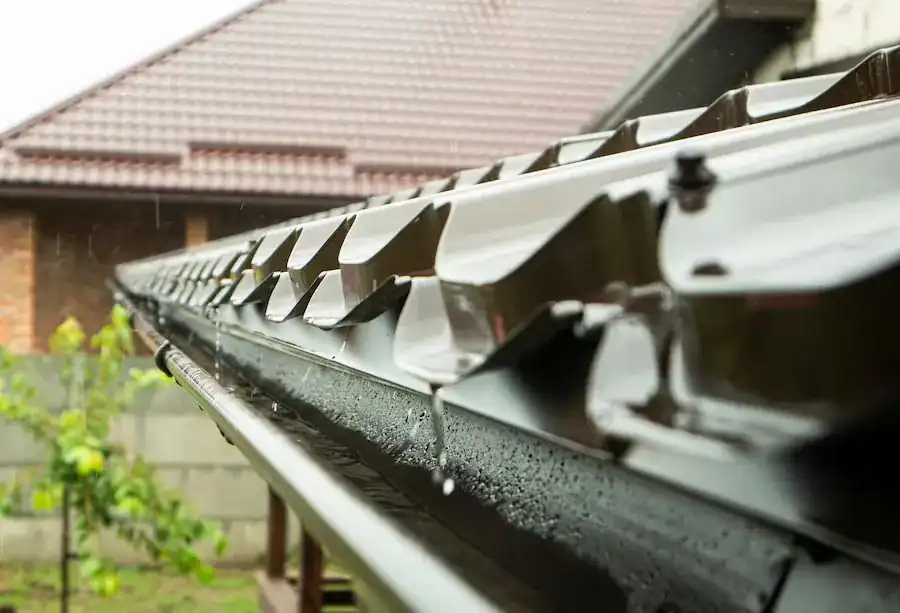
K-style gutters have a flat back and a decorative front that looks a bit like crown molding. They hold more water than a half-round gutter of the same width, and they’re the standard on most homes.
Half-round gutters are a rounded trough, often paired with round downspouts. They suit some older and traditional homes, and they’re a common pairing with copper.
Most homes get a seamless K-style gutter, formed on site to the length of each run so there are fewer joints to leak. We cover that in more detail on our seamless gutters in Denver page.
Getting the size and downspouts right
Size is set by how much roof drains into each run and how steep it is. Homes typically get 5-inch or 6-inch gutters. A big or steep roof draining into one run often needs the larger size.
Downspouts are where many systems fall short. One downspout on a long run will overflow in a hard storm no matter how clean it is. Valleys, where two roof slopes meet, send a lot of water to one spot, and a downspout near there often fixes chronic overflow.
Hanging gutters for snow and ice
Ice is heavy, and the hangers carry that weight. Hidden hangers spaced closer together hold up better under ice than the long spikes used on older systems. The gutter also needs a slight, even slope toward the downspouts so water drains instead of sitting and freezing.
The roof edge matters too. A drip edge should carry water off the shingles and into the gutter, not behind it. If the fascia board behind your old gutters is soft, it should be repaired before new gutters go up. We work on fascia and soffits as well.
Where the water goes
Each downspout should send water several feet away from the foundation, with an extension, a splash block or a drain line. Pay attention to where that water lands in winter. A downspout that empties onto a driveway or walkway can turn into an ice patch.
Rain gutters with a new roof
If you’re replacing your roof, it’s often a good time to replace gutters too. The roof edge is open, the drip edge is new, and the gutters can be fitted to it properly. Hail that damaged your roof may have dented your gutters as well, and both can be documented at the same time. You file your own insurance claim and pay your own deductible, and we document the damage and work with your adjuster.
How it works
- Book your free estimate. Call 720-902-6940 or request a free estimate online.
- Get a clear, honest assessment and estimate. We measure each run and the roof area draining into it, check the fascia and roof edge, and recommend a material, size and downspout layout with the reasons behind it. Financing is available through Aqua Finance, Fortifi, Hearth and Home Run Finance.
- Your gutters go up and the site gets cleaned up. You’ll know the timeline before work starts.
Rain gutter questions from Denver homeowners
Do I really need gutters in a dry climate?
Yes. Summer storms and snowmelt both put a lot of water at the edge of the roof, and without gutters it lands right at your foundation.
Aluminum or steel gutters for Denver?
Heavier aluminum works well for most homes. Steel is stronger against hail and ice, but it can rust where the coating is damaged.
What size gutters do I need?
Most homes get 5-inch or 6-inch gutters. Bigger or steeper roofs usually need 6-inch, along with enough downspouts.
Rain gutters in Denver, measured for your home
Call 720-902-6940 or book your free estimate online. You can also see all of our Denver gutter services.
The goal is gutters you never think about: no overflow at the door, no ice sheet on the walk and a dry foundation.