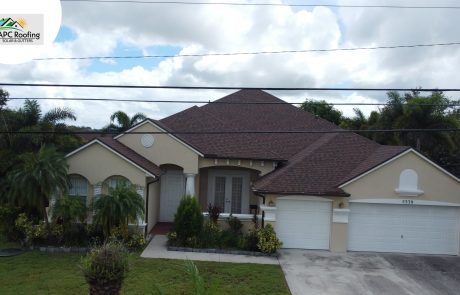
Searching for Hurricane Damage Roof Repair for a House in Daytona Beach Florida?
APC Roofing inspects the shingles once conditions have settled, checking every edge and photographing what is there.
Reach us at 386-356-2111 to arrange a visit from a roofer.
Airflow Over a Sloped Roof: a Detail Worth Knowing
The greatest pressure gathers at the eaves, the rakes and the ridge, and a wide open middle takes far less punishment. Blowing air working under a raised flap lifts the shingle set above the flap, so a lone nail beneath a shingle bears a following blast unaided.
At a house corner, wind rounding two exterior faces collides, and hardware spacing shrinks at that point on a well-built roof. A course beside a structure's outside edge bears a heavier load than a course out in the open, and a crew's layout accounts for that extra pull in advance.
An Invisible Step in Every Install – Easy to Miss
A bead of adhesive runs beneath every shingle, which is what keeps a shingle from lifting in a light breeze. Uplift can loosen a bond over a wide stretch, yet a parted shingle looks the same for now.
A broken seal goes unnoticed until the wind returns, and rain then reaches nail heads left bare for the first time. A single shingle off a bond hurts nothing taken alone, while a broad run of parted shingles is a serious gap.
What a Bundle Label States – Often Misread
In a lab, unused shingles are pinned to a board and every seal is made deliberately, before a controlled gust is brought to bear on the assembly. Years of sun and cold change how a shingle performs compared with the shingle's very first months in place, so a rating drawn from the original goods does not describe an aged roof.
A nail driven above the marked strip catches only the upper edge of a shingle, which puts the actual limit under a label's stated figure. A weathered mat behaves differently from the sample once tested at a factory, and a laboratory rating fits new construction, never an older roof.
Hail and What a Strike Leaves: the Part That Matters
Stones grow largest in storms that cross the colder end of our territory, though a milder shower still reaches every market we serve. An impact packs the top dressing into the body of a shingle, so a hollow forms where the surface gave way.
What stops rain from reaching a deck lies under the topmost grit, and a fault at that depth is never merely cosmetic. A damaged section of a shingle breaks down ahead of the surface nearby, and a slope carrying many such spots fails unevenly over time.
What Else Takes a Beating – Damage With No Warning
Impact a shingle survives leaves a mark on a metal cap, and nothing pushes a bent surface back into shape once calm returns. A collar broken by a strike quits sealing where a pipe passes through a roof, and a ceiling below takes drips within a day or two. A gutter knocked about at the front still moves water as designed, though a squashed downspout keeps the length above a squashed section from emptying out.
Lighter items up on a roof get checked the same way as the shingles, so nothing made of trim is left out of a written record. Dented metal parts rarely turn up where the asphalt above escaped unharmed, and the damage on that hardware is a reasonable clue to how the shingles have held up.
A Trickle of Sediment – a Sign With a Source
A mineral coat baked onto a shingle screens the asphalt from direct sun, because an uncovered stretch dries out and cracks quickly. A downpour carries loosened grains along the slope into a gutter run, and a heap of sand there says a great deal about the slope above.
Bare spots widen as the sheet beneath a bare patch dries out, so a minor fault becomes a reason for replacement later on. A drift of grit at a downspout fell from the roof plane overhead, and the quantity found says something about how hard a storm hit.
Water Pushed Uphill by Wind: Why a Sound Roof Still Drips
A shingle's lap directs a vertical descent down across the surface, and a lateral shove from a strong gust upsets that assumption completely. A turbine housing passes rain through once wind reaches a certain speed, which reads indoors like a fault in the shingles that is not really there.
What a Storm Drops From Above: Worth Opening Up
Sudden momentum drives an entire mass through one narrow point of contact, and the framing bears force the finish alone never reveals. A panel underneath can crack though the outer layer looks untouched, which is why the attic gets a separate look after every storm.
Wood swinging in a gust wears shallow arcs into the mineral coat, so the pattern left behind traces how far that motion carried. Reaching a cracked board usually means lifting the shingles above the break, and the finished patch ends up wider than the mark visible above.
The View From the Rafters: Seen From Below
A gleam higher up signals a gap in the roof, so the precise place gets logged before anything else is disturbed. Wet plywood darkens, and the tips of nearby nails often show rust, and the darkest mark generally sits closest to the actual opening.
Matted fiberglass under a rafter says seepage has been arriving there for a while, and a room beneath that area can lose heat as a result. A driven shower through a vent can wet framing at the gable end, so nothing on the covering needs disturbing at all in a case like that.
Down Where People Live: Tracing a Source Upward
A blotch overhead turns up where a trickle gave out, not where the leak began farther up, because the flow often runs along a rafter for some distance before falling. Bubbling up above means the finish has separated from the board beneath, and a small mark can sit directly under a much larger fault.
A light fixture that drips calls for cutting power to that circuit at once, so nothing indoors gets touched until the switch is confirmed off. Dampness at the top of a wall adjacent to a chimney can run down inside the chase, which puts the search exactly where two different materials meet.
Metal at the Joints: Quietly Doing Real Work
Every wall unit up there is fastened and lapped at the same time, and a failure at either point alone can let rain through. A squall catching the end of a course can tear the drip edge loose, which turns a small opening into a bare run of exposed flashing.
Ridge caps sit in the roughest airflow on a roof and can still come away as a unit, and the seam remains without any seal for the full distance when that happens. A vent unfastened at one end can rattle loose in a following gale, and framing well beyond that single spot can end up soaked as a result.
What Lets Daylight In – What a Storm Finds
The frame under a skylight stands above deck level on purpose, and courses step around that rise in a set sequence. A direct knock can craze the outer pane of the unit while the inner pane stays sound, so a new cap goes in at the same time.
A polycarbonate cover can take a hit and end up scored across the surface, and warm weather can lengthen a split that started out tiny. Cloudiness inside the glass is a broken seal, not everyday dirt, and the surrounding curb is a separate matter from that fault.
When the Rate Climbs Too High: What Overflows and Why
A sudden downpour can pass along more volume at once than a trough can handle, and whatever misses the channel runs down the siding underneath. Buildup at a drop point can turn an entire drain line into a stagnant pool, which puts strain on brackets never designed to take that much moisture.
What Bridges the Gap – Anchored, Not Weighted
Plastic pulled across a break can stop rain from reaching rooms below, though nothing about that covering is built to last for long. A covering laid over the high side and anchored on both slopes stays effective, and screws for that step land in framing, not merely in the covering.
A sheet left loose at the corners can turn into a sail in a stiff wind, and debris from that failure can end up scattered across the yard. Putting fasteners through good material creates problems nobody had before, and the solid part of a roof stays untouched by that kind of work.
Noting the Details Early – Length and Extent
The state of the house gets captured on camera while conditions are still current, and every face of the house gets included in that record. Each damaged spot gets a number attached in ordinary figures, and a ruler answers what the eye alone cannot.
Conditions keep changing what a later look would actually find, and the earliest check usually captures the fullest state. What gets requested for review comes across precisely as the paperwork shows, and none of that material gets altered for anybody's benefit.
New Faces After the Damage – Why the Hurry
Out-of-town vans can tour a neighborhood once a storm has passed, but not every outfit working the area is a problem. A form signed at a front door binds a homeowner like any other contract, and nobody should feel rushed through terms that matter.
A company with a local address can be found again months after a job ends, which is no small consideration when picking who does the work. An offer that expires while a truck sits in the driveway is not a real offer, and a reliable roofer has no trouble giving a homeowner time to decide.
What a Repeat Visit Brings – Reading a Pattern
A slope carrying broken seals meets the next gust already at a disadvantage, and a lighter storm can then do what a harder one did before. A fold formed in one storm marks a weak line that never fully disappears, and granules often shed heavily from exactly that spot.
Once framing has taken on water before, a fresh leak follows the same open path, which is how a small fault can grow into a much more sizable one. Delamination can begin wherever dampness settles between the layers underneath, and covering over material in that condition wastes the new stock used.
What to Watch For After a Storm: Notes Worth Keeping
- Tabs missing, creased or turned up along a rake, visible without climbing a ladder.
- Dents in a vent hood, a cap or a length of trim, still evident long after weather has passed.
- Granules washing out where a gutter empties, more than a covering normally sheds.
- A visible gap in a deck seen from inside, anywhere along a ridge line.
- A brown ring on a ceiling that grows after rain, in any room below the roofline.
- A dark line running down an interior wall, with no plumbing anywhere close by.
- Glass in a skylight chipped or broken, on any unit facing the weather directly.
- A downspout crushed or pulled loose from a bracket, where a fall has gone visibly wrong.
How APC Roofing Approaches Hurricane Damage Roof Repair in Daytona Beach Florida: From the Call to the Finish
The first steps happen at ground level, watching the yard for debris before a ladder comes out, and stray pieces scattered nearby offer the first clue about what gave way overhead. Up top, each accessible plane gets covered end to end, and the space beneath the deck gets examined from the attic.
Photographs, measurements and notes get written up and handed over in plain language, and each page gets built so a reader can trace every point on the house. A recommendation comes with the reasoning laid out step by step, and a homeowner decides from there without pressure either way.
Hurricane Damage Roof Repair in Daytona Beach Florida: Straight Answers After Bad Weather
Call 386-356-2111 to arrange a visit.
Snow Banked on a Slope – A Sturdier Kind of Build
Out at the colder end of our territory, a large fall remains on the rafters well after the weather has moved on, which strains the wood beneath more than fresh powder would. A frozen edge at the gutter line can trap runoff on the slope higher up, which the membrane at that edge is meant to guard against.
Up at the colder end of our territory, a lower roof beside a taller section collects drifting snow, which is often where sagging first becomes visible. A slab breaking loose can take a gutter down in one motion, which is why guards get installed in some exposed spots.
A Harder Environment Near the Shoreline: Checked More Often Out Here
At the coastal end of our territory, a large system can take a full day to move through, longer than a short spell anywhere else in our service area ever would. Hours of steady pressure can rock nails back and forth within a fastener hole, so shingles can lift well after a storm peaks rather than at the height of the storm.
Spray blown against a wall can find every lap in the exterior finish, which is why the whole house gets checked after a storm like that, not just the roof. Along the coast, roofs typically go on with extra fastening at rakes and eaves, which any patch in that region has to respect.
Old Section, New Section: What Homeowners Should Expect
Material from a current production run differs in tone from shingles baked by years of sun, and the surrounding roof ends up setting the visual standard. A repair on the street-facing side can be noticeable from the sidewalk, though a season or two eases some of that mismatch.
A discontinued profile gets replaced with the closest style still in production, which is worth knowing before work begins. Where one face of a house carries too many separate repairs, a patchwork look sets in, and an even surface is often the whole point of a full redo.
What a Homeowner Should See Afterward: Nothing Left Loose
A mended section sits down without any visible ridges, and the courses run true with the shingles set on either side. Metal at a wall gets stepped in stages as the shingles rise, and caulk never ends up as the thing actually keeping water out.
No fastener shows on the visible face of a completed area, and the count per shingle matches the maker's specification. A snapshot taken soon after a repair is worth saving for the future, since a later inspection can see exactly what section was replaced and when.
If Hurricane Damage Roof Repair is on your mind after a hard blow in Daytona Beach Florida, phone APC Roofing at 386-356-2111 and ask for a roofer to take a look. The covering gets gone over, measured and pictured from every angle, and a homeowner gets walked through exactly what was found.
Verified

Verified
Verified
Verified